
News · 16 August 2026 · 5 min read
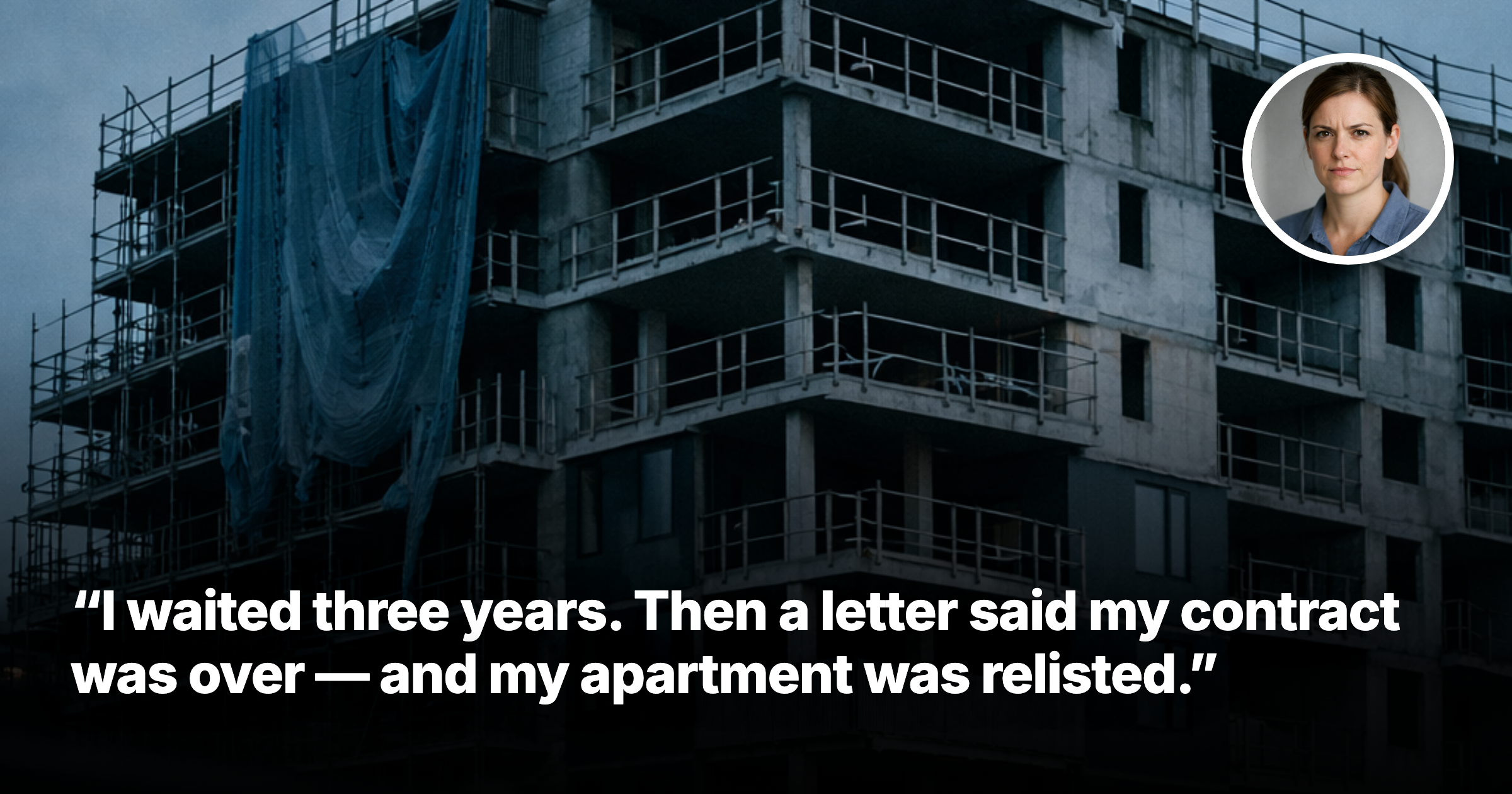
'I waited three years for an apartment. Then a letter said my contract was over — and the same apartment went back on the market'
She waited just over three years, then a letter said the contract was over and the apartment was relisted. The date in an off-the-plan contract is not a deadline — it is a door, and the law is unusually specific about who may walk through it.
She had read the contract. That is the part she keeps returning to.
A 38-year-old dental hygienist bought off the plan, paid her deposit, and waited. Just over three years later a letter arrived telling her the contract was at an end, because the building had not been finished by the date written into it. Weeks after that, an apartment she recognised was advertised again.
She asked us one question, flatly.
"Can they actually just do that?"
The short answer is no — not on their own
Almost every off-the-plan contract contains a date. If the thing being sold does not legally exist by then, the contract can be brought to an end. Most buyers read that date the way she did: as a deadline the developer has to beat.
It is not a deadline. It is a door — and the law is unusually specific about who may walk through it.
A developer cannot end an off-the-plan contract on that basis unless one of two things happens. Either every purchaser consents in writing, after being formally served with notice of the proposed termination, or the developer obtains an order of the court permitting it. There is no option available to the developer acting alone.
That inverts the assumption most buyers carry. The date arriving does not end anything. Legislation dealing with these clauses states plainly that such a clause cannot automatically end the contract — if it purports to, it is read instead as merely permitting termination on or after that date, through the proper process. The drafting also anticipates relabelling: ending, terminating or otherwise bringing the contract to an end are treated as the same act.
Then there is the part almost nobody notices
The same section that gates the developer's exit expressly preserves the purchaser's right to end the contract under that same clause.
Same clause. Same date. Same unfinished building. One party needs consent or a judge; the other's right is left untouched.
That asymmetry is deliberate, and it is the single most valuable thing an off-the-plan buyer can understand. If the project runs past its date, the buyer is not trapped waiting on a developer who may be waiting for something better.
What a court actually weighs
Where consent is not given, the developer must satisfy a court that termination is just and equitable in all the circumstances, and the court is directed to weigh specific things. Among them: whether the developer has acted unreasonably or in bad faith; the reason the milestone was missed; when it is now likely to be reached; the effect on each purchaser; and — the one that tells you what the legislature was actually worried about — whether the lot has increased in value.
The statute names the incentive out loud: it contemplates a developer who would rather sell the same apartment again at today's price, and makes that motive something the court must weigh.
The cost rules point the same way: the developer is liable for the purchaser's costs of those proceedings unless it satisfies the court the purchaser unreasonably withheld consent. The default runs against the party seeking to terminate.
Two further details matter. A purchaser must be given written notice at least 28 days beforehand, specifying why the milestone was missed. And these protections reach backwards — applying to contracts entered into before the provisions commenced, unlike the rest of the regime around them. Nor can contract terms escape them: anything inconsistent has no effect, and anything excluding the regime is void.
The exit buyers forget they have
One other door opens before completion, and it closes fast. Before signing, the buyer must be given a disclosure statement in the approved form. If it was wrong — or becomes wrong — in a material particular, the developer must serve a notice of changes, and the buyer can walk if they would not have signed had they known and would be materially prejudiced.
The catch is timing: notice must be served within 14 days — a fortnight, on paperwork most people forward to their conveyancer and forget. Miss it and the statement is treated as amended, and the buyer taken to have accepted the change.
Why this is a data problem, not just a legal one
Every metric investors rely on measures things that exist. Days on market, rental history, vacancy, comparable sales — all of it measures built stock. An off-the-plan buyer has none of it. They hold a contract over a lot that legally does not exist until a plan is registered, and they hold that exposure for years before there is anything to measure.
So the only things separating two buyers are per-contract, per-lot facts: what date is in the contract, what extension sits beside it, which stage the lot falls into. Two people on the same floor can carry materially different exposure, and nothing in a suburb report separates them — a suburb report is an average of what has already been built.
That gap is the whole argument for street-level data. Across a single suburb, the spread in effective yield between best and worst streets routinely runs 20–30% — and an off-the-plan buyer commits to one point in that spread years early, on evidence drawn from the suburb's past rather than the street's future. The days-on-market gap between two streets in one suburb is measurable today; for a lot that does not exist yet it must be modelled — from the street, the stage, and the supply already approved around it.
Same lesson as when a building is finished and defect liability attaches to the building rather than the builder who left, or when a title carries a construction status no price signal reveals. The document, not the postcode, holds the risk.
What we told her
To stop treating the letter as a conclusion. A notice is a proposal, not an outcome — and the door it points at is one the developer cannot walk through unaccompanied.
For anyone buying off the plan now: find the date before you sign. Ask what extends it, who can, and which stage your lot sits in. A ten-minute conversation governing three years of exposure.
None of this argues against buying early. Off the plan can be an excellent way to acquire well — new stock, staged payment, time for the street around you to mature. And the risk everyone fears is now gated, disclosed, cost-shifted against the party trying to use it, and written to apply retrospectively. The asymmetry runs in the buyer's favour, almost nobody reads it that way, and so the market keeps pricing the fear instead of the fact. That mispricing is exactly where a well-researched buyer makes money.
The date in her contract was never the problem. The problem was that she had read it as a deadline for the builder, when it was actually a door — and she had never once asked who was allowed to walk through it.
If there's a specific street you're weighing up right now, check its Street Score first — it's free, takes ten seconds, and tells you whether that street is pulling the suburb average up or riding on it.
Frequently asked questions
Can a developer in Australia end an off-the-plan contract just because the building is late?
No, not on their own. Under the article, the developer can only end the contract if every purchaser gives written consent after formal notice, or if a court orders termination.
Does the date in an off-the-plan contract mean the builder must finish by then?
Not exactly. The article says that date is not an automatic deadline that ends the contract; it is a point after which termination may be possible, but only through the proper process.
What notice must a developer give before trying to terminate an off-the-plan contract?
The purchaser must be given written notice at least 28 days beforehand, and the notice has to explain why the milestone or completion date was missed.
Can a buyer walk away from an off-the-plan contract if the developer changes something material?
Yes, if the disclosure statement was wrong or becomes wrong in a material particular, the developer must serve a notice of changes. The buyer can end the contract if they would not have signed with that information and would be materially prejudiced.
What practical risk should buyers watch for before signing an off-the-plan contract?
The article says buyers should focus on the date in the contract, any extensions, and which stage the lot is in. A suburb report does not show the specific risk in a yet-to-be-built lot, so the contract terms and lot-specific facts matter most.
General information only. It does not take your objectives, financial situation or needs into account, and nothing here is legal, financial, taxation or investment advice specific to your circumstances.