News · 16 August 2026 · 5 min read
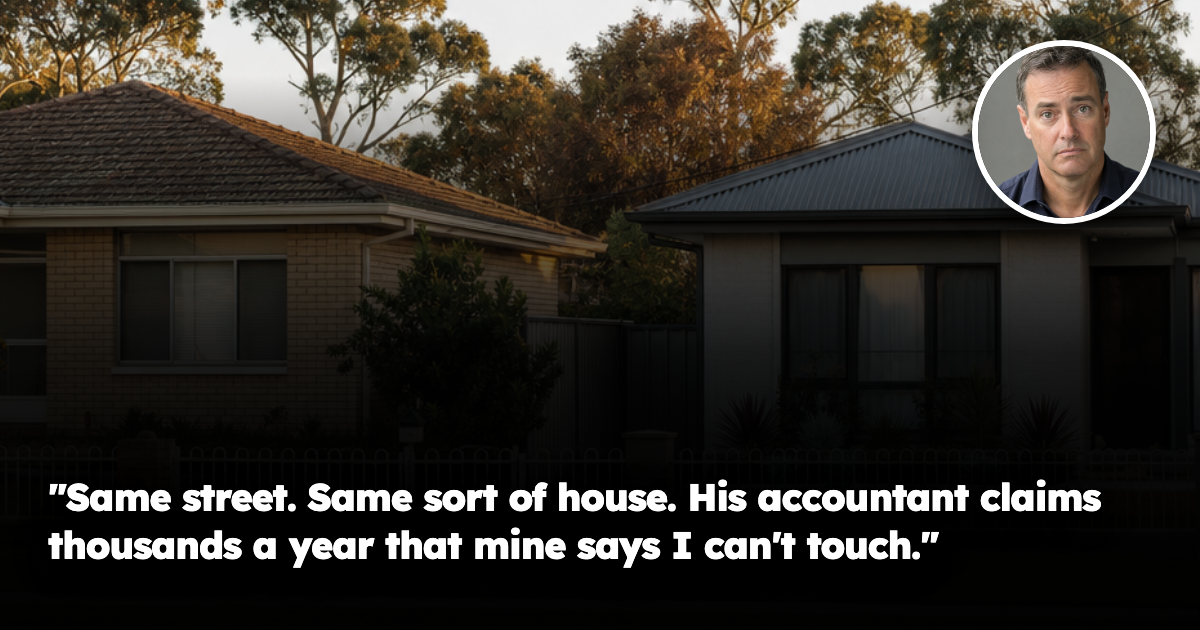
'My neighbour and I bought almost identical houses on the same street. His accountant claims thousands a year that mine says I can't touch'
He bought a near-identical house on the same street as a friend, for almost the same money. His friend's accountant claims a deduction every year that his own accountant says doesn't exist. Here's the rule that decides it — and why it's a property question, not a tax question.
We get asked a version of this question constantly, and almost always with a note of suspicion — as though somebody, somewhere, is getting away with something.
This one came from an investor in his early fifties. He and a friend bought investment houses about eighteen months apart, on the same street. Same bedrooms, similar land size, purchase prices within a rounding error of each other.
His friend's accountant claims a deduction every year for the building and its fittings. His own accountant told him a large part of that simply isn't available on his property.
His question, more or less verbatim: is my accountant wrong, or is his cheating?
Neither. And the reason is one of the most under-appreciated facts in Australian property investing.
The answer: depreciation isn't something you claim, it's something you own
Most investors think of depreciation as a tax activity — something you organise at the end of the financial year, like sorting receipts. It isn't. It is closer to a characteristic of the building itself, like land size or aspect. It is largely determined before you ever inspect the property, and by the time you sign a contract it is already fixed.
Two separate things are being written off, and they follow different rules.
The structure. The building and permanent works — walls, roof, floors, driveways. The law turns on one question: when did construction begin? The legislation draws hard lines at specific historical dates, and the deduction runs across a fixed statutory life measured from completion, not from when you bought it. Investors find this hardest to accept: buying an older building does not reset any clock. If it was constructed before the relevant threshold, there is no structural write-off to inherit. If after, whatever remains of that statutory life passes to you — and you can be claiming on a building somebody else paid to construct decades ago.
The fittings. The removable and mechanical items — oven, dishwasher, air conditioning, carpets, blinds, hot water system. Until 2017, second-hand ones were claimable. Then the rules changed, and this is where our two neighbours diverge.
The 2017 rule almost nobody had read
Legislation passed that year did something quite specific to residential property. In broad terms, for assets acquired at or after 7.30pm on 9 May 2017, an investor generally cannot claim the declining value of previously used fittings in a residential rental property.
The trigger is not the item's age. It is whether you first held it when it was first used or installed. Buy an established house and the existing air conditioner has already had a life with somebody else — so it generates no deduction for you, however much working life is left. Install a new one yourself and it does, because you are the first holder.
There are carve-outs. The restriction targets residential premises used to provide residential accommodation and not assets used in carrying on a business. Certain owners are excepted — companies and large superannuation funds among them. Notably, self-managed super funds are not on that exempt list, which surprises people who assumed SMSF-held property was treated like an institutional holding. And where a property is supplied to you as genuinely new residential premises, the restriction doesn't bite the same way.
One point is routinely misread as confiscation: the amounts you can't deduct annually aren't vaporised. The legislation threaded them through the capital gains provisions instead — changing when you get the benefit, not erasing it. For cash flow that difference is enormous. For the total picture it is smaller than the outrage suggests.
So: his friend bought a newly built house. He bought a well-kept established one, after May 2017. Same street, same money, same rent, materially different after-tax position. Nobody cheated.
Why this is a street-level question, not a suburb-level one
Here is the part that matters most, and the reason we treat this as a property question rather than a tax one.
Every input that decides depreciation is specific to one building: the year construction started, whether it was sold to its first owner as new, whether the kitchen was replaced by the vendor or by you. None of that is visible in a suburb median, which averages 1950s cottages and townhouses finished last spring and reports one number as though they were the same asset.
They are not — and Australian suburbs are not built uniformly. They were released in distinct subdivision cohorts, sometimes decades apart. Stand on one street looking at original post-war stock, walk two hundred metres, and you'll find infill built in the last fifteen years sharing the same postcode, median and catchment. We've written before about how construction era behaves as a street-level attribute rather than a suburb one, and depreciation is the cleanest financial expression of it.
This is the resolution problem street-level data exists to solve. Measuring two streets inside a single suburb — same postcode, same median, same catchment — we routinely find a 20–30% spread in effective yield once you use achieved rents, real vacancy duration and actual days on market rather than advertised figures. Depreciation sits underneath that spread and widens it, because it changes the after-tax return without changing the rent.
Two houses. One street. Same price. Different assets. That has been the argument all along — this is just an unusually literal example, and one where the difference arrives on a tax return every year of the hold.
What to actually do
Find out before you buy. Construction date, sale history and whether the property was ever sold as new are knowable during due diligence. By settlement your position is locked.
Get a proper schedule prepared. Where original construction costs aren't available — most of the time on established property — an appropriately qualified professional can estimate them. Investors skip this assuming an older property has nothing to claim. That assumption is frequently wrong: structural improvements made by a previous owner can still carry value.
Take advice on your own circumstances. The exceptions — business use, entity type, new residential premises, the capital gains interaction — are genuinely technical and turn on facts specific to you.
The bigger point
None of this argues against buying established property. Older stock frequently sits on the earliest-subdivided, best-located, largest blocks in a suburb, and the market has a long habit of pricing whole categories rather than individual assets — which is precisely where the opportunity lives.
It argues against buying blind. Depreciation is one of a long list of factors decided at the address, not the postcode: aspect and overshadowing, slope, flood level, soil class, subdivision era, buyer depth, achieved rent. Every one can be measured before you commit, and almost none appear in the number most buyers use to decide.
He didn't get a worse deal. He got a different asset, and found out afterwards.
If there's a specific street you're weighing up right now, check its Street Score first — it's free, takes ten seconds, and tells you whether that street is pulling the suburb average up or riding on it.
Frequently asked questions
Why can two nearly identical houses on the same street produce different depreciation deductions in Australia?
Because depreciation depends on the specific asset, not the suburb or even the street. The key factors are the building’s construction start date, whether it was sold as new, and whether the fittings were previously used before you bought it.
What changed in the 2017 Australian depreciation rules for residential investment properties?
For assets acquired at or after 7.30pm on 9 May 2017, investors generally cannot claim the declining value of previously used fittings in a residential rental property. New items you install yourself are different, because you are the first holder.
Can you claim depreciation on an older house you buy as an investment?
Sometimes, but not always. If the building was constructed before the relevant legislative threshold, there is no structural write-off to inherit, though later improvements or new fittings may still have value depending on the facts.
Does the depreciation restriction apply to self-managed super funds in Australia?
The article says self-managed super funds are not on the exempt list. It notes that companies and large superannuation funds are among the exceptions, but SMSFs are not treated the same way.
What should an investor check before buying if depreciation matters to them?
Check the construction date, sale history, and whether the property was ever sold as new before settlement. The article says those facts are knowable during due diligence, and once you settle, your depreciation position is locked in.
General information only. It does not take your objectives, financial situation or needs into account, and nothing here is legal, financial, taxation or investment advice specific to your circumstances.