News · 21 August 2026 · 5 min read
"I own the house. I lost my job, I need to live in it — and a stranger gets to decide whether that counts"
A 38-year-old scaffolder was made redundant and needed to move into the investment property he owns. He found a legal route to do it — built on a ground the Act never defines, a notice step it lets you skip, and a warrant it must issue.
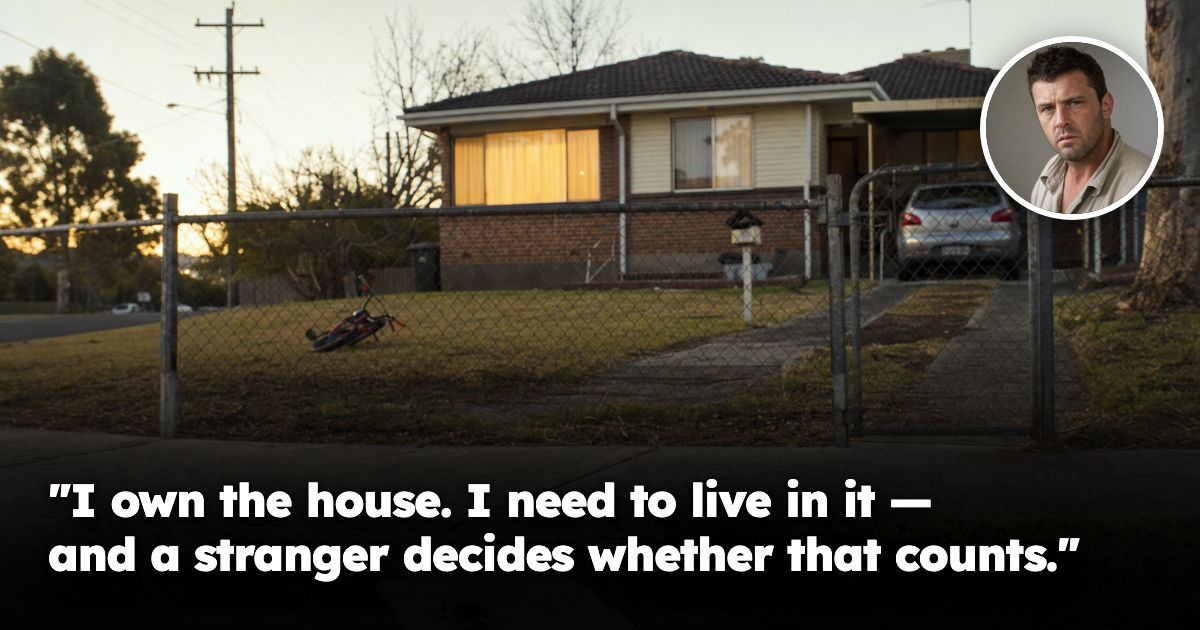
He is 38, a scaffolder, and until March he had never thought about the difference between owning a house and being able to live in it.
He bought the place in 2019 — a low-set three-bedroom on a corner block, eleven years of saving and a great deal of overtime. He never lived in it. He rented it out from settlement, and by his own account he was a good landlord: repairs done promptly, one rent increase in six years, the same tenants for three of them.
Then the company he had worked for since his apprenticeship lost a major contract and made him redundant. The rental he was living in went up. He reached the obvious conclusion: he owns a house, so he should move into it.
That is when he found out the question is not his to answer.
His tenants are eleven months into a fixed-term agreement. They have never been late. There is no breach to point at, nothing to remedy, nothing anyone has done wrong. He asked us directly:
"I own it. I've got nowhere else to go. Why is there no way to just get my own house back?"
There is a way. It is the part that surprises people.
The ground that says almost nothing
Tenancy law contains a route for exactly his situation. An owner can apply to a tribunal for a termination order on the basis that they would suffer excessive hardship if the agreement were not terminated. No breach required. No fault, no allegation, no notice period ticking down.
Then you read the section telling the tribunal how to decide it.
It is one sentence long. On such an application the tribunal may make the order if satisfied the applicant has established the ground. That is the entire operative provision. There is no definition of excessive hardship. No threshold, no factors, no examples, no list of things the tribunal must weigh.
The Act's own dictionary is stranger still. Its entry for the term directs you to four other sections — and every one of them merely names the ground. Not one defines it. The definition is a signpost pointing at its own label.
The absence is the point
You could call that sloppy drafting. Read the neighbouring sections and it clearly is not.
Sit the grounds side by side and the pattern is unmistakable. Where an owner applies because a tenant failed to fix a breach, the tribunal may only terminate if the breach justifies terminating — and the Act lists what to weigh: seriousness, steps taken to remedy it, recurrence and frequency, detriment caused. For objectionable behaviour, the same structure: the behaviour must justify terminating. For injury, the tribunal must have regard to five enumerated matters.
Every ground either side of this one carries a justification gate and a checklist.
Excessive hardship carries neither. The drafter fitted a lock to the door on the left and the door on the right, and left this one on a latch. Whatever "excessive" means, it means what a decision-maker decides on the day, on those facts, in that room.
The bypass most owners never notice
A second feature matters more in practice than the first.
Almost every route to possession begins with a notice: a stated ground, a minimum period, a handover day, a paper trail. Not this one. The Act lists a set of grounds on which an application can be made without giving a notice to leave at all, and excessive hardship is on it. The first thing those tenants receive is not a warning letter. It is the application itself.
And if it succeeds, the consequence is automatic. Where a tribunal makes a termination order on an application brought by anyone other than a tenant, it must also issue a warrant of possession — not on request, not as a second step. That warrant authorises a police officer or authorised person to enter and give possession, using necessary and reasonable help and force, and runs for fourteen days unless extended for special circumstances. A tenant who wins gets the agreement ended. An owner who wins gets the agreement ended and the instrument to enforce it.
The line that admits what is happening
The most revealing provision is the last.
Where the order is made because of excessive hardship, the tribunal may also make any other order it considers appropriate — and the Act gives an example: an order that the applicant pay compensation to the other party for that party's loss of the tenancy.
That is not compensation for a breach, or for damage, or for anything anyone did. It is compensation for losing the tenancy — a statutory acknowledgement, written into the law, that this process can put a blameless household onto the street and that money may be owed for it.
And it is may, not must.
What this actually means for owners
He is not a villain here and neither are his tenants. Both are being entirely reasonable, and the law has built a room for them to do it in.
The practical lesson keeps recurring: the asset and the access to it are two different things, and only one is on the title. A house is not liquid because you own it. Its usability depends on the agreement over it, the stage of that agreement, and a standard nobody has bothered to define.
That is precisely where suburb-level data goes quiet. Two houses on one street can share a median, a growth rate, a school catchment and a council — and share none of their tenancy structure, lease expiry, tenant tenure, or how quickly they could realistically be vacated. One is a genuinely flexible asset. The next, on identical fundamentals, is a house you own and cannot enter for another eleven months.
A suburb median has never once read a lease. This is why we work at street and property level rather than postcode averages: on achieved rents, true days-on-market, real vacancy duration and actual tenure, the effective-yield spread between the best and worst street in one suburb routinely runs 20–30%. Lease structure belongs in that same column — a value factor, measurable before you commit.
The genuinely good news
Every rule here is written down. The undefined ground, the notice bypass, the mandatory warrant, the fourteen-day clock, the discretionary compensation — all published and readable years before he needed any of it, and all knowable when he chose a lease term.
That is the whole advantage. Risk you can read in advance is not a threat; it is a line item, and a negotiating position. The investors who keep buying well are not the ones who avoid complexity — they price it while everyone else assumes the title deed answers every question.
He will probably get his house back. He is finding out that owning it was only ever half the answer.
Related: the break-lease fee that is the lesser of two numbers, a database listing that outlasts the dispute, and the cap deciding who pays for an emergency repair.
If there's a specific street you're weighing up right now, check its Street Score first — it's free, takes ten seconds, and tells you whether that street is pulling the suburb average up or riding on it.
Frequently asked questions
Can an Australian landlord end a tenancy just because they want to move back into their own property?
Yes, the article says tenancy law allows an owner to apply to a tribunal for termination on the ground of excessive hardship. It does not require the tenant to be at fault or in breach.
What does “excessive hardship” mean in this tenancy context?
The article says the Act does not define excessive hardship. It leaves the decision to the tribunal, which can decide it on the facts of the case.
Does the landlord have to give a notice to leave before applying in this situation?
No. The article says excessive hardship is one of the grounds that can be applied for without giving a notice to leave first, so the tenants may receive the tribunal application as the first step.
If the tribunal terminates the agreement, what happens next?
The article says the tribunal must also issue a warrant of possession when the order is made on an application brought by someone other than the tenant. That warrant authorises possession to be given over, and it lasts for 14 days unless extended for special circumstances.
Can the tribunal order compensation if the tenant loses the tenancy because of excessive hardship?
Yes. The article says the tribunal may make other orders it considers appropriate, including compensation to the other party for loss of the tenancy. It is discretionary, not automatic.
General information only. It does not take your objectives, financial situation or needs into account, and nothing here is legal, financial, taxation or investment advice specific to your circumstances.