News · 19 August 2026 · 5 min read
'My agent said breaking my lease would cost $3,120. I paid $780. Both numbers came from the same clause'
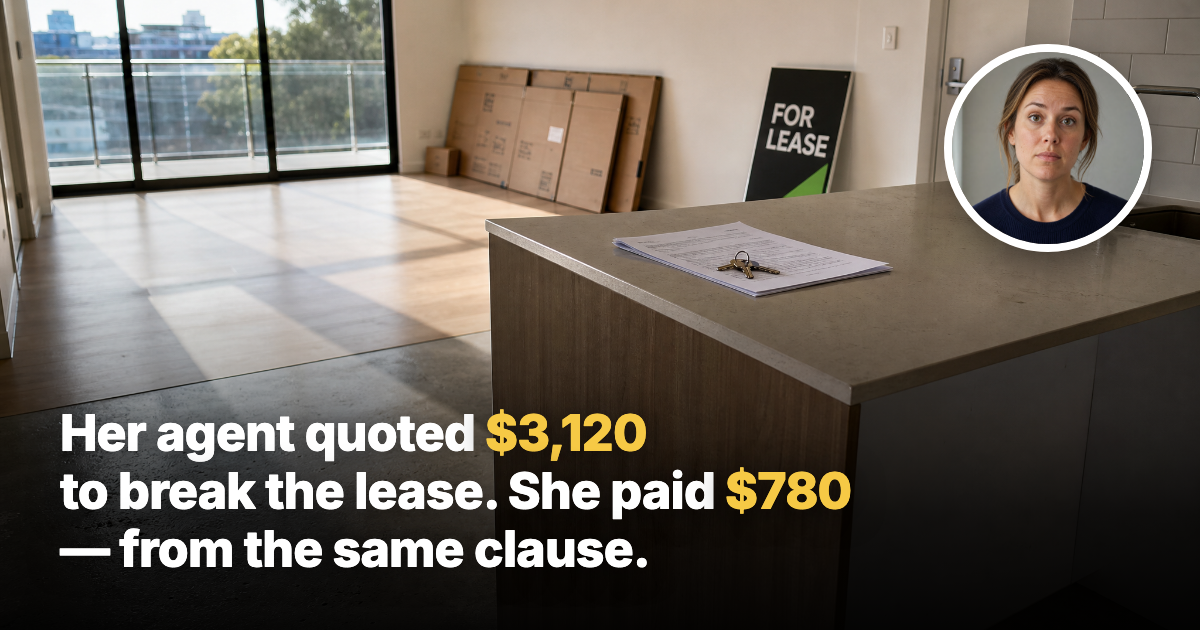
A physiotherapist fourteen months into a two-year lease was quoted $3,120 to leave early. She paid $780. The difference wasn't a negotiation — it was the second half of a clause almost nobody reads, and it's set by how fast one specific property relets.
She read the email out to us twice, because the second time she was looking for the word she'd missed.
A 29-year-old physiotherapist, single income, fourteen months into a two-year lease on a unit she'd signed in 2024. Then a job offer four hours away — the role she'd worked toward since she graduated. She gave notice the way she thought you were supposed to: apologetically, in writing, six weeks out.
The reply came back with a figure in it. Four weeks' rent, plus advertising, plus a letting fee. $3,120. She didn't argue. She'd broken a contract; the number felt like the price of that.
She paid $780.
Not because she fought, and not because anyone did her a favour. Because of what the clause she'd agreed to actually says — and the half of it that never makes it into the email.
The question she asked us
"If the fee is written into my lease, how can the number be wrong? And why did nobody, including me, read past the first line of it?"
We get this every week. The misunderstanding runs both ways — tenants overpay, and landlords quietly forfeit the entitlement by asking for too much.
The answer: the famous number is a ceiling, not a price
Most people have heard of the sliding scale. It's the part quoted everywhere, and it works on the proportion of the fixed term expired at the moment the tenant handed over vacant possession:
- less than 25% of the term expired — four weeks' rent
- 25% or more but less than 50% — three weeks' rent
- 50% or more but less than 75% — two weeks' rent
- 75% or more — one week's rent
That scale is real. What almost nobody reads is the sentence immediately above it, which says the amount payable is the lesser of two things: that scale amount, or an amount equal to the rent payable between the tenant handing over vacant possession and the day a new agreement commences after the property is relet.
Two limbs. One conjunction. The tenant pays whichever is smaller.
So the scale is not the bill. It is the maximum. The actual number is whatever the landlord genuinely lost while the property sat empty — and if it relets quickly, that figure collapses.
She was fourteen months into twenty-four: past 58% of the term, putting her ceiling at two weeks, not four. But the unit relet nine days after she handed over the keys. Nine days of rent was $780 — less than two weeks, so nine days is what she owed.
Both numbers came out of the same clause. One of them came out of the whole clause.
On a fixed term longer than three years the ceiling limb changes shape — one month's rent for each remaining 12-month period, capped at six months' rent — but stays subject to the same "lesser of" test.
The three conditions, and the word "void"
Here's the part landlords should read twice. A term making a tenant pay reletting costs is only enforceable if all three of these hold: the agreement is for a fixed term; the tenant is liable only if they end it other than in a way the law permits; and their liability is limited to the reletting costs as the provision defines them.
Miss one and the term is void. Not reduced to the correct figure — void.
So the clause trying to recover "all reasonable costs including advertising and letting fees" is not stronger than the compliant one. It fails the third condition and can take the entire entitlement with it. The most aggressive drafting produces the weakest position.
A separate duty runs underneath all of it: a landlord who suffers loss because of something the tenant did must take all reasonable steps to mitigate that loss, and is not entitled to compensation for any loss that could have been avoided. A property left sitting, or relisted above what the street will pay, does not automatically produce a recoverable vacancy.
The limb that switches the clause off entirely
There is one circumstance where none of this applies. Where a tenant has ended the agreement, or their interest in it, after experiencing domestic violence, the reletting-costs term does not apply — and a separate provision goes further, saying they are not liable for costs of ending the agreement, costs relating to goods left behind, or costs of reletting. It operates despite any term of the agreement to the contrary.
The review right is narrow, deliberately. A landlord can apply within seven days to set the notice aside if the paperwork doesn't comply. But the tribunal must not examine whether the tenant experienced domestic violence, or their belief about whether they could safely stay. The form is reviewable. The fact is not.
What this means if you own the property
Read the second limb again, because it isn't a legal question at all. It's a performance question about one specific address.
Your recovery is capped by how fast your property relets. Nine days, and you recover nine days. Eleven weeks, and the scale caps you long before you're made whole. The lease sets the ceiling. The street sets the number.
And reletting speed is not a suburb trait. This is the gap our research engine exists to measure: two properties in one postcode, sharing the same median, growth rate, catchment and council — four hundred metres apart — where one has a queue at every inspection and a sub-fortnight vacancy, and the other averages five weeks empty and relets $40 under budget. Suburb-level data cannot see that. Street-level data can: achieved rents rather than asking rents, real vacancy duration rather than a headline rate, true days-on-market. Across our work the effective-yield spread between the best and worst street inside a single suburb regularly runs 20–30%.
A suburb median has never once relet a unit.
We've written before about what happens when a landlord ends a tenancy by notice after a period of silence, about the real dollar value of a long-staying tenant, and about the cure right that expires the moment the other side acts. Same lesson, different angles.
None of this is hidden. The three conditions, the void clause, the sliding scale, the "lesser of" test and the mitigation duty are all published and readable long before anyone needs them. Nothing here happens by ambush. It happens by nobody reading past the first line.
That's the opportunity, not the warning. Risk you can read in advance is risk you can price, and priced risk isn't a threat — it's an edge over every buyer who never looked. The investors who do best aren't avoiding rental property; they bought on the street where the vacancy math works, and a fast-reletting asset quietly shrinks every downside the paperwork can throw at it.
She thought she was buying her way out of a contract for $3,120. She was really being billed for a vacancy — and her landlord had bought on a street that barely has any.
If there's a specific street you're weighing up right now, check its Street Score first — it's free, takes ten seconds, and tells you whether that street is pulling the suburb average up or riding on it.
Frequently asked questions
How is an early lease break fee calculated in this article's example under Australian rental rules?
It is the lesser of two amounts: the sliding-scale maximum in the lease, or the rent lost until the property is relet. In the example, the unit relet after nine days, so the tenant only owed nine days’ rent, not the higher maximum.
Why did the tenant get quoted $3,120 but only pay $780?
The $3,120 figure was the ceiling from the reletting-cost clause, while $780 was the actual loss because the unit was relet after nine days. The clause says the tenant pays whichever is smaller.
What does the sliding scale for lease break costs mean in a fixed-term tenancy?
The scale sets a maximum based on how much of the fixed term has already passed when vacant possession is given. In the article, the examples are four weeks’ rent, three weeks’ rent, two weeks’ rent, or one week’s rent depending on the stage of the lease.
Can a landlord in Australia charge any advertising and letting fees they want when a tenant breaks a lease?
No. The article says the reletting-cost term must be limited to the costs the provision defines, and the landlord must also take reasonable steps to reduce their loss. If the clause is too broad or misses the required conditions, it can be void.
Does the reletting-cost clause apply if a tenant leaves after experiencing domestic violence?
No. The article says the reletting-costs term does not apply in that situation, and the tenant is not liable for costs of ending the agreement, goods left behind, or reletting costs. This applies despite anything written in the lease.
General information only. It does not take your objectives, financial situation or needs into account, and nothing here is legal, financial, taxation or investment advice specific to your circumstances.