News · 18 August 2026 · 6 min read
'How is 11 square metres worth $29,400 when the land is worth $9,800?'
He measured to the fence before he built. The identification survey said the fence was 310mm inside the neighbour's land — and the compensation rule for a building over a boundary carries a three-times multiplier attached to intent.
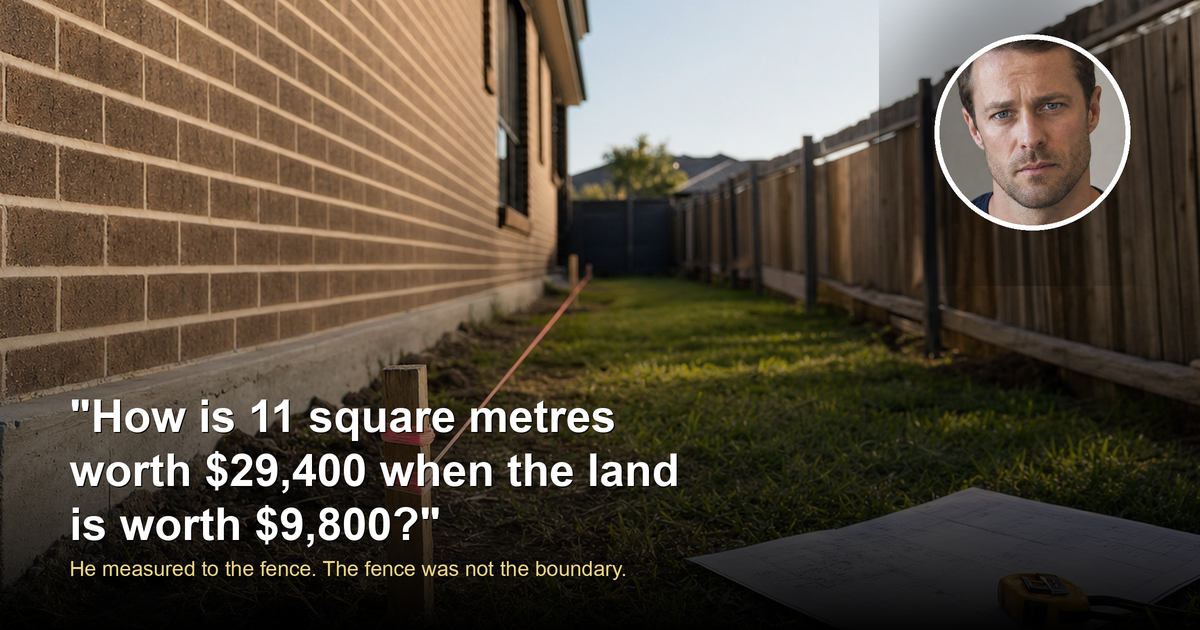
He measured to the fence. The law does not care where the fence is.
A question landed with us this week that we get asked more often than you would think — and almost always too late to be cheap.
The man asking is in his late thirties. He owns a 1960s brick-and-tile investment property on a battle-axe block, held four years, tenanted throughout. Two years ago he added a garage and carport slab down the side. He did what any sensible person would do: he measured off the fence. It had been there for decades. Nobody had raised it.
He is selling now. The buyer's solicitor ordered an identification survey — the cheap document almost nobody buys. It showed the fence sitting 310 millimetres inside the neighbour's land. His garage wall, and the footing under it, sat on and beneath that strip.
Eleven and a half square metres. Land value: $9,800.
The figure that stopped him was $29,400.
The question
"How is 11 square metres worth $29,400 when the land is worth $9,800?"
The answer
Because the compensation rule for a building over a boundary is not a valuation rule. It is a minimum, with a multiplier attached to intent.
Where a building encroaches onto a neighbour's land, either owner can go to court for relief. The person whose land the building comes from is the encroaching owner; the person whose land it extends onto is the affected owner. Either can start it — the first thing most people get wrong. Your neighbour need not complain.
The court has wide power. It can order the affected owner to transfer, lease, or grant an easement over the strip to the encroaching owner. It can order land for access and curtilage, a plan of survey, or compensation. Or it can order the encroachment modified or removed — the garage wall comes off. It can also refuse relief.
And where compensation is ordered, the amount must be at least:
- the market value of the interest in the affected land — if the encroaching owner satisfies the court the encroachment was not intentional and did not arise from negligence; or
- three times that market value — otherwise.
That is the whole answer. $9,800 is the market value. $29,400 is three times it. The gap between those numbers is not about the land at all. It is about who carries the onus of proof — and it sits with him.
Read that condition again. The default is the higher number. The lower number is an exception he has to earn, by satisfying a court on two limbs — that it was not intentional, and did not arise from negligence. Not intentional is easy. Not negligent is where measuring off a fence instead of a survey peg becomes an argument rather than an assumption.
The definitions widen it further. A building here means a substantial structure of a permanent character — and expressly includes a part of one, a wall being the given example. Encroachment covers a building over the line, and also overhang, and intrusion on, into, or under the soil. His footing is underground. It still counts. And this law applies despite any other Act.
A neighbouring rule covers a different mistake — a lasting improvement built on land someone genuinely but mistakenly believed was theirs. There a court can go further: declare an interest free of a mortgage or easement, or vary a mortgage, lease or contract to make the fix work. Notably, that rule expressly excludes fences. The fence is not the asset the law argues about. The building is. Which is why the equal-contribution rule governing a dividing fence offered him nothing — and why long occupation of a strip is a different mechanism, running on time rather than a court's discretion.
To be clear about what this does not mean: nothing says a court will award three times, order removal, or force a neighbour to sell. Every order is discretionary, and the court weighs how the encroachment happened, its nature and extent, the value and situation of the land, the planning controls, and — pointedly — the loss the encroaching owner would suffer if removal were ordered. Small, innocent strips get pragmatic outcomes. The point is not that the ceiling is terrifying. It is that the floor is set by statute, and which floor you land on is decided by how you behaved before anyone measured.
What it means for you
This is a street-level problem wearing a suburb-level disguise — the exact shape of asset risk our research engine exists to price.
Two houses in one street. Same median, same growth rate, same vacancy figure, same days-on-market — identical on every metric a suburb report will ever show you. One sits on a surveyed rectangle with the fence on the line. The other has a garage footing 310 millimetres into the neighbour's soil and a five-figure statutory floor attached. Same suburb. Different asset. That is not hypothetical.
Working at street level rather than suburb level, we routinely find a 20–30% effective-yield gap between the best and worst streets in a single suburb once you use achieved rents, real vacancy duration and actual days-on-market instead of averages. Boundary integrity belongs in that same category of invisible-at-suburb-level cost lines — like insurability, which can move 60% between two houses on one street, or an allowance schedule that quietly reprices a build. A boundary is not a suburb characteristic. It is a property characteristic — and the one the market almost never prices.
The practical fix is an afternoon and a few hundred dollars:
- Order an identification survey before you build anything near a boundary. Not the fence. The survey. A fence is a convenience, not evidence.
- Do it before you buy, too, if the block is narrow, irregular, battle-axe, or has structures hard against the line.
- Keep the paperwork. The lower compensation floor is something you have to prove. Evidence you engaged a surveyor is what discharges that onus.
- Check overhangs and footings, not just walls. Eaves and foundations count.
The part that should make you optimistic
Every element of this is written down before you exchange. The definition of a building. The inclusion of overhang and subsoil intrusion. The orders a court can make. The two-limb test. The multiplier. None of it is secret — it is a document you can read for a few hundred dollars plus a surveyor's fee.
Which means it is priceable. And almost nobody prices it.
That is the whole opportunity, and why property remains one of the few asset classes where diligence still pays a measurable premium. Headlines argue about rates and medians — things everyone knows and nobody can act on differently. The real spread between a good buy and an expensive one sits in documents on a street, waiting for someone to read them. Right asset, right street, right data beats right headline, every time.
He did not lose because he was careless. He lost because he trusted the most visible object in the yard — the same misplaced trust that cost one Northern Territory pastoral leaseholder $260,000 of improvements when a state lease was forfeited over $9,800 in arrears.
The fence was never the boundary. It was just the only line anyone had drawn.
If there's a specific street you're weighing up right now, check its Street Score first — it's free, takes ten seconds, and tells you whether that street is pulling the suburb average up or riding on it.
Frequently asked questions
Why can a small boundary encroachment trigger compensation that is three times the land’s value in Australia?
Because the compensation rule for a building over a boundary is a statutory minimum, not a normal valuation rule. If the encroachment was intentional or negligent, the court can require compensation of at least three times the market value of the affected land.
Does the neighbour have to complain before a court can deal with a building that crosses the boundary?
No. Either owner can start the court process, and the neighbour does not need to have raised the issue first. The court then decides what relief is appropriate.
What can the court order if a garage wall or footing is found to be over the boundary?
The court has wide powers. It can order the encroachment to be modified or removed, or it can order a transfer, lease, easement, access or curtilage arrangement, compensation, or even refuse relief.
Why didn’t measuring from the fence protect the property owner in this article?
Because the law does not treat the fence as the boundary. The identification survey showed the fence sat 310 millimetres inside the neighbour’s land, so the garage wall and footing were still an encroachment.
What is the practical step property owners should take before building near a boundary?
Order an identification survey before building, and do it before buying if the block is narrow, irregular, battle-axe shaped, or has structures close to the line. The article also notes that overhangs and footings should be checked, not just walls.
General information only. It does not take your objectives, financial situation or needs into account, and nothing here is legal, financial, taxation or investment advice specific to your circumstances.