News · 16 August 2026 · 5 min read
'My neighbour has been mowing a strip of my block for eleven years. A solicitor told me I have twelve months to act — or it stops being mine'
Adverse possession is not a loophole. It is a rule with a clock attached, and the clock runs whether or not the owner is paying attention. Here is how a strip of lawn becomes a title claim, what it does to your resale, and why the risk sits on a handful of streets rather than a whole suburb.
He wasn't angry. That is what made the call worth taking.
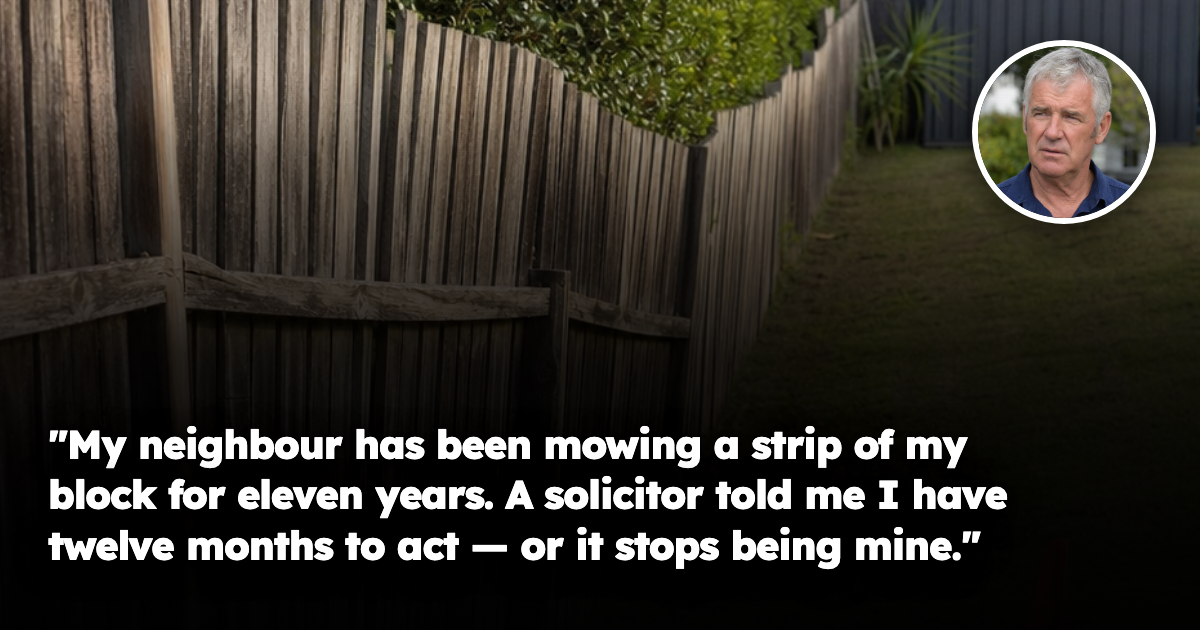
A 61-year-old owner of a home and one investment property rang us this month. Two decades ago, a previous owner of the block next door put a fence up — not on the boundary, but two and a half metres inside it, cutting off a strip along the back corner. Nobody argued. Nobody surveyed. The neighbour mowed the strip, planted a hedge, eventually put a shed in the corner.
He only found out because he was considering subdividing and paid for a survey.
"So it's my land," he said. "I've paid rates on it for nineteen years. But the solicitor told me I need to act quickly. If it's mine, how does waiting change anything?"
It changes everything. This is one of the few areas of property law where doing nothing is the decision.
The rule almost nobody checks
Most Australian jurisdictions carry a limitation period on actions to recover land. In this owner's state, the statute says an action to recover land is not maintainable by anyone other than the Crown after twelve years, running from the date of dispossession or discontinuance of possession.
Read that plainly: from the moment somebody else takes possession of your land, you have twelve years to act. After that the courts will not help you get it back. That is the doctrine most people know as squatter's rights; its formal name is adverse possession. The period is not uniform nationally — it is longer in some places, and Crown land runs thirty years in the same statute. But the shape is identical everywhere: possession plus time plus silence equals a claim.
The bar is not low. The possession has to be open, continuous, and without the owner's permission — which is why a note saying "happy for you to use it" defeats a claim outright. And it has to look like ownership rather than convenience: fencing, building, maintaining, excluding others.
What actually happens
If the twelve years run out, the occupier can apply for registered title by statutory declaration to the state land registry. These applications are technically demanding, scrutinised, and they fail regularly.
They also carry a consequence most people have never considered. In a recent case, an inner-city terrace fell into limbo after its owner died in 1995 leaving an informal will naming an overseas beneficiary who could not be located. Occupants later applied for title, declaring possession since late 2000 — but it was tenanted at that point, and genuine owner-like conduct did not begin until 2003, putting the real period short of twelve years when the application went in during 2013. The court found multiple deceptions in the documents, which had expedited obtaining the property near the end of the limitation period. Two people were convicted of dishonestly obtaining property by deception, an offence carrying a maximum of ten years — described by their own counsel as the first time criminal law had been invoked over an adverse possession claim in this country. The property sold in 2022 for $3.67 million.
The point for an ordinary owner is not the criminality. It is the timeline. Twenty-seven years passed between that owner's death and the sale, and for most of it nothing visible happened at all.
Why this is a street problem, not a suburb problem
Here is the part that matters for anyone buying.
Adverse possession risk does not distribute evenly across a suburb. It concentrates on specific streets and specific blocks, and the drivers are physical and historical, not demographic: older subdivisions where fences went up before modern survey standards; irregular or battle-axe lots nobody ever pegged; streets backing onto a laneway or unformed road; runs of houses where one builder fenced six blocks in a week and got one wrong, so the error repeats down the row.
Two houses can share a postcode, a median, a council, a school zone and a train station, and one sits on a street where four of the last nine sales required a boundary adjustment while the other has never had one. A suburb median is structurally incapable of seeing that: it averages both streets and reports the mean, which describes neither.
This is the same problem we measure everywhere else. Our street-level analysis routinely finds a 20–30% spread in effective yield between the best and worst streets inside a single suburb — on achieved rents, real days-on-market and actual vacancy duration, not advertised figures. Boundary integrity is the physical counterpart: a defect that attaches to a parcel, sits below the resolution of every number most buyers use, and gets priced only when someone finds it.
It compounds with the other lines drawn through suburbs that nobody checks — the public acquisition overlay that can require you to demolish at your own cost, the rezoning boundary that stops at one lot and taxes the owner on the other side, or the soil classification that differs between two blocks four doors apart. Different mechanisms; identical lesson.
What to actually do
If you're the owner losing ground: act in writing. A short letter recording that the occupation is with your consent converts adverse possession into a licence and stops the clock dead, because possession with permission is not adverse.
If you're buying: a contract and a title search tell you where the boundary is on paper. They do not tell you where the fences are. An identification survey — which physically pegs the boundary against the plan — is the only document that answers the actual question, and it is ordered on a small minority of purchases. Order it where the lot geometry is irregular, the fencing looks old, there's a shed near a boundary, or the block backs onto a reserve or laneway.
If you're selling: a boundary problem found by a buyer's surveyor mid-campaign is a discount. Resolved before listing, it is a line item. Risk always costs more than the fix.
The honest conclusion
This is not a reason to be nervous about property. It is a reason to be specific about it.
Boundary integrity is objective, verifiable before you commit, and almost universally skipped. That combination is exactly where mispricing lives — some blocks carry a discount for a problem they don't have, others are bought at full price with a defect nobody counted. That asymmetry is not a threat to a well-researched buyer. It is the opportunity. Property remains one of the few assets where diligence at the individual-parcel level reliably converts into price, because so few of the people bidding against you are doing it.
He kept the strip, incidentally. One letter, sent in the eleventh year, granting permission. The clock stopped.
The mistake was never trusting the fence. It was assuming the fence and the boundary were the same line.
If there's a specific street you're weighing up right now, check its Street Score first — it's free, takes ten seconds, and tells you whether that street is pulling the suburb average up or riding on it.
Frequently asked questions
What is adverse possession, and how does it work in Australia?
Adverse possession is a legal rule that can let someone claim land they have occupied openly, continuously and without the owner’s permission for long enough. In the article’s example state, the period is 12 years from dispossession or discontinuance of possession.
If my neighbour has been using part of my land for years, what stops them from eventually claiming it?
Permission stops the clock. A written note saying they are allowed to use the land turns the occupation into a licence, which means it is not adverse possession.
How do I know whether a boundary problem exists before I buy a property?
A contract and title search only show the boundary on paper. The article says an identification survey is the only document that physically pegs the boundary against the plan.
Which properties are most likely to have adverse possession or boundary issues?
The risk is concentrated on specific streets and blocks, especially older subdivisions, irregular or battle-axe lots, properties backing onto laneways or unformed roads, and streets where fences were historically placed incorrectly.
Why does an undiscovered boundary issue matter when selling a property?
If a buyer’s surveyor finds the problem during the campaign, it is likely to become a discount. If it is resolved before listing, it is more likely to be treated as a normal line item rather than a surprise defect.
General information only. It does not take your objectives, financial situation or needs into account, and nothing here is legal, financial, taxation or investment advice specific to your circumstances.