News · 18 August 2026 · 6 min read
'We've mowed that strip for thirty years. A surveyor just told us it's a public road — and we can't buy it'
Her family had mowed the strip since 1994. There is a shed on one end and paving on the other. A surveyor told her it is a dedicated public road — never built, never graded, never driven on, and a road anyway. The question that costs owners money is not what it is worth. It is whether they can ever own it.
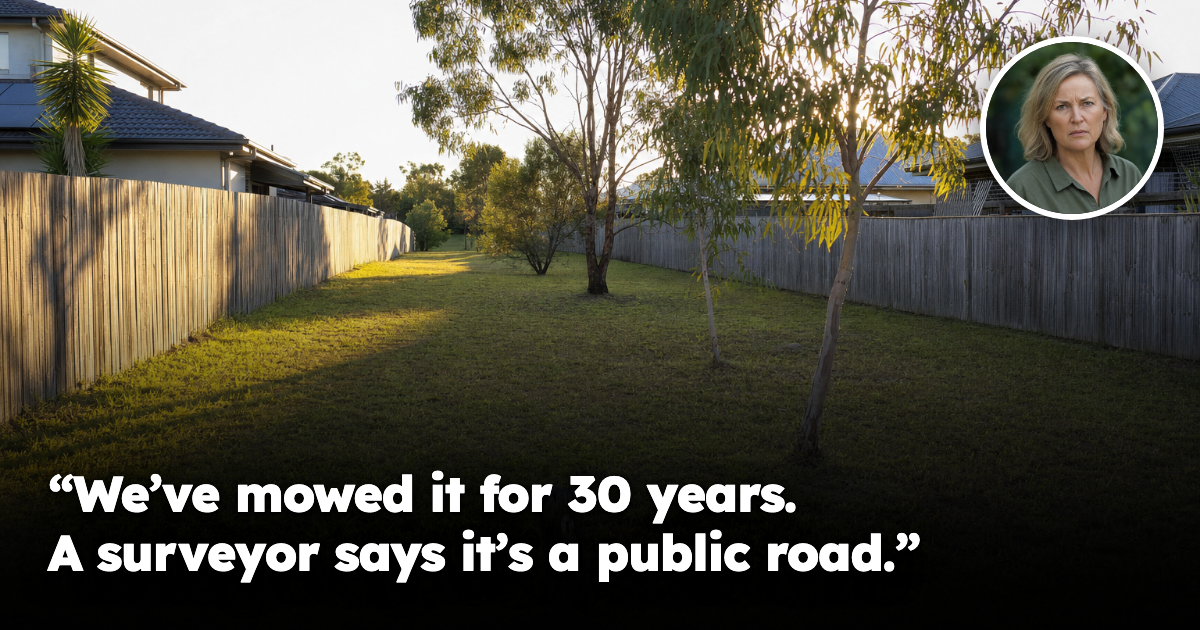
She sent us a photo before she sent the question, which tells you how much she already suspected.
It showed eight or nine metres of mown lawn between two paling fences, a couple of gum saplings, and an old timber peg with a rusted tag she'd assumed for three decades was subdivision leftover. Her family had mowed that strip since 1994. There's a garden shed at one end and a paved turning area at the other — both hers.
The surveyor she engaged before subdividing the rear of the block told her the strip is a dedicated road. Never built, graded, kerbed or signed. A road anyway.
The question she asked us
"How can a strip of grass in my own backyard be a public road when there is no road there? And if it is one — how much do I pay to buy it back?"
The second half costs people money, because usually the answer isn't a number. It's that you can't.
What a "paper road" actually is
The legislation defines a road as an area of land — then adds four words that decide her situation: whether surveyed or unsurveyed — dedicated, notified or declared to be a road for public use.
Nothing in that requires anything to be built. Dedication is a paper act, done by registering a dedication notice or a plan of subdivision, and on that day the land is legally opened for public use as a road.
Then comes the provision that closes off the easy solution. The land in all roads dedicated and opened for public use vests in, or remains vested in, the State.
Not the neighbours. Not whoever fenced it. Not the family who mowed it thirty years.
That matters, because plenty of owners reach for the wrong remedy here. They've heard that long, uninterrupted occupation of land can eventually turn into ownership. It can — against a private neighbour, on a clock measured in years. It does not work against dedicated road vested in the State. Thirty years of mowing and paving buys her nothing in title. All it created is improvements sitting on land she doesn't own.
And one number worth knowing: where an older plan shows a road without stating its width, the width is taken to be 60 metres.
So what can she actually do?
Two paths, and the difference is the whole story.
The road licence is the quick one, and it's a ceiling dressed up as a step. An adjoining owner can be granted a licence to occupy the road — but the statute forbids that licence from containing any right to renew it, to convert it to another tenure, or to buy the land. It is legislated to be a dead end. Only three structural improvements are permitted on licensed road: boundary fences, and irrigation pipes or channels crossing it. A shed isn't on that list. Neither is a slab, driveway, pool or carport. And the Minister may cancel it after reasonable notice, with no compensation payable — any improvements become the property of the State.
Permanent closure is the real path, and only two classes of applicant can start it: a public utility provider, or an adjoining owner. She's the second, and she can ask that the closed road be amalgamated with her land.
But three grounds allow refusal, and they're effectively a valuation test. The Minister may refuse if satisfied the road is the only dedicated access to a person's land; that it is, or may be, used regularly by the public; or that it provides continuity to a road network. And a harder rule sits on top: the Minister must refuse if satisfied the road is still needed. Needed by anyone — not by the applicant.
Then the sting nobody sees coming. If the closed road is of adequate area to stand as its own lot, it must be shown as a lot and may be dealt with as unallocated State land. Only if it's too small to be a lot must it be amalgamated with adjoining land. The wider and more useful the strip, the less certain you are to end up owning it.
Same lesson as a structure crossing a boundary by a few square metres: a boundary problem's cost has little to do with the land's size.
Why this is a street question, not a suburb question
Here's where it stops being a legal curiosity and becomes an asset-selection problem.
Take two houses in one suburb — same postcode, median, catchment, council. Both have an unformed strip of dedicated road along the rear boundary: invisible, mown, fenced into the yard.
House A's strip dead-ends, providing access to the land of a single adjoining owner. Under the legislation that's a no-through road, and an application to close it doesn't even require public notice. Nobody objects because nobody is notified. It closes, it amalgamates, and the owner's usable land — and subdivision potential — quietly increases.
House B's strip lines up with the road on the far side of the block and serves as a pedestrian shortcut. It trips two refusal grounds on its own: public use, and continuity of the network. It will not be closed — that owner has a permanent unbuildable corridor through their block.
Same suburb. Same median. One block holds a latent land gain, the other a permanent defect. No suburb-level metric can tell you which one you're standing on. A median averages both.
This is the mechanic behind the number we quote constantly: between the best and worst streets inside one suburb we routinely measure a 20 to 30 per cent spread in effective yield, using achieved rents, real vacancy duration and real days on market rather than advertised figures. People assume that gap is about postcodes and prestige. Far more often it's exactly this — what the title contains, what the block can legally become, where the invisible lines run. Only visible at parcel level, because that's the only level at which it exists.
What she should do, in order
Order a title search and an identification survey first. Not an appraisal. An appraisal tells you what somebody thinks a property is worth; a survey tells you what the property is. Almost every expensive surprise — down to a shed built on the wrong lot — is the gap between those two documents.
Walk the corridor for the three refusal grounds. Does it serve anyone's only access? Does the public use it? Does it line up with a road on the other side? Any owner can answer those in twenty minutes on foot — before spending a cent.
Then re-run the numbers on the block, not the suburb. If the strip closes and amalgamates, her usable land grows and so does her subdivision case. If it can't, her real block is smaller than the one on the contract, and every yield figure she's calculated is wrong.
Her strip dead-ends behind a single neighbour's shed. It's a no-through road. She has the best version of this problem, and she'd spent three weeks assuming she had the worst.
That's the part worth taking away. Property doesn't punish owners for the risks they've priced — it punishes them for the ones they never went looking for. And those live below the suburb line, in documents that cost a few hundred dollars to read. The owners who consistently do well didn't time a cycle. They found out what they actually owned before the market did.
If there's a specific street you're weighing up right now, check its Street Score first — it's free, takes ten seconds, and tells you whether that street is pulling the suburb average up or riding on it.
Frequently asked questions
How can a grassy strip in a backyard be a public road in Australia if no road was ever built there?
Under the legislation, a road can be a dedicated area of land whether it is surveyed or unsurveyed, and it does not need to be built, graded or signed. If it was dedicated by a notice or subdivision plan, it is legally opened for public use as a road.
If a family has mowed and used the strip for decades, can they claim ownership of it?
Not if it is a dedicated road vested in the State. The article says long, uninterrupted occupation may help against a private neighbour, but it does not work against dedicated road land vested in the State.
Can an adjoining owner buy back a dedicated public road in this situation?
Usually not through a road licence, because the law does not allow a licence to be converted into ownership or include a right to buy the land. Permanent closure is the path that can lead to amalgamation with adjoining land, but it is subject to refusal grounds.
What reasons can the Minister use to refuse closing a public road?
The Minister may refuse if the road is the only dedicated access to someone's land, is or may be used regularly by the public, or provides continuity to a road network. The Minister must also refuse if the road is still needed.
What should an owner do first if they discover a strip in their yard may be a public road?
The article says to order a title search and an identification survey first. Then check the corridor on foot for the key refusal grounds and re-run the numbers on the block itself, not just the suburb.
General information only. It does not take your objectives, financial situation or needs into account, and nothing here is legal, financial, taxation or investment advice specific to your circumstances.