News · 17 August 2026 · 6 min read
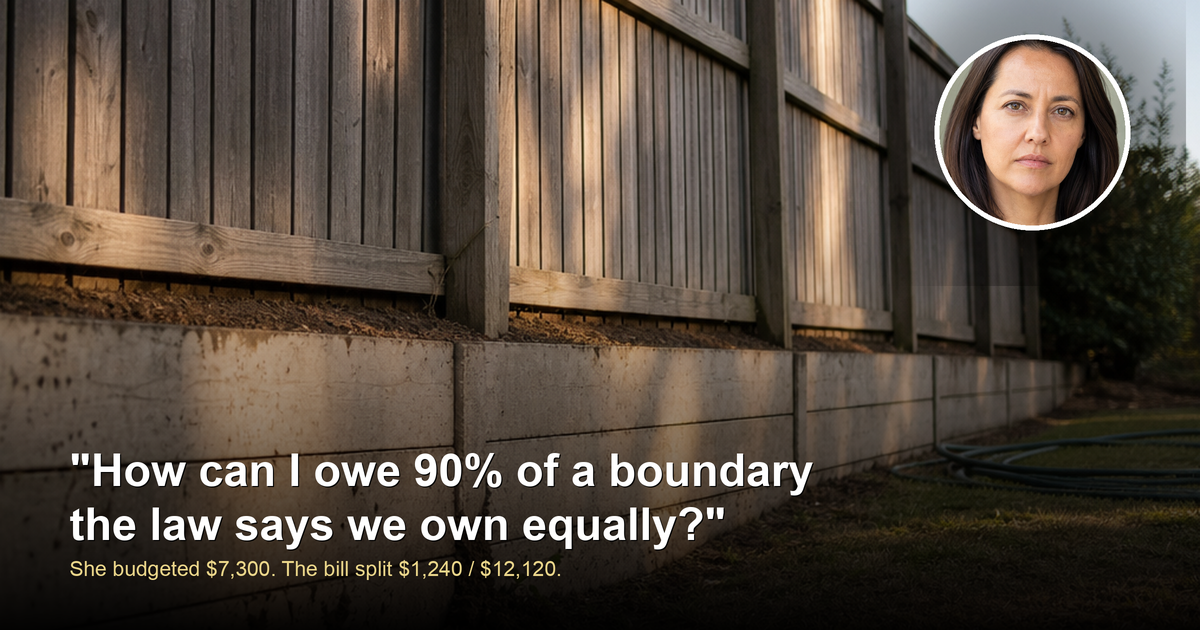
"How can I owe 90% of a boundary the law says we own equally?"
An investor on a sloping block expected the statutory half-share of a $14,600 boundary bill. The split came back $1,240 for the fence and $12,120 for the wall. The reason is two provisions long — and it is a cost line that is invisible at suburb level.
She had read the legislation. That is the part she keeps returning to.
An investor in her early forties brought us a question this week that we get asked in some form constantly, usually after the invoice has already landed. She owns a house on a sloping block, held about six years, tenanted the whole time. The boundary structure between her property and the neighbour's had been failing for a while — leaning, weeping soil after heavy rain. The neighbour organised the replacement. The total came to $14,600.
She had done her homework. She knew the rule that adjoining owners contribute equally to a dividing fence. So she budgeted $7,300 and waited for the paperwork.
The split came back $1,240 for her, and $12,120 for the wall.
Her question, almost word for word: "How can I owe 90% of a boundary the law says we own equally?"
The rule she read is real
She had not misread anything. The fencing rules genuinely do work the way she thought.
A sufficient dividing fence is required between two parcels of land if an adjoining owner asks for one. Adjoining owners are each liable to contribute equally to carrying out that fencing work. Where the fence sits on the common boundary, it is owned equally by both owners. If one of them wants something better than the required standard, that owner carries the cost of the upgrade — the excess above the sufficient standard, not the whole job.
The standard itself is written down. For two parcels of residential land, a dividing fence is sufficient if it is between 0.5m and 1.8m high and consists substantially of prescribed material. Owners can also agree a fence is sufficient, or a tribunal can decide it. The obligation applies even if there is already a fence falling short of the standard, and even if one or both blocks are vacant land.
So far, exactly what she expected.
The sentence that moved $12,120
Then there is the definition.
A fence, for these purposes, is a structure, ditch, embankment, hedge or similar barrier bounding land. It includes gates, a watercourse separating the two properties, and any foundation or support built solely to support and maintain the fence.
And then: a fence is not a retaining wall, and not a wall forming part of a house, garage or other building. A retaining wall is a structure that supports excavated or filled earth.
The equal-contribution chapter also says, in its own terms, that it does not affect a law about retaining walls or rights of support, including easements of support. It also leaves untouched any covenant or agreement between adjoining owners about a dividing fence, made before or after the rules commenced.
That is the whole answer to her question, and it is only two provisions long. The fence panels on top were shared 50/50 — that was her $1,240. The structure holding the cut-and-fill earth up underneath was, by definition, not a fence, so the cost-sharing rule simply did not reach it. She wasn't denied her half. She was never inside the rule for that portion.
It is worth being precise here, because this gets told wrong in both directions. It does not mean a retaining wall can never be shared. It means the fencing rules aren't the instrument that shares it. A separate body of law about support and easements of support governs it, any covenant or private agreement governs it, and where a tribunal orders fencing work it can also order other work necessary to carry that work out — including work for a retaining wall. What you lose is the automatic entitlement to half.
The process most people only read afterwards
The other half of her problem was sequence.
To make a neighbour contribute, you give a notice to contribute. It must describe the land, the line the fence will sit on, the type of work, who will do it, and the estimated cost with a quotation. It may propose costs be borne other than in equal proportions — and if so, must state those proportions.
Then the fuse: if the owners have not agreed within one month, either may apply to the tribunal within two months of the notice. And critically — until they agree, neither owner may carry out the work, other than urgent work. The equal-contribution liability is only enforceable if the owners agreed under the rules, or a tribunal ordered it.
There is a matching provision for the boundary itself. If you disagree on where the line is, one owner can give notice of intent to engage a cadastral surveyor; the other has a month to respond. If both surveys land in substantially the same place, the owners are each liable for half that reasonable cost, recoverable as a debt.
And it survives settlement: a tribunal order continues to apply even after either party stops owning the land.
What it means if you own or are buying
Here is where this becomes an investment question rather than a neighbour question.
The obligation attaches to a common boundary between two named parcels. Not to a postcode. Not to a suburb — the same reason a strip of lawn mowed for eleven years can change who owns it.
Take two near-identical houses in one street, same year, same land size. One sits on a flat pad: its worst boundary event is a $1,240 half-share. The other sits on cut-and-fill, carrying a five-figure retaining liability the equal-contribution rule expressly does not touch. Same median, same growth figure, same vacancy rate. Utterly different asset.
This is the gap our research engine exists to price, and it is the same pattern as two houses on one street being quoted wildly different insurance, or a rates bill doubling while the valuation sits still. Street-level data — achieved rents rather than asking rents, real vacancy duration, actual days on market — routinely shows a 20–30% spread in effective yield between the best and worst streets in a single suburb. Topography is one of the reasons, and it is a cost line, not a character line. It is invisible at suburb level and it lands in net yield the year it falls due.
The practical fix is small. Before you buy on a slope, look at the boundary and ask: is any part of this structure retaining earth? Then check the title for a covenant or agreement about the boundary, and get the height and material standard confirmed. That is an afternoon, not an engagement.
The part that should encourage you
Every element of this is knowable in advance. The height standard, the material standard, the definition of a retaining wall, the notice, the proportions, the one-month fuse, the survey cost split — all written down, all readable before you exchange. Which makes it priceable.
Almost nobody prices it. That is precisely why it stays mispriced, and why the market keeps reading a slope as a view instead of as a cost line. Investors who do the street-level work aren't taking more risk than everyone else. They are taking less, and buying the same suburb at a better real yield.
She was looking for the clause that gave her her half. She had found the right statute. Her half was simply on the other side of a definition — one sentence, in the part of it she hadn't needed until the invoice arrived.
If there's a specific street you're weighing up right now, check its Street Score first — it's free, takes ten seconds, and tells you whether that street is pulling the suburb average up or riding on it.
Frequently asked questions
Why can a property owner on a sloping block be charged more than half of a boundary bill in Australia?
Because the equal-cost fencing rules only apply to a dividing fence, not to a retaining wall. If part of the boundary structure is supporting cut-and-fill earth, that part is treated separately and the fencing law does not automatically split it 50/50.
What counts as a sufficient dividing fence under the article?
For two parcels of residential land, a dividing fence is sufficient if it is between 0.5m and 1.8m high and substantially made of prescribed material. The owners can also agree on what is sufficient, or a tribunal can decide.
What should I do before asking a neighbour to pay for a fence?
The article says you need to give a notice to contribute that describes the land, the fence line, the type of work, who will do it, and the estimated cost with a quotation. If the owners do not agree within one month, either may apply to the tribunal within two months.
Can boundary work start before the owners agree?
No, not under the rules described in the article. Until the owners agree, neither owner may carry out the work unless it is urgent.
What should buyers or investors check on a sloping block before they buy?
They should check whether any part of the boundary structure is retaining earth, confirm the fence height and material standard, and look for any covenant or agreement on the title. The article says these costs are often visible in advance and can affect net yield.
General information only. It does not take your objectives, financial situation or needs into account, and nothing here is legal, financial, taxation or investment advice specific to your circumstances.