News · 15 August 2026 · 5 min read
My neighbour got 60% cut off part of his premium. Same street, same year, almost the same house
A man with two houses on one street found his neighbour had more than halved part of his premium. Insurance has started paying owners for physical facts at a single address - and the suburb median cannot see any of it.
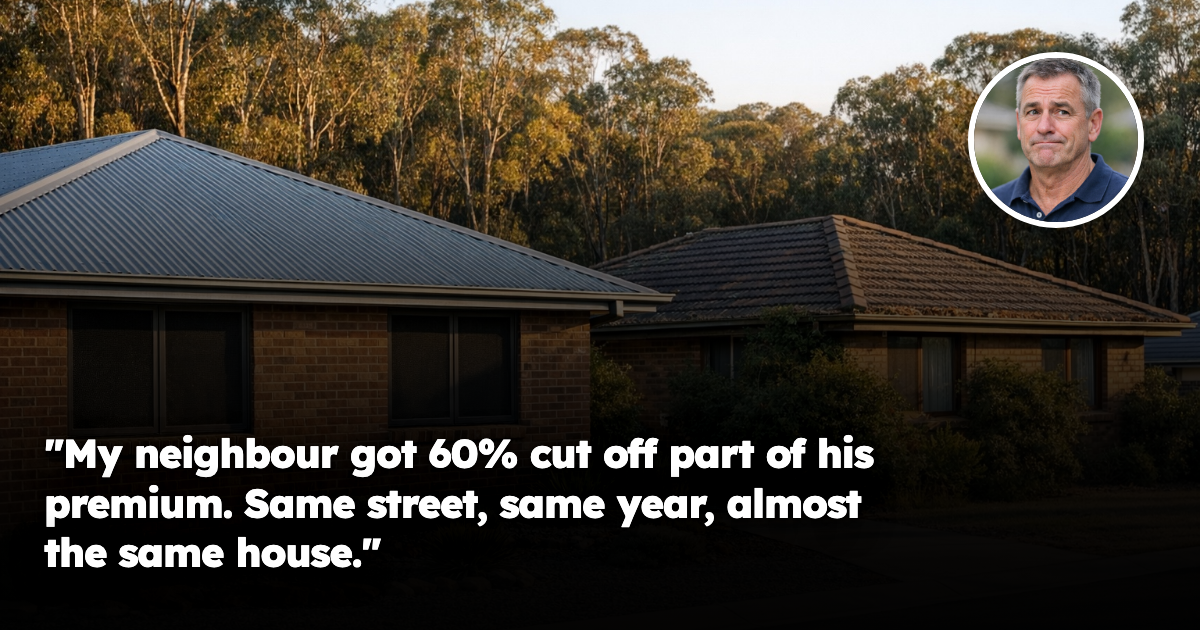
A man in his mid-fifties asked us this a fortnight ago, the way people ask when they already suspect the answer will annoy them.
He owns two houses on the same street in an outer-metro pocket — the one he lives in, and one four doors up he bought as an investment in 2016. Same era of construction. Same distance from the same bush reserve. Both renewed within weeks of each other.
At a street barbecue, a neighbour mentioned that the bushfire component of his premium had come down by more than half. Not a discount for switching. Not a haggle. A structural reduction, because he had documented work he had already done to the house.
Our man had done some of that work too. He had simply never told anybody, and nobody had ever asked.
His question: is this real, or is my neighbour telling barbecue stories?
It is real, and it is newer than most owners realise
For fifteen years, the only direction insurance moved for Australian property owners was up. Between 2010 and 2025, home insurance premiums rose by an annual average of 7.2% while wages grew 3.1% a year. That gap does not feel like much in any single year. Compounded across fifteen, it is why insurance has become one of the largest uncontrolled line items in a holding budget.
The pressure is measurable. The proportion of households paying more than four weeks of gross income for home insurance reached 15%, or 1.61 million households, up from 10% two years earlier. Prudential modelling projects the share of uninsured households widening from around one in seven today to one in four by 2050.
Against that backdrop, something genuinely new happened. Government and the insurance industry formalised a set of guiding principles committing both sides to recognising mitigation works in the peril component of the premium — the part of the price that reflects the specific hazard your specific address faces.
Four insurers are now reducing the bushfire risk component by up to 60% for owners with verified resilience investments. Households are reporting total premium reductions of 5% to 21%. The scheme currently covers bushfire, with work underway to extend it to flood, storm and cyclone — the perils driving the largest affordability pressure nationally.
Insurers are not offering a loyalty discount. They are repricing a physical fact about one title.
The second thing happening at the same time
While price is starting to move down for documented properties, the claim is getting harder to predict for everyone.
The competition regulator recently knocked back an industry application to standardise common definitions of "taking reasonable steps to maintain" and "wear and tear" across home insurers. The application rested on a striking number: denials attributable to maintenance and wear-and-tear exclusions rose from 9.2% of all claim denials in 2020 to 51% in 2023.
Half of all refused home claims now turn on wording that remains non-uniform across the market.
There is a parallel gap in what people think they bought. Industry review of product disclosure found 87% of home building policies include flood cover, but only 63% include storm surge — and the structure varies from default inclusion, to optional opt-out, to an active add-on. One water event can be split into flood, storm, rainwater run-off, storm surge, or action of the sea, each treated differently. Owners discover which one arrived at their house on the day it arrives.
Take-up compounds it. In the top 2.5% of flood-exposed properties nationally, building flood cover falls to 33%. Of the 242,000 homes facing severe-to-extreme flood risk, roughly 77% carry no flood cover at all.
Why this is a street-level question, not a suburb one
The national dataset behind those flood participation figures was built by cross-referencing insurer data against address, census and land title records. Underwriting has already moved below the suburb line. It is priced at elevation, slope, vegetation proximity, distance to a watercourse, construction era, roof form, and now — explicitly — documented mitigation on the individual title.
The market's own risk pricing has gone granular. The data most buyers use to make the decision has not.
This is the same pattern we see across our street-level work. Inside a single suburb, on achieved figures rather than advertised ones, the spread in effective yield between the best and worst streets routinely runs 20–30% once real vacancy duration, true days on market and achieved rents are measured rather than assumed. Insurability belongs on that list — and unlike most factors, it produces a bill every twelve months whether or not anything happens.
A suburb median takes the house with a documented mitigation record and the house 400 metres away with a storm surge exclusion nobody read, averages them, and confidently reports a number describing neither.
His two houses are four doors apart. One will qualify for a peril-component reduction. The other, on current documentation, will not. Nothing in any suburb-level dataset will tell him which is which.
Four things worth doing
Ask what your premium is made of. The peril component is the part that responds to mitigation. A premium is not a single price; it is a stack, and only part of it moves through physical work.
Document work you have already done. Most owners in hazard-exposed areas have made improvements — roof, screening, clearances, drainage, materials — and never recorded them in a form an underwriter can verify. Undocumented mitigation is worth nothing at renewal, and for many owners the work is already paid for.
Read the exclusions before the price. Given half of denials now hinge on maintenance and wear-and-tear wording, and that the wording is not standardised, the exclusion schedule is a more important document than the premium figure. If your property is coastal or low-lying, confirm in writing whether storm surge is included, opt-out, or absent.
Get a quote before you buy, not after. An insurance renewal is one of the few genuinely unsentimental opinions anyone will offer about a property — and the pricing gap between two addresses in one suburb is now large enough to change a holding-cost model. It belongs alongside the flood mapping check and the bushfire rating on the title, not after settlement.
What this means if you own property
It would be easy to read rising premiums and a widening protection gap as an argument against owning property. It is the opposite.
For the first time, the insurance market is paying owners cash for physical facts that exist at the level of a single title — every year, compounding, on properties that can prove it. That rewards selection and documentation over timing and sentiment. It also means the penalty for owning the wrong address in the right suburb is becoming explicit and annual rather than hidden and occasional.
Property is not becoming less investable. It is becoming more differentiated — and differentiation is only a threat if you are buying an average.
He thought his neighbour got a discount. His neighbour got paid for something he could prove about his house.
If there's a specific street you're weighing up right now, check its Street Score first — it's free, takes ten seconds, and tells you whether that street is pulling the suburb average up or riding on it.
Frequently asked questions
Can a neighbour on the same street really pay much less for home insurance just because of work done to the house?
Yes. The article says insurers are now reducing the peril component of premiums for verified mitigation work, so two similar houses on the same street can be priced differently. It is not a loyalty discount; it is a repricing of the physical risk at that specific address.
What kind of home improvements can help reduce the bushfire part of an insurance premium?
The article mentions improvements such as roof work, screening, clearances, drainage and materials. The key point is that the work must be documented so an underwriter can verify it at renewal.
Why does the article say suburb-level data can miss the real insurance cost of a property?
Because insurers are pricing risk at the individual address level, using factors like elevation, slope, vegetation proximity, distance to water and construction details. A suburb median can average very different houses together and hide the premium difference between them.
What should an owner check before focusing only on the premium price?
They should read the exclusions and not just the price, because many claim denials now turn on maintenance and wear-and-tear wording that is not standard across insurers. If the property is coastal or low-lying, the article also says to confirm whether storm surge is included, optional or excluded.
If I’m buying a house in Australia, what is the most important insurance check to do before settlement?
Get an insurance quote before you buy, because the premium can affect the holding-cost model and may differ sharply between two addresses in the same suburb. The article says this should be considered alongside flood mapping and bushfire rating checks.
General information only. It does not take your objectives, financial situation or needs into account, and nothing here is legal, financial, taxation or investment advice specific to your circumstances.