News · 17 August 2026 · 5 min read
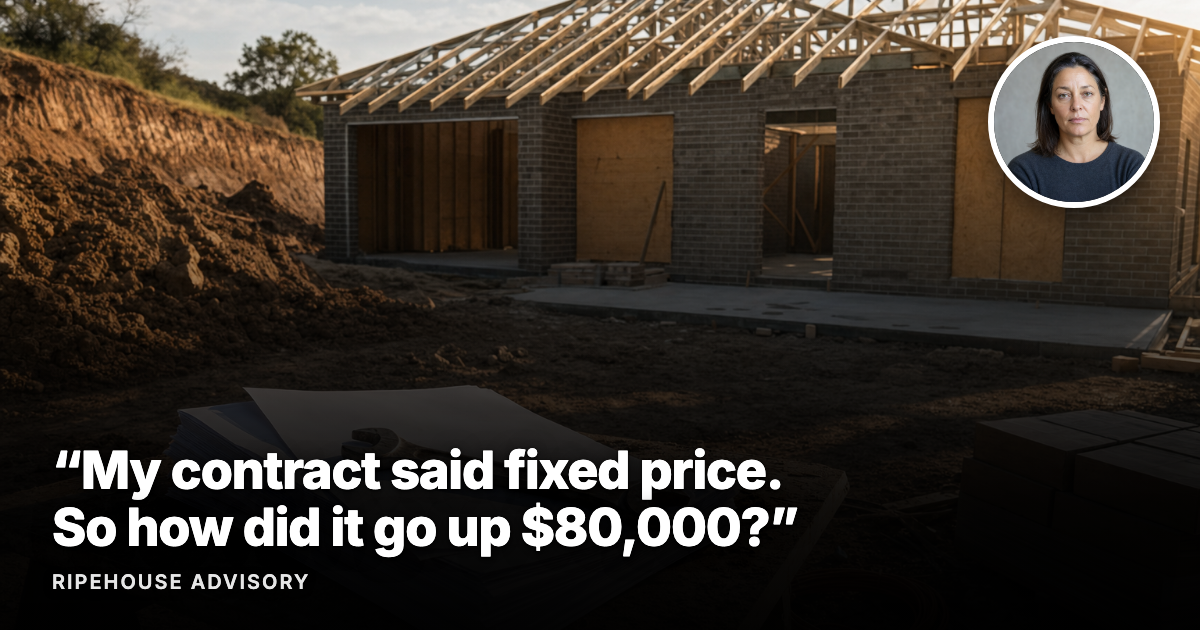
"My contract said fixed price. So how did it go up $80,000?"
She rejected a builder over a rise-and-fall clause, then watched a 'fixed price' build climb $80,000 with no variations. The two devices that made it legal — and the escape hatch that expressly ignores them.
She had the contract in front of her when she called us, and kept returning to the same two words on the front page.
Fixed price.
The build was a knockdown-rebuild on a block she already owned. She had compared three tenders and rejected one builder because his contract contained a rise-and-fall clause she had been warned about. The one she signed did not have that clause. She checked.
Eleven months later the invoices had taken the job roughly $80,000 past the number on the front page. Not one increase was a variation she had asked for. She had not changed a benchtop, moved a wall or upgraded a tap.
Her question was the flat, tired one we hear once the money is already gone.
"If none of it was my idea, and there was no rise-and-fall clause, what actually went up?"
The answer: a price, plus a list of things that were never priced
Domestic building contract legislation recognises two devices that sit inside a contract price without being part of it the way buyers assume.
The first is a prime cost item: an item — the example given is a fixture or fitting — that either has not been selected, or whose price is not known when the contract is signed, and for which the builder must include a reasonable allowance.
The second is a provisional sum: an estimate of the cost of particular work, including materials, for which the builder, after making all reasonable inquiries, cannot give a definite amount at signing.
Read those definitions slowly, because their honesty is the problem. Both are, by design, placeholders. A contract can carry a total, a signature, the words "fixed price" — and behind it, a schedule of numbers everybody has agreed are not yet known.
When the tiles are chosen, when the excavator finds rock, when the driveway is measured, the placeholder is replaced by the real figure. The price moves. No clause was triggered, because none was needed — a close cousin of the problem we covered when a staged payment schedule turned out to be a ceiling rather than a record of ownership.
The part that makes it more than a technicality
Her instinct about rise-and-fall clauses was correct. The legislation is genuinely hostile to them. A cost escalation clause — a provision letting the price rise to reflect increased labour, material or delay costs — cannot be used at all unless the price exceeds $500,000 or the clause is in a regulator-approved form. Even then it is void unless the builder first handed over an approved notice explaining its effect and the owner initialled directly beside it.
Now the carve-out. The definition of a cost escalation clause expressly does not include a provision letting the price rise to reflect prime cost items or provisional sums.
So the device that must be disclosed, approved and initialled is tightly regulated. A number left blank and labelled an allowance is none of those things. Her rejected builder had offered the transparent version. The one she chose used the version that needs no signature.
And then the escape hatch she thought she had
There is a statutory release valve. An owner may end a major building contract if the price rises by 15% or more, or the build takes one and a half times the period it was supposed to — provided the cause was something the builder could not reasonably have foreseen at contract date.
Her $80,000 cleared 15% comfortably. She thought she had a door.
The very next provision closes it. In calculating that price rise or time blow-out, any increase arising from a prime cost item or a provisional sum — or from a variation — is to be ignored.
The exit exists for price rises. The most common source of price rises is excluded from the calculation. For the purpose of the only clause that could have released her, her $80,000 was $0.
What the law does give her
A builder warrants that any provisional sum was calculated with reasonable care and skill, using all information reasonably available at contract date — expressly including the nature and location of the building site. And a builder must not write in an allowance lower than the reasonable cost of the item or work. Those carry penalties.
Better still, for a major contract every such item must have its own written schedule: a detailed description, and a breakdown showing at least the estimated quantities of materials and the unit cost to the builder. And — the sleeper clause — if the builder intends to charge anything above the actual increase, the schedule must state how that extra is worked out. These sit alongside the statutory warranties, which behave differently again from the insurance that only responds once the builder is genuinely gone.
So the question is never "was the price fixed". It is: were these allowances set honestly against this particular block? A site-costs figure identical on every contract regardless of soil is not a forecast that missed — it is a number never aimed at her land. And thin allowances make a tender look sharp next to an honest one.
Where the street-level data comes in
Every metric investors rely on — median price, days on market, vacancy, rental history, comparable sales — measures the finished asset at a settled price. None tells you how much of your price was a price and how much was a placeholder.
Those are per-site facts, in the same way an owner-builder permit quietly changes what a buyer inherits. Two identical packages on the same street, same suburb, same builder can carry very different quantities of unpriced work — driven by slope, soil, access and services. That is exactly what the allowances were supposed to reflect, and what street- and site-level analysis reads: the character of the block, not the average of the postcode.
We routinely find a 20–30% spread in effective yield between the best and worst streets of a single suburb. Part of that spread was never build quality. Part of it is how much of the price was ever a price at all.
What it means for you
None of this is an argument against building — allowances exist because some costs genuinely cannot be known on the day you sign.
It is an argument for reading the schedule instead of the front page. The definitions, the $500,000 threshold, the signing formalities, the itemised breakdowns and the carve-out from the 15% exit are all published, and checkable before you sign. That makes them priceable — count the allowances, test the big ones against the site, and ask why any is thinner than the neighbour's.
Almost nobody does, which is why the market prices the anxiety instead of the fact. Do the reading and you buy the same asset carrying less risk than the buyer beside you.
She hadn't been given a price with some gaps in it. She'd been given a list of the gaps, and asked to sign underneath the total.
If there's a specific street you're weighing up right now, check its Street Score first — it's free, takes ten seconds, and tells you whether that street is pulling the suburb average up or riding on it.
Frequently asked questions
How can a “fixed price” build still end up costing more in Australia?
A contract can still contain prime cost items and provisional sums, which are allowances for items or work not fully known when you sign. When those placeholders are replaced by the actual costs, the total price can rise even without a variation or rise-and-fall clause.
What is the difference between a prime cost item and a provisional sum?
A prime cost item is an item or fitting that has not been selected, or whose price is not known, when the contract is signed. A provisional sum is an estimate for particular work and materials where the builder cannot give a definite amount after making reasonable inquiries.
Why didn’t the rise in price trigger the contract’s cost escalation rules?
The article says cost escalation clauses are tightly regulated and do not apply to prime cost items or provisional sums. So a price increase caused by those allowances is not treated the same way as a rise-and-fall provision.
Can an owner end a major building contract if the price jumps by more than 15%?
Yes, but only if the increase or time blow-out is caused by something the builder could not reasonably have foreseen at contract date. In calculating that threshold, increases from prime cost items, provisional sums and variations must be ignored.
What should a buyer check before signing a domestic building contract?
The article says to read the schedule, not just the front page, and test whether allowances are set honestly for that specific site. For major contracts, each item should have a written schedule with descriptions and cost breakdowns, including estimated quantities and unit costs.
General information only. It does not take your objectives, financial situation or needs into account, and nothing here is legal, financial, taxation or investment advice specific to your circumstances.