News · 18 August 2026 · 5 min read
'I built a $96,000 shed on the wrong block. The bank's mortgage is the part nobody warned me about'
He owned both blocks and built on one of them — the wrong one. The rule for a lasting improvement made under a mistaken belief about ownership has no compensation floor at all, and the orders available can strip or rewrite a registered mortgage.
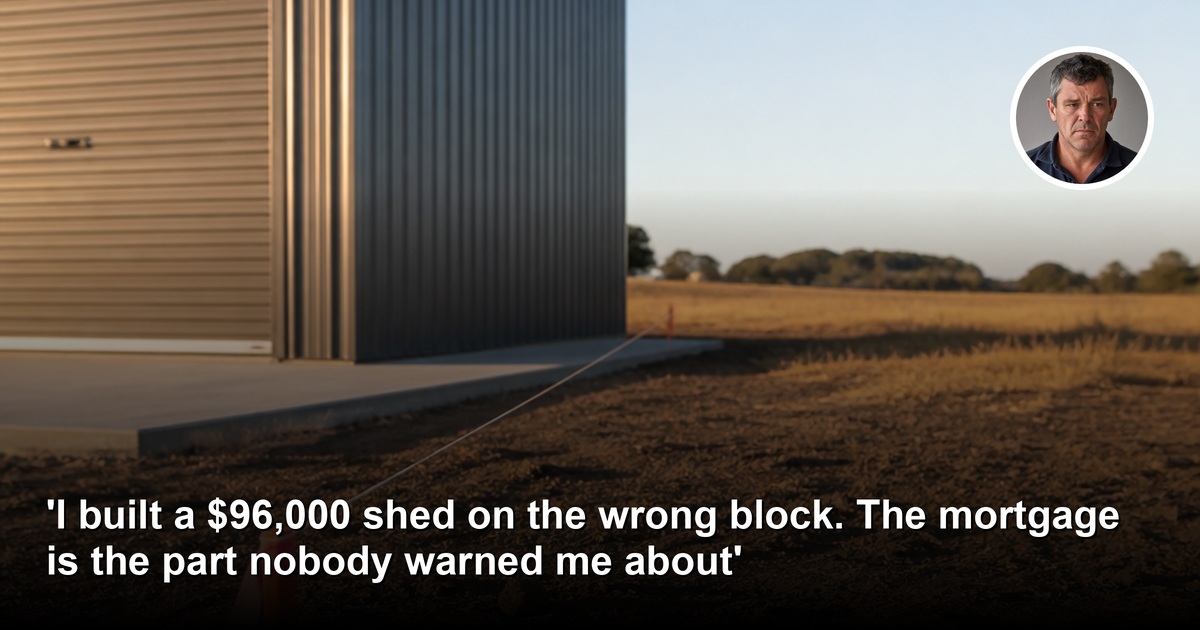
He owned two adjoining lots. He built on one of them. It was the other one.
The question came to us from a man in his late forties who had spent eleven years accumulating property slowly: a house, a second house, then two vacant blocks side by side in a growth corridor he'd researched for a year. The plan was to hold them, build a large shed on one for a small trade business, and sell the other when the corridor matured.
He built the shed. Slab, steel frame, roller doors, three-phase power, concrete apron — $96,000 by the time the last invoice cleared. He measured off the frontage, counted the pegs the way the estate map showed them, and put the building where he had always pictured it.
Fourteen months later he went to sell the second block. The buyer's solicitor ordered a survey. The shed was not on the lot he thought. It was on the lot he was selling — the whole structure, not a corner of it — and he had since refinanced, so the block under the shed carried a mortgage the shed had never been valued into.
His question, almost word for word: 'If I own both blocks, how is this even a problem?'
The answer: the law has a rule for exactly this, and it is not the rule most people have heard of
Most people who have hit a boundary problem have heard of encroachment — a wall, an eave, a footing crossing the line. The striking feature of that regime is that compensation carries a statutory minimum with a three-times multiplier attached to intent.
This is the neighbouring rule, and a different animal. Where a person makes a lasting improvement on land owned by someone else in the genuine but mistaken belief that they owned that land, a separate division applies — and it applies despite any other Act.
Two things about it are worth understanding before you ever need it.
First, it is much wider than a building. The encroachment rule is written around a building — a substantial structure of a permanent character, including a part of one. This rule is written around a lasting improvement, not limited to buildings at all. A slab, a hardstand, an in-ground installation, a permanent structure of almost any kind can qualify. The one thing the definition expressly excludes is a fence — which is why fencing disputes run down an entirely separate track with its own equal-contribution rule.
Second, and this is the part that surprises people: the orders available can reach other people's registered interests.
What a court can actually order
The court — and here the word means the Supreme Court, not a tribunal — may refuse relief entirely. If it grants relief, the orders available include ordering a person to transfer, lease, or grant an easement or another interest in the affected land; land reasonably required as curtilage and for access; a plan of survey; compensation for loss of the land or other loss; or that the improvement be modified or removed.
Then there are the two almost nobody expects. The court may order that an interest in the affected land is free from a mortgage, lease, easement or other interest affecting the land. And it may order the varying — to the extent necessary — of a mortgage, lease, easement, contract or other document relating to that land.
Read that again with a lender in mind. The remedy for a mistaken improvement can strip or rewrite a registered security. It exists because the alternative — demolishing a $96,000 asset because a title boundary sat three metres from where someone assumed it did — is often worse for everyone, the bank included.
It also explains why the applicant list is broader than the two obvious parties. It includes the person who held the mistaken belief, a person who built on behalf of someone else who held it, anyone with an interest in the land or the improvement — a mortgagee, a lessee — and, notably, the local government in whose area the land sits.
The asymmetry nobody prices
Here is the finding that matters for anyone holding land, and it is structural rather than dramatic.
The encroachment rule has a floor. Compensation must be at least market value, or three times market value if the encroaching owner can't satisfy the court the encroachment was neither intentional nor negligent. Harsh, but knowable — you can model a worst case.
The mistake-of-title rule has no floor. No minimum, no multiplier, no formula. Everything is discretion, guided by a list: the circumstances in which the improvement was made, its nature and extent, the situation and value of the land, the loss to each side, the loss if removal were ordered, the planning scheme that applies, and any other circumstance the court considers relevant.
That cuts both ways, and honesty requires saying so. The punitive multiplier can't be aimed at you. But there is no ceiling written down, no entitlement to keep what you built, and nothing preventing an order to remove it. Discretion is not leniency — it is the absence of a number you can plan around.
What this means if you own property
The unit of this rule is a named parcel — not a suburb, not a postcode. That is precisely why suburb-level analysis cannot see it.
Two blocks in one street can share a median, a growth figure, a vacancy rate and a days-on-market number, and be different assets: one with a surveyed, unencumbered improvement, the other carrying a structure the title says belongs to someone else and a mortgage never written around it. Nothing in a suburb report distinguishes them. Our street-level work exists because of gaps like this — the spread in effective yield between the best and worst streets in a single suburb routinely runs 20–30% once you use achieved rents, real vacancy duration and actual days-on-market instead of averages. It is the same reason two houses in one street can be priced identically and insured completely differently. Title integrity is a property-level fact: invisible at suburb level, decisive at settlement.
The practical fix costs an afternoon and a few hundred dollars: an identification survey before you build and before you buy, not when a buyer's solicitor orders one for you. Where you own adjoining lots, confirm which title the improvement actually sits on — owning both is not the protection it feels like, because the titles, the mortgages and the buyers are separate even when the owner isn't.
And the reason this argues for property rather than against it: every element here is published and readable before you commit. The definition, the applicant classes, the orders, the exclusion of fences, the absence of a floor. All checkable, therefore priceable — and almost nobody prices it, which is why careful buyers keep finding value where careless ones find surprises. Rules you can read in advance are the cheapest edge in this market.
He had owned both blocks for four years. He had never once checked which one he was standing on.
If there's a specific street you're weighing up right now, check its Street Score first — it's free, takes ten seconds, and tells you whether that street is pulling the suburb average up or riding on it.
Frequently asked questions
If I own two adjoining blocks in Australia, can I still run into trouble if I build on the wrong one?
Yes. The article says owning both lots does not prevent a problem if the improvement sits on the wrong title, because the land, the mortgage and any buyer’s rights are treated separately. A mistaken improvement can still trigger a court process.
What kind of mistake does this law cover — only houses and sheds?
No. The rule applies to a lasting improvement made on someone else’s land in the genuine but mistaken belief you owned it. It is broader than a building and can include a slab, hardstand or other permanent installation, but it expressly excludes fences.
What can the Supreme Court order if a lasting improvement was built on the wrong title?
The court may refuse relief, or it may order a transfer, lease, easement or other interest, a survey plan, compensation, or removal or modification of the improvement. It can also deal with curtilage, access and related loss.
Can a mortgage be affected if the shed or other improvement ends up on the wrong lot?
Yes. The article says the court can order an interest in the affected land to be free from a mortgage, lease, easement or other interest, and can vary a mortgage or other document to the extent necessary. That means a registered security can be stripped or rewritten.
Is there a fixed compensation amount for this kind of mistaken improvement in Queensland?
No. Unlike encroachment, this rule has no statutory floor, no multiplier and no set formula. The court decides using the circumstances, the value of the land, the losses to each side and any other relevant factor.
General information only. It does not take your objectives, financial situation or needs into account, and nothing here is legal, financial, taxation or investment advice specific to your circumstances.