News · 18 August 2026 · 5 min read
'I spent $18,400 on a carport. My neighbour can have it taken down — and I have to pay for that too'
He did everything he thought mattered: approval, a licensed builder, a quote in writing. Then a letter arrived about a rule that has nothing to do with councils or builders. Because the fence he bolted his carport to is not his fence — it is half his, and the consent that governs it belongs to the person on the other side.
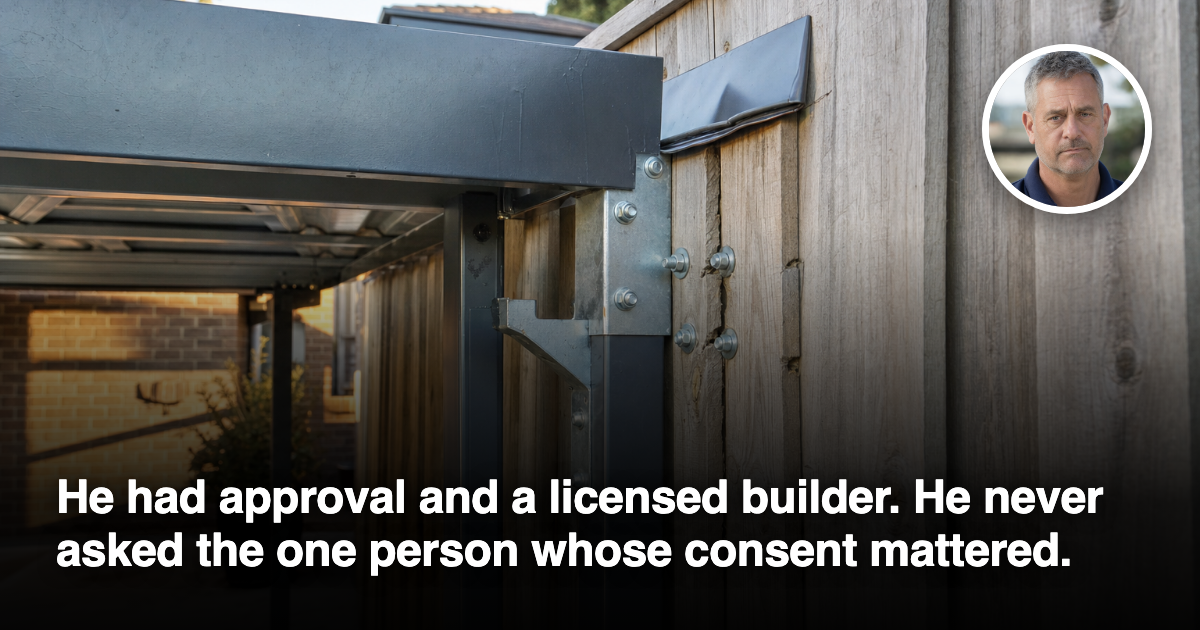
He is not angry about the money. He is angry that he checked everything except the one thing that mattered.
An owner in his fifties brought us this question a fortnight ago. Long-held property, tenanted for years, the kind of investor who keeps receipts in a folder. The driveway ran tight against the side boundary and the tenants wanted covered parking. So he did it properly: confirmed the approval, engaged a licensed builder, took a written quote. $18,400.
The tight side meant the cleanest engineering was to fix one edge of the structure to the existing boundary fence — solid, good condition, running the length of the drive. The builder did exactly that. Bolted through, flashed, sealed.
Seven months later the property next door sold. The new owner walked the boundary, looked up, and wrote a letter.
"I had approval and a licensed builder. How can a neighbour who wasn't even living there override that?"
The trigger is not the council. It is the person on the other side
Here is the sentence that reorganises this whole problem, and it is not in any building code.
Legislation dealing with fences between neighbours preserves a common-law position most owners have never had reason to think about: a dividing fence on the common boundary is owned equally by the owners on both sides. Not yours. Half each, along its entire length.
Once you see the fence as a jointly owned asset, the rest follows with uncomfortable logic. A specific rule states that an owner must not, without the consent of the adjoining owner, attach a thing to a dividing fence that unreasonably and materially alters or damages it.
And the examples the legislation itself gives of an attachment are worth reading slowly: a carport. Shade sails. Lattice work. Canvas. Signs.
That is not a list of vandalism. It is a list of the things people build when they are trying to improve a property. The rule is aimed squarely at useful additions — because a useful addition to one side is a permanent alteration to something the other side half-owns.
Note what is absent from the trigger. Not "if it damages the fence." Not "unless the council approves." The gate is consent from next door — from the owner at the time, not goodwill inherited from a neighbour who has since sold.
What can actually be ordered
This is where it stops being a technicality.
Where the rule is breached, the adjoining owner can apply to the relevant tribunal for an order that the owner remove the thing attached, and restore the fence to a reasonable standard, having regard to its condition before the thing was attached. The tribunal's list of available orders names that remedy expressly.
Compare the two other ways a structure goes wrong on a boundary, because the contrast is the useful part.
If your building physically crosses the line into the neighbour's soil, that is an encroachment, and the compensation rule carries a knowable worst case — at least market value of the land, and up to three times market value where the owner cannot satisfy the court it was neither intentional nor negligent. Ugly, but modellable.
Build on the wrong title entirely, believing it was yours, and that is a different rule again — no compensation floor and no multiplier at all, just discretion.
Attachment is the third case, and structurally the quietest. His carport crosses nothing. Every post sits on his land. No encroachment, no mistaken title, no survey error. The structure is entirely his — it is merely fixed to the shared thing on the line. And the remedy is not compensation, so there is no cap to argue about. It is restitution of a physical state: take it off, put the fence back. That costs whatever it costs, and it lands on whoever attached it.
There is a threshold, and it matters: the alteration must be unreasonable and material. A hook, a plant, a light — plainly not this. A bolted-through connection carrying a roof is a different conversation. And consent solves it completely, for free, and almost nobody gets it in writing.
The escape hatch was in the definition all along
The most valuable line here is not in the rule. It is in the definition of "fence", and it is an exclusion.
A fence is not a retaining wall, and not a wall that is part of a house, garage or other building. We used that same exclusion for a different consequence when we looked at why a $14,600 boundary bill landed 90/10 instead of 50/50.
Read it here and it becomes an engineering instruction. Fix the carport to the dividing fence and the consent rule engages, with a removal order behind it. Fix the identical carport to your own garage wall a metre away, and that rule never engages at all.
Same structure. Same builder. Same cost. Same street. The exposure turns entirely on what you fixed it to.
One more detail: the prohibition also reaches a person who enters your land with your express consent — your builder is inside the rule, but the owner is the one an order names. Your tradesman's decision, your order.
This is the unit our data actually works in
We build street- and suburb-level data for a living, and this is the cleanest illustration of why the suburb is the wrong unit.
Two houses can sit side by side and share every metric a suburb report contains — median, growth, vacancy, days on market, catchment, council. One has covered parking bolted to a jointly owned fence with no written consent, an addition a new neighbour can move to have removed. The other has identical parking fixed to its own garage wall, with no exposure at all. One is an improvement. The other is a liability wearing an improvement's clothes. No median tells you which is which.
When we model streets, the spread between the best and worst inside a single suburb routinely runs 20–30% on effective yield — measured on achieved rents, real vacancy duration and real days on market, not advertised figures. Detail at this scale feeds that spread, because buyers and their solicitors price it long before the market does.
The practical fix costs nothing. Before you attach anything to a boundary fence, get the adjoining owner's consent in writing and keep it with the title documents — written consent survives a sale far better than a friendly chat. Where the design allows, fix to your own structure instead. Before you buy, look up along the boundary and ask what is bolted to that fence.
This is why careful investors keep finding value here. The ownership rule, the consent requirement, the removal order and the exclusion are all published and readable before you commit a dollar. Knowable risk is priceable risk. Almost nobody prices it — which is why the buyers who do keep acquiring good assets from sellers who never looked up.
He had walked past that fence for three years. He had never once wondered whose it was.
If there's a specific street you're weighing up right now, check its Street Score first — it's free, takes ten seconds, and tells you whether that street is pulling the suburb average up or riding on it.
Frequently asked questions
Can I bolt a carport to the boundary fence in Australia if the council has already approved the structure?
Not necessarily. The article says the key issue is consent from the adjoining owner, because a dividing fence is jointly owned by both neighbours. Council approval and a licensed builder do not override that rule.
Why does a neighbour’s approval matter if the carport is entirely on my land?
Even if every post is on your land, attaching the carport to a shared boundary fence can still breach the rule. The fence is treated as half-owned by each neighbour, so consent from the other side is the relevant protection.
What can the next-door owner do if I attach a structure to a dividing fence without consent?
They can apply to the tribunal for an order requiring the attached thing to be removed and the fence restored to a reasonable standard. The article says the remedy is focused on restoring the physical state, not on compensation.
Does this rule apply only if the fence is damaged or if the structure crosses the boundary?
No. The article says the trigger is attaching a thing to a dividing fence in a way that unreasonably and materially alters or damages it. A carport is specifically mentioned as an example of the kind of attachment covered.
How can I avoid this problem before building on a boundary fence in Australia?
Get the adjoining owner’s consent in writing before attaching anything to the fence, and keep it with your title documents. Where possible, fix the structure to your own wall or structure instead of the shared fence.
General information only. It does not take your objectives, financial situation or needs into account, and nothing here is legal, financial, taxation or investment advice specific to your circumstances.