News · 22 August 2026 · 5 min read
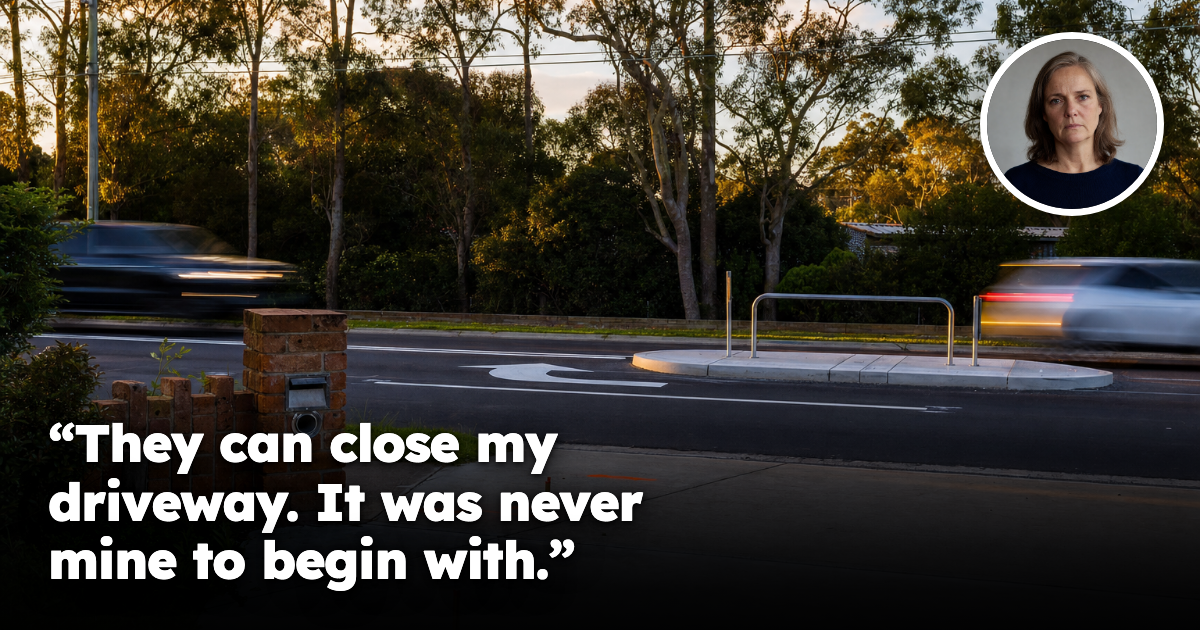
'They can close my driveway. I found out it was never mine — and that asking permission is what costs you the $215,000'
A driveway onto a main road is not part of your land. It is a decision in force, revocable on a forecast — and the compensation section quietly excludes the loss of passing traffic and pays nothing at all where the owner applied.
We get asked a version of this every few weeks, and the answer surprises people so badly they ask us to put it in writing.
A woman in her late fifties came to us this month. She is recently widowed. She and her husband bought their block in 2014 — a wide frontage on a busy road they had waited eleven years to afford. The frontage was the reason they bought it.
Eighteen months ago she started planning a wider entry and a better turning area, and lodged the application she was told to lodge. The answer came back with a condition. The entry could be widened, but it had to move eleven metres north, it became left-in and left-out only, and the existing crossing had to be removed at her cost. Her valuer put the effect at $215,000.
'How can they take away a driveway I've had for twelve years? And how is it possible that I get nothing — when the only reason any of this happened is that I did the right thing and applied?'
The part almost nobody knows
A driveway onto a significant road is not, in law, part of your land. The legislation does not call it a driveway. It defines it as a location on a property boundary between land and a road for the entry or exit of traffic — and a permitted one exists only where a decision in force allows it.
Not a right, not an easement, not something that runs with the title. A decision in force — and decisions in force can be replaced.
The instrument goes further. It declares, expressly to remove doubt, that a decision permitting access does not give rise to any rights, beneficial or otherwise, in property on or part of the road. The permission confers nothing.
Then it does something almost unheard of. A notice of decision about your access must state that there is no guarantee of the continuation of road access arrangements. The law compels the State to tell you, in writing, that your driveway is not permanent.
What can actually be done
Where a road is declared a limited-access road, a written decision may set where access is permitted, condition its use, require existing works changed or their use discontinued, prohibit all access, or require works removed by the owner within a stated time.
The example conditions are worth knowing: a ban on turns in or out; a cap on the type and number of vehicles; a restriction on the hours access may be used; a duty on the owner to ensure others comply.
Two further details matter. First, the authority must maintain a written policy for each such road. Replacing it requires publication; amending it does not — where the change concerns one or more particular properties and those owners are notified. The rule that applies specifically to your block is the one that can change without appearing anywhere public.
Second, where access already exists, the authority can act on its own initiative only if it considers the access is creating, or may in the future create, a hazard; is reducing, or may in the future reduce, safety; is having, or may in the future have, an adverse effect on traffic operations. Every limb is future conditional. The threshold is a forecast — and a forecast cannot be disproved by twelve uneventful years.
There is also a power to direct an owner with no decision in force to apply within 28 days.
Why she gets nothing
Compensation exists — an affected owner may recover the diminution in value as a debt. But it is fenced on three sides.
First: access that could be made available at other locations must be taken into account, so an inferior alternative reduces the claim.
Second, and this decides most main-road cases: compensation is not payable to the extent the loss is attributable to a change affecting the supply of access to and from a traffic stream. Passing traffic — the whole premium of a busy frontage — is excluded by name.
Third, and this answers her question. Where the decision was made on an application by a person with an interest in the land, and it substantially changes a previous access decision, the authority is not liable to pay compensation at all — and that applies whether or not the application resulted from a direction to apply. You can be ordered to apply, then lose your remedy because you did.
Worse: a routine planning application involving a change of vehicular access to such a road is taken to also be an application about that access — so owners trigger the bar without knowing they made it.
What this means for you
None of this is a scandal. Managing where vehicles enter a high-volume road is a genuine safety function, and review and appeal rights are real.
But it illustrates why we do what we do. Two properties on the same road, four hundred metres apart, produce an identical suburb report — same median, growth rate, catchment, council and vacancy rate. One sits on a declared stretch with a policy already written against its frontage. The other does not. They are not the same asset.
A suburb median has never once read a gazette notice. That is the gap our street-level work exists to close: within one suburb we routinely measure a 20–30% spread in effective yield between the best and worst streets — achieved rents rather than asking rents, real vacancy duration rather than a headline rate, true street-level supply and demand. Frontage status widens that spread again, invisibly to every suburb-level product on the market. If you've read how a paper road can run through a backyard, how a boundary can be drawn through land you already own and then allowed to move, or how a road closure can change a street's traffic without a public notice, you know the pattern: the decisive fact is never in the listing.
Here is the part that should encourage rather than frighten you. Anyone with an interest in land may ask, in writing, for a copy of the access decision in force for that land — and the authority must give it to them. No fee, no discretion. One letter, sent before you make an offer rather than after you engage a designer. Declarations are published, policies inspectable, and the exclusions printed in the same section as the compensation.
That is the argument for property as an asset class. The material risks are written down and free to read, and almost nobody reads them — so the person who does buys the same street on better terms than everyone beside them at the inspection. Risk you can read is risk you can price, and priced risk isn't a threat. It's an edge. Nothing here happens by ambush — it happens to people who never asked. She would still have bought that block, knowing what the frontage was, and on her own numbers paying less for it.
She didn't lose a driveway. She lost twelve years of assuming that the thing her cars drove over every day belonged to her.
If there's a specific street you're weighing up right now, check its Street Score first — it's free, takes ten seconds, and tells you whether that street is pulling the suburb average up or riding on it.
Frequently asked questions
Can a driveway onto a main road in Australia be closed even if it has been used for years?
Yes. The article says access is not permanent and is only allowed while a decision in force permits it. That decision can be changed or replaced, so long-standing use does not create a guaranteed right to keep the driveway.
Why did the owner in the article get no compensation after the driveway access was changed?
The article says compensation is excluded where the loss is attributable to changes in the supply of access to and from a traffic stream, which includes passing traffic value. It also says that if the access decision was made on the owner’s application and substantially changes a previous decision, the authority is not liable to pay compensation at all.
Does asking for a driveway change yourself affect your compensation rights?
According to the article, yes. If the decision is made on an application by a person with an interest in the land and it substantially changes an earlier access decision, compensation is not payable. That applies even if the application was made because the authority directed the owner to apply.
What kinds of conditions can be placed on access to a declared limited-access road?
The article says a written decision can set where access is allowed, condition its use, require existing works to be changed or removed, or prohibit access entirely. It can also limit turn movements, the type and number of vehicles, and the hours access may be used.
How can an owner find out what access decision applies to their land before making a change?
The article says anyone with an interest in the land can ask in writing for a copy of the access decision in force, and the authority must provide it. It is free and can be requested before making an offer or lodging an application.
General information only. It does not take your objectives, financial situation or needs into account, and nothing here is legal, financial, taxation or investment advice specific to your circumstances.