News · 21 August 2026 · 6 min read
"I paid $685,000 for the block. The neighbour bought the road to my gate for a price nobody advertised"
A 29-year-old nursery grower paid $685,000 for a semi-rural block with a formed track running to her front gate. Two years later that track had been permanently closed and amalgamated into the farm next door — and because of one definition, nobody was required to tell her it was happening.
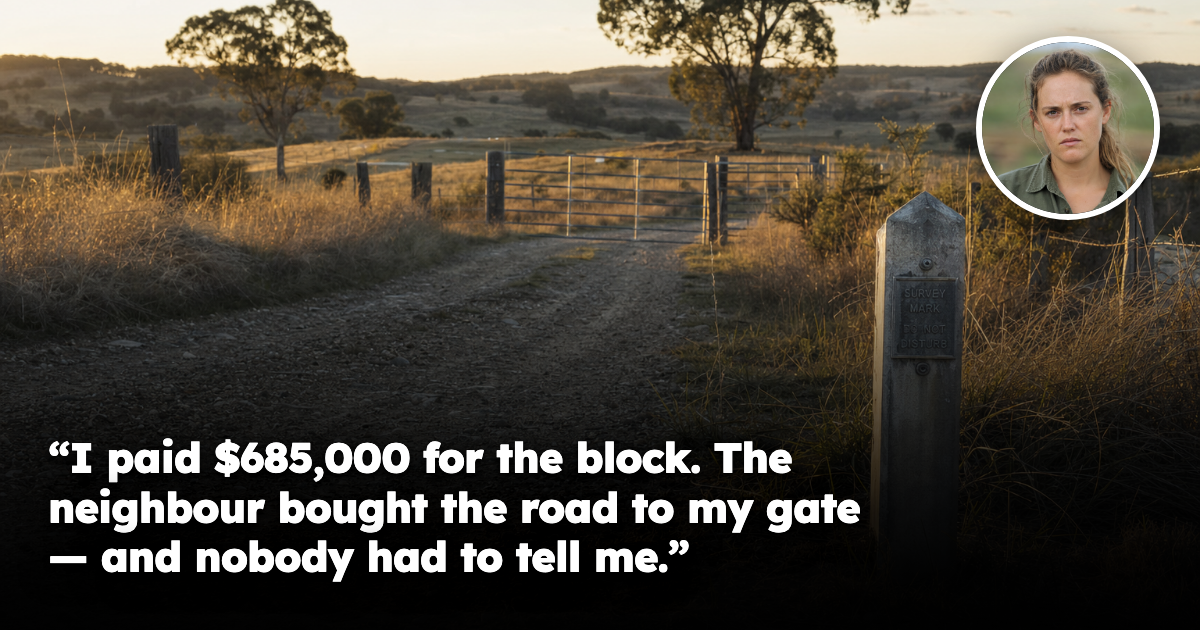
A 29-year-old nursery grower bought a semi-rural block with a formed track running to the front gate. Two years later the track belonged to the farm next door — and the law did not require anybody to tell her it was happening.
She is twenty-nine and spent six years propagating stock for other people's nurseries before she bought anything of her own. The block was two and a half hectares on the edge of a growth corridor: $685,000, close enough to the highway to be worth something later, flat enough for shade houses.
A gravel track ran off the sealed road to her front gate. Everyone used the word "road" for it. It was on the plan and it had a name.
She was not careless. She ordered a title search, walked the boundaries, and asked the obvious question: is that track mine, or council's, or public? She was told it was a road. That answer was correct, and it cost her.
Two years after settlement, a letter arrived with a plan attached. The track had been permanently closed and amalgamated into the neighbouring farm. The strip she drove over daily was now somebody else's paddock, subject to an access arrangement she had to negotiate.
Her question was one sentence.
"How does a public road get sold to one person without the neighbours being asked?"
It is a fair question, and the answer is uncomfortable — because nothing here was done unlawfully.
The answer
Start with what a road actually is. Land dedicated and opened for public use as a road vests in the State. It is not the council's asset the way a park is, and it is not yours because it dead-ends at your gate. It is Crown land carrying a public right of passage, and that right can be switched off — in much the same way that a third party can hold a veto over what you build on your own land.
Two mechanisms do the switching.
The first is temporary closure, achieved by issuing a licence over the road to somebody — almost always an adjoining owner. During the licence the land is still dedicated as a road; the public simply cannot use it. The licence is deliberately weak: no right of renewal, no conversion to another tenure, no right to buy. Almost no structures are permitted. It can be cancelled on reasonable notice with no compensation payable, and any improvements left behind become the property of the State.
The second is permanent closure, and this is the one that changed her position. The threshold is a single satisfaction test: after such inquiry and notice as is considered appropriate, that the road is not needed. If the land is big enough and well enough located to stand alone, it becomes a lot. If it is not — which describes most access tracks — it must be amalgamated with adjoining land: either adjoining State land, or, failing that, the land of an adjoining owner. Before the closure takes effect, that road has to be sold to one or more adjoining owners, at a purchase price fixed the way a regulation prescribes.
Read that again slowly. Not auctioned. Not offered around. Sold, to an adjoining owner, at a prescribed price.
The part almost nobody knows
There is a public-notice process. A closure application normally requires public notice — a sign kept in a conspicuous place on or near the road, an objection window, a stated closing day — plus enquiries that include notifying owners of land adjoining the road, land adjoining that land, and land whose dedicated access might be affected. Objections must be considered, and the application must be refused if the road is still needed. Further refusal grounds: if the road is the only dedicated access to someone's land, if the public uses it regularly, or if it provides continuity to a road network.
That is a real process. And it has an exception that swallows a lot of ground.
Public notice is not needed at all where the application is to close a "no-through road" — defined as a road closed at one end that provides access to the land of only one adjoining owner.
So the protection is strongest for busy through-roads lots of people would notice anyway, and weakest for exactly the quiet dead-end tracks where one decision settles whether a block has an access problem forever. And separately, the Minister may close a road without receiving an application at all.
One more asymmetry. An adjoining owner applying for permanent closure may ask, in the same breath, that the closed road be amalgamated with their land. The applicant can name the outcome. Everyone else is limited to objecting — assuming a notice reached them.
What this means for you
Nothing here is a scandal. Roads that serve nobody are a real cost to the public, and closing them is sensible administration. The refusal grounds are real, the "still needed" test has teeth, and the neighbouring farm did nothing but use a lawful process competently. The only thing that went wrong for her is that she did not know it existed.
And this is where a suburb-level view of property fails completely. Two blocks in the same postcode, same zoning, same school catchment, same median, are not the same asset if one fronts a sealed road it will always front and the other reaches the world across a strip of Crown land that a single decision can hand to a neighbour. That difference never appears in a median. It appears in the plan, in the tenure of the access strip, and in whether the road is a through-road or a dead end with one adjoining owner — the same class of parcel-specific fact as an order that travels with the property onto a register almost nobody searches.
This is the whole argument for reading a property at street level. The gap in effective yield between the best and worst street inside one suburb routinely runs 20–30% — visible only in achieved rents rather than asking rents, real vacancy duration, true days on market and genuine street-level supply and demand. Access tenure sits in the same category: a checkable, parcel-specific fact that decides value and never shows up in an average. A suburb median has never once read a plan of subdivision.
The practical checks are cheap. Ask what tenure the access strip is under, not just whether it is "a road". Ask whether it is a through-road or a dead end. Ask whether any road licence is registered nearby — a licence is often the first step, and a covenant gets registered when one issues. And if you are an adjoining owner, you may be able to apply yourself. It is worth reading alongside what happens with land taken by the State and the price you are offered when it is handed back.
None of this is hidden. The tests, the exceptions, the no-notice category and the sale-to-an-adjoining-owner rule are published and readable long before anyone needs them. That is the good news, and it is the case for buying property rather than avoiding it: risk you can read is risk you can price, and priced risk is not a threat — it is an edge over every buyer who never looked.
Her block is still a good block. The corridor is moving her way, the soil is right for what she grows, and she has access in writing now.
She just never imagined that the most important line on the plan was the one she thought belonged to everybody.
If there's a specific street you're weighing up right now, check its Street Score first — it's free, takes ten seconds, and tells you whether that street is pulling the suburb average up or riding on it.
Frequently asked questions
How can a road that leads to a private property gate end up being sold to the neighbour in Australia?
In the article, a road dedicated for public use vests in the State and can later be permanently closed if it is considered not needed. If the road is too small to stand alone, it must be amalgamated with adjoining land and sold to one or more adjoining owners at a prescribed price.
Do buyers have to be told if a dead-end access track might be closed later?
Not always. The article says public notice is generally required for road closures, but that notice is not needed for a “no-through road” that is closed at one end and provides access to only one adjoining owner.
What is the main risk for a buyer of a semi-rural block with access over a road reserve or Crown land?
The access strip may later be temporarily licensed or permanently closed, which can change who controls the route to the property. The article says that risk may not appear in suburb-level averages, so the access tenure and road type matter at parcel level.
What should a buyer check before purchasing a block with a road or track to the front gate?
The article says to check what tenure the access strip is under, whether it is a through-road or a dead end, and whether any road licence is registered nearby. It also suggests reading the plan closely and not assuming that “road” means permanent public access.
If a road closure is applied for next to your property, can you object?
Yes, the article says objections must be considered when public notice is required. However, if the road is a no-through road, public notice may not be needed at all, which limits the chance to object.
General information only. It does not take your objectives, financial situation or needs into account, and nothing here is legal, financial, taxation or investment advice specific to your circumstances.