
News · 23 August 2026 · 5 min read
'The job finished two years ago. My solicitor says I can still unwind the whole $196,000 contract'
A completed building contract can be rescinded from the moment it was signed if one mandatory paragraph was never in it. The seven-day clock only starts when the owner finds out, and there is no long-stop.
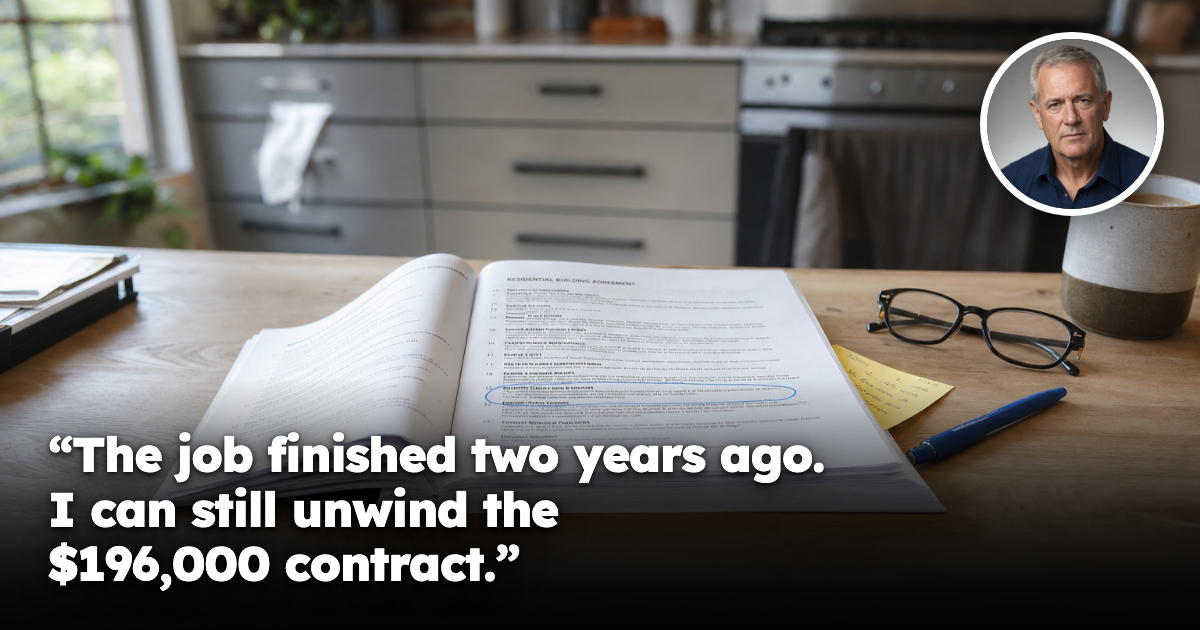
He is 62 and remarried five years ago, and the renovation he and his wife did was meant to be the last building project either of them went near. They extended the rear, reworked the kitchen and added a bathroom for the grandchildren. The contract price was $196,000. The builder was licensed, insured and — by the standards of most stories that reach us — pretty good. The job ran eleven weeks over and finished.
That was two years ago. Last month, chasing something unrelated, his solicitor read the building contract properly for the first time and told him he may be able to rescind it. Not sue on it. Unwind it, as though it had never been signed.
His question, when he rang us, was almost apologetic:
"The work is done. We live in it. We're happy with it. I paid every invoice on time. How can a contract I completed two years ago still be cancellable?"
What his solicitor actually found
Nothing about the workmanship, the price or the delay.
A missing paragraph.
Where residential building work is contracted above a prescribed value, the legislation sets out what the contract must contain. It reads like an invoice: the parties' names, the licence number, a description of the work, the plans, the price, the applicable statutory warranties, the cost of insurance cover, the progress payment details.
And one more item — a conspicuous statement setting out the cooling-off period that applies to the contract.
Every homeowner signing such a contract has a short cooling-off right: notice in writing, and the contract is rescinded from the moment it was signed. Most people never use it. That is not the point. The point is that the statute requires the contract to tell you the right exists, and puts that requirement in the same mandatory list as the price.
His did not contain it.
The clock that never started
Here is the part that made his solicitor sit up, and it is the reason we are writing this.
Where a contract does not contain that statement, the customer may rescind it by notice in writing within seven days of becoming aware that the contract should have contained such a notice.
Read the trigger again. Not seven days from signing, from completion, or from the final invoice. Seven days from becoming aware.
There is no outer long-stop. Every other clock in this legislation runs from an event datable on a calendar — the day work finished, the day a copy was handed over, the day a contract was terminated. This one runs from a state of knowledge.
The consequence is deliberate: the right cannot expire against someone never told it existed. Someone who signs a defective contract, lives in the finished house for a decade and then learns of the requirement has seven days from that moment.
Two further provisions close off the obvious objections. A contract can be rescinded even if the work has already been done. And on notice, it is taken to be rescinded from the time it was signed — not ended going forward, unwound backwards.
So does he get the renovation for nothing?
No. And the way the statute prevents that is the most elegant thing in the mechanism.
Once the contract is rescinded, the builder is entitled to a reasonable price for the work carried out. He is paid — simply on a different basis.
But the builder may not recover more than he would have been entitled to recover under the contract. The destroyed document still sets the ceiling. A builder who underquoted cannot use his own paperwork failure to escape into a higher market rate; a builder who was owed money is not stripped of it. The cap runs one way only, against the party required to get the paperwork right.
That subsection is why this is a real remedy rather than a windfall. Its leverage is rarely the money. It is that a live rescission right sits over a completed job — and where there is a genuine dispute about defects, delay or a final claim, the party holding it negotiates from somewhere quite different.
One related detail is worth knowing. The cooling-off right can be signed away — but the waiver does not take effect until the customer gives the builder a certificate signed by a lawyer who is not acting for the builder, not employed in that lawyer's practice, and not a member of that lawyer's firm. Three independence limbs. The statute anticipated who would otherwise be volunteered for the job, and closed it in advance.
What this actually means if you own property
We are not suggesting anyone hunt through old contracts for a way out of a job they were happy with. He is not doing that. What he is doing is renegotiating a defects claim he had written off, from a position he did not know he had.
The transferable point is broader: the risk in property is rarely the thing you are looking at. He inspected the work, checked the licence, confirmed the insurance and paid on time — everything a careful person does. What he never did, because nobody suggested it, was check whether the document itself complied with the list.
That is the same discipline that separates good and bad results at the asset level, and it is where the numbers get large. Two houses four hundred metres apart in one postcode return an identical suburb report — same median, growth rate, catchment, council and vacancy rate. Every number the same number. Yet the spread between the best and worst street in a single suburb routinely runs 20–30% in effective yield once you measure achieved rents rather than asking rents, real vacancy duration rather than a suburb average, and true days-on-market at street level. A median has never once read a contract, and it has never once walked a street.
The published, checkable detail is where the money is, and almost nobody checks it — not because it is hidden, but because it is boring and sits one layer below where everyone is looking.
The part worth keeping
Every provision described here is published, in force, and written in ordinary language in a numbered list. It cost him nothing to find; it cost him two years of not knowing to look.
That is the case for property done properly. This is an asset class where the rules are written down, the data exists at street level, and whoever reads both is buying a different risk profile to whoever reads neither. Risk you can read is risk you can price — and a priced risk is not a threat, it is an edge over every buyer who never asked the question.
He is not angry about the paragraph. He is rattled by what else he signed over forty years without reading the list beside it.
Related reading: the statutory warranty that transfers to a buyer while the clock keeps running from completion, the building permit that removes your insurance and the warning that legally expires, and the variation a builder cannot charge for even when the owner asked for it.
If there's a specific street you're weighing up right now, check its Street Score first — it's free, takes ten seconds, and tells you whether that street is pulling the suburb average up or riding on it.
Frequently asked questions
Can a completed residential building contract in Australia still be rescinded years later?
Yes, if the contract did not include the mandatory conspicuous statement about the cooling-off period. The article says the contract can be rescinded from the time it was signed, even after the work is finished.
When does the seven-day period to rescind start if the cooling-off notice was missing?
It starts when the owner becomes aware that the contract should have contained that notice. It does not run from signing, completion, or the final invoice, and the article says there is no long-stop.
Does rescinding the contract mean the homeowner gets the renovation for free?
No. The builder is still entitled to a reasonable price for the work carried out, but cannot recover more than what would have been payable under the original contract.
What kind of detail is missing from a building contract if this rescission right applies?
The contract must contain a conspicuous statement setting out the cooling-off period that applies. The article says this statement is one of the mandatory items required in the contract, alongside details like the parties, price, licence number and insurance cost.
Can the cooling-off right be waived in a residential building contract?
Yes, but only if the homeowner gives the builder a certificate signed by an independent lawyer. The article says the lawyer must not be acting for the builder, employed in that lawyer's practice, or part of that lawyer's firm.
General information only. It does not take your objectives, financial situation or needs into account, and nothing here is legal, financial, taxation or investment advice specific to your circumstances.