News · 24 August 2026 · 6 min read
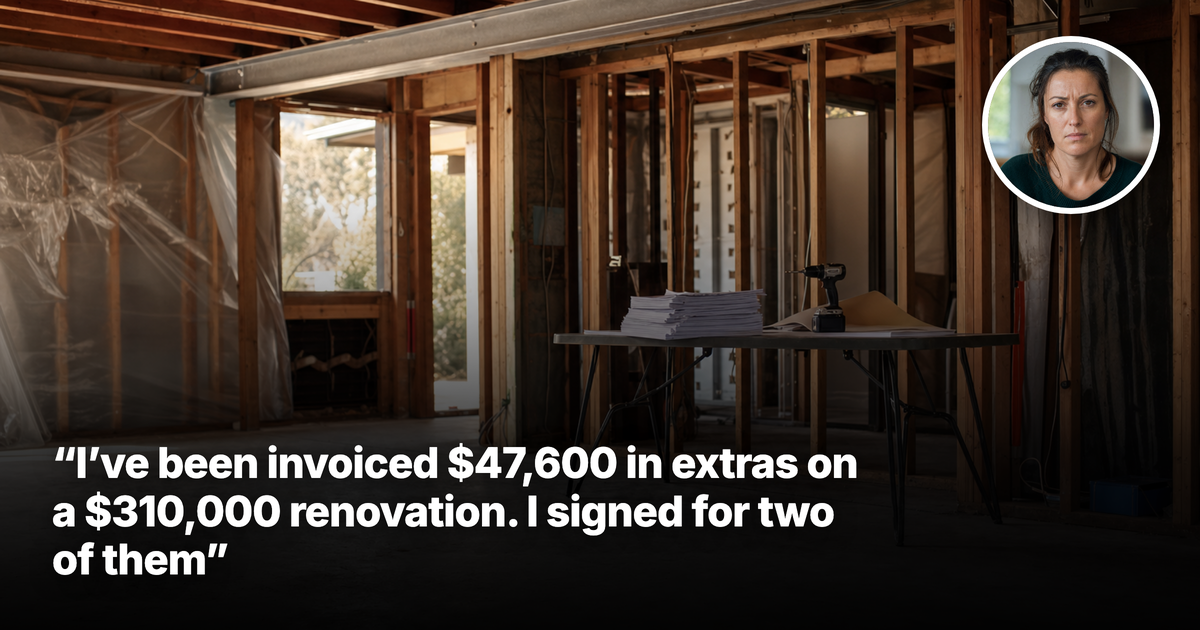
'I've been invoiced $47,600 in extras on a $310,000 renovation. I signed for two of them'
She bought out her brother's half share, signed a fixed-price renovation contract, then received nine invoices for extras totalling $47,600 — and had signed for only two. Whether a builder can recover on a variation turns on two conditions, not one, and almost nobody reads to the end of the sentence.
She is 42, and she is renovating the house she grew up in.
When her mother's estate was settled she bought out her brother's half share for $395,000 rather than sell, then signed a fixed-price contract at $310,000 to reconfigure the back of the house.
Five months in, the work is largely done. So are the extras.
Nine of them, over and above the contract price, totalling $47,600. The largest is $18,900 for a steel beam. Two came with a document she signed. The other seven arrived as line items on an account, described in a sentence, priced after the work was finished.
She is not disorganised. She kept every email, text and site note — which is exactly why she is angry in the contained way people get when they did everything properly and still ended up here.
The question she asked us is blunt:
"The work is done, it's in my house, and the invoices keep coming. I never signed for seven of them. Do I actually have to pay for something I never agreed to a price for?"
The answer most people get wrong
Almost everyone — owners and plenty of builders — believes the rule here is about paperwork. Get the variation signed and the builder gets paid. Miss the signature and it becomes a fight about fairness.
That is half the rule. Reading only that half is what costs people money.
Where a residential building contract is above a certain size, a builder who wants to change the plans or specifications must give the owner a notice first. It has to describe the change, say why, state what it will do to the job as a whole, say whether a permit needs varying, give a reasonable estimate of any delay, and state the cost and its effect on the contract price. Five things, before a tool is picked up.
The builder then must not give effect to the change unless the owner hands back a signed consent attached to a copy of that notice. One narrow exception: where a building surveyor or other authorised person formally requires the change, the requirement arose from circumstances beyond the builder's control, the builder attached a copy to the notice, and the owner does not dispute it in writing within five business days. Say nothing for five business days and you have consented.
So far, so procedural. Here is the part never read to the end.
The builder is not entitled to recover any money for the change unless the builder has complied with all of that and can establish that the change was made necessary by circumstances that could not reasonably have been foreseen at the time the contract was entered into.
Both. Joined by "and".
That second limb does something quite different from the first. It is not asking whether the builder filled in a form. It asks whether this was genuinely a surprise — or something a competent builder should have priced when they quoted. A rotten bearer found once the floor is up is one thing. A beam any set of drawings implied is another.
So perfect paperwork does not guarantee payment, and missing paperwork is not automatically fatal — a tribunal can still allow recovery where there are exceptional circumstances, or the builder would suffer significant or exceptional hardship, and it would not be unfair to the owner. That safety valve is real. It also has to be applied for and won, which is why the default is what most people live with. Where it is granted, the builder recovers the cost plus a reasonable profit — not merely break-even.
The asymmetry nobody mentions
Now compare the section immediately next door — the one that applies when the owner asks for the change.
Same subject, same consequence, one limb deleted.
Where the owner requested it, the builder need only have complied with the procedure. The "could not reasonably have been foreseen" test is simply absent. That is not sloppy drafting; it is a deliberate allocation. Whoever proposed the change wears the foreseeability risk.
There is a second asymmetry. If the builder reasonably believes an owner-requested change will not need a permit variation, will not cause delay, and will not add more than 2% to the original contract price, the builder may simply do it — no notice, no costing, no signature. On a $310,000 contract that is $6,200 of work chargeable on the strength of what the builder believed at the time.
Then the carve-out that swallows much of the protection: none of this applies to contract terms dealing with prime cost items or provisional sums. The two mechanisms under which renovation budgets most reliably blow out sit entirely outside the variation regime.
One more thing. A valid variation does not only move the price — it also moves the completion date. Owners who agree to a change to keep the job moving frequently agree to a later finish without registering it.
For her, seven invoices are not automatically payable — but not automatically void either. Each has to be tested separately, on both limbs. The steel beam is likely a different case from a tiling upgrade. She should be asking, in writing, for the notice and signed consent for each of the nine, then testing the rest against foreseeability. Some may stand up. That is a very different position from paying $47,600 because an invoice arrived.
What this has to do with buying well
None of this is really a story about a builder. It is about how much of a property's outcome is decided by things that never appear in a suburb report.
Two houses in one suburb share a median, a growth rate, a catchment and a council. They do not share a floor structure, a slab, a soil classification, a site fall, or the depth of the trade pool available to work on them. One renovates to budget. The next, on identical fundamentals, generates nine variations — because the unforeseen was always more likely there, and a suburb median has never once looked under a floor.
It is the same reason the effective-yield gap between the best and worst street in one suburb routinely runs 20–30% — measured on achieved rents rather than advertised ones, real vacancy duration rather than the quoted rate, and true days on market. The data is not poor. The unit of measurement is wrong.
What she has actually bought, at some expense, is the knowledge that a document is an asset — that the paperwork behind a building contract can decide outcomes years later, that winning an argument and collecting on it are different problems, and that protections you assume are automatic usually have conditions attached.
That is the reframe. Every rule above was published, free and readable on the day she signed. Risk you can read in advance is not a threat — it is a line item, a negotiating position, and an edge over every buyer bidding against you who never looked. The investors who compound quietly over decades rarely found a secret. They read to the end of the sentence.
She will finish the house, pay some of the nine and contest the rest.
What she will never do again is let work start on a number nobody wrote down.
If there's a specific street you're weighing up right now, check its Street Score first — it's free, takes ten seconds, and tells you whether that street is pulling the suburb average up or riding on it.
Frequently asked questions
If a builder sends extra invoices on a fixed-price renovation contract in Australia, do you automatically have to pay them?
No. The article says a builder’s right to recover variation costs depends on more than just sending an invoice — they must follow the notice and consent process, and also show the change was not reasonably foreseeable when the contract was signed.
What must a builder do before changing the work and charging extra on a residential building contract?
For a contract above the relevant size, the builder must give a notice describing the change, why it is needed, its impact on the job, whether a permit variation is needed, the likely delay, and the cost effect. The owner must then sign consent attached to that notice before the change is given effect, unless a narrow exception applies.
Can a builder still recover money for a variation if the paperwork was not signed properly?
Possibly, but only in limited cases. The article says a tribunal can sometimes allow recovery in exceptional circumstances or where the builder would suffer significant or exceptional hardship and it would not be unfair to the owner.
Why does the article say some renovation extras are more likely to be disputed than others?
Each extra has to be tested on its own facts. The article says something like a rotten bearer discovered after demolition may be different from a beam or upgrade that should have been allowed for in the original drawings and quote.
Do variation approvals also change the renovation completion date?
Yes. The article says a valid variation can move both the price and the completion date, and owners may agree to a later finish without realising it.
General information only. It does not take your objectives, financial situation or needs into account, and nothing here is legal, financial, taxation or investment advice specific to your circumstances.