News · 24 August 2026 · 5 min read
‘A court has ordered me to demolish it. I didn’t build it — it was already there when I bought the place’
He bought the house with the studio already in the back yard. Six years later a court order told him to demolish it — and the man who built it was never a party to anything. Here is how an order attaches to the land and binds whoever owns it next.
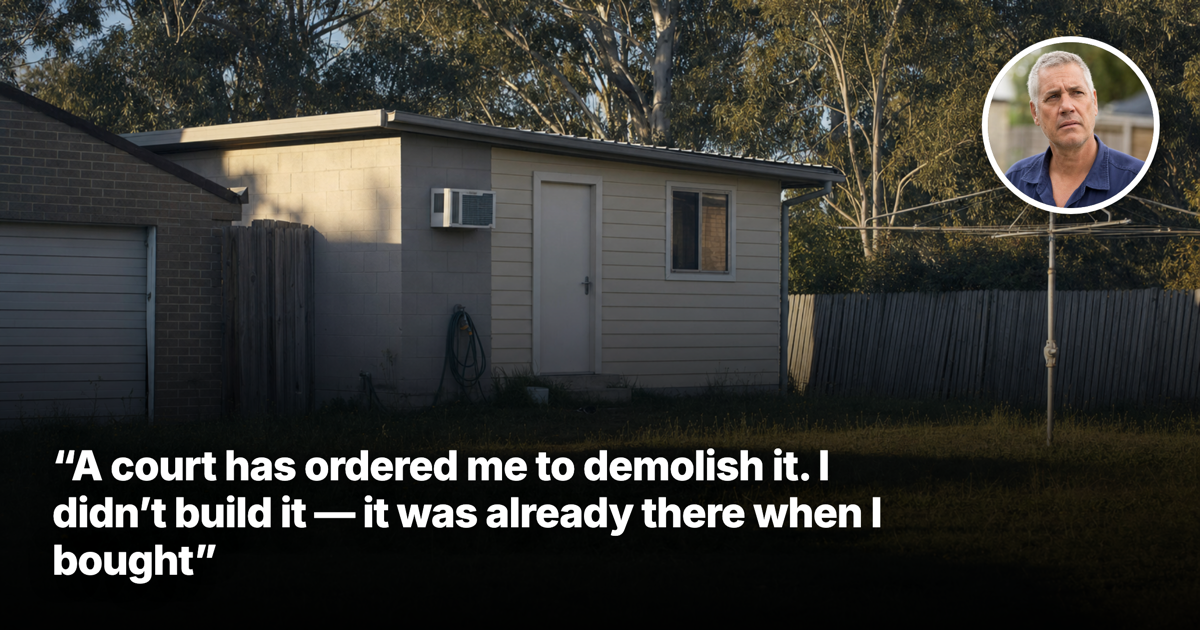
He bought the house with the studio already in the back yard. Six years later a court order told him to demolish it — and the man who built it was never a party to anything.
He is 58. He bought his second property in 2018, a solid brick house on a wide block, and the thing that sold him on it was the self-contained studio behind the garage. Kitchenette, bathroom, its own entrance. It appeared in the listing photos, in the contract, in the bank's valuation, and in the rent — $210 a week on top of the house, for six years.
Nobody ever told him it had no approval.
The building certificate he received at settlement covered the house. The pest and building inspection described the studio as in good condition, which it was. His conveyancer did the searches a conveyancer ordinarily does. Not one returned a document saying the structure in the back yard had never been assessed.
He found out when a neighbour, in dispute with him over a fence, started proceedings.
The question
"I didn't build it. I didn't know. I paid for it, I paid tax on the rent from it, and the bank lent against it. How can a court order me to knock down a building someone else put up before I ever owned the place — and how did that get past three professionals and a bank?"
The answer
Three separate mechanisms are working here. Each alone would be survivable; together they produced the order.
First: using the building is its own offence, committed by whoever is using it. The legislation does not only prohibit carrying out work without approval. It separately prohibits using premises unless the use is a lawful one. That second offence is not historical — it is something the current owner commits every day the studio is occupied, and it renews itself every morning. This is why the ordinary time limit — proceedings must start within a year of the offence, or within a year of it coming to the complainant's knowledge — offered him nothing. A continuing offence has no expiry to run out.
Second: the notice does not have to go to the person who did it. Where an enforcement authority believes a development offence has been committed and the offence involves premises, the notice may be given to the offender and, if the offender is not the owner, to the owner of the premises. The owner is not named because the owner is blamed. The owner is named because the owner is the person who can lawfully do something about the building.
Third, and almost nobody knows this: any person may start the proceedings. Not only the council. Any person may apply to the planning court for an enforcement order, and the court may make one if it considers a development offence has been committed. There is no requirement that the applicant be harmed, no standing test to fail. His neighbour did not need permission. His neighbour needed a filing fee.
And then the sting in the tail. Unless the court orders otherwise, an enforcement order attaches to the premises and binds the owner, the owner's successors in title, and any occupier. The person who obtains it must ask the titles registrar to record it. It sits there until somebody applies for a separate compliance order proving the work was done, and gives that to the registrar to have the record removed.
The order does not just fall on him. It falls on whoever buys the house next.
Why nobody caught it
This is the part that unsettles investors.
A title search returns interests registered on title. In 2018 there was nothing on title, because no order existed yet. A building and pest inspection reports on condition, not on approval status — a well-built unapproved studio inspects beautifully. A bank valuation prices what is standing there.
The document that would have caught it is a search of the council's records for the approvals held over the property, compared against what is physically on the block. That search is available and cheap. It is not part of a standard conveyance, nobody is obliged to order it, and no professional in his transaction was negligent for not doing so.
Nobody behaved badly here. The rules exist for a sound reason: if unapproved work were cured by selling, it would be cured constantly, and structures never assessed for fire separation, drainage, setbacks or structural adequacy would quietly become permanent. Councils are usually pragmatic — the first response is generally an invitation to apply for approval retrospectively, and a great many are approved. A demolition order is the far end of the scale. The problem is that once a private party brings the proceeding, the pragmatic path is no longer in the council's hands.
What this actually means for investors
This is the same lesson an unpaid land tax debt teaches when it follows the title rather than the person who ran it up, and the same shape as a repair order that attaches to the premises and transfers to the buyer, or a registered statement that binds successors to a levy they never agreed to. The obligation is attached to the dirt. You inherit it with the keys.
Here is where the street-level view earns its money.
Two houses in the same suburb share a median, a growth rate, a school catchment and a council. They do not share what has actually been built on them. One street of post-war homes with forty years of owner-built extensions, carports and studios carries a materially different risk profile to the newer street four hundred metres away where every structure went through a certifier. Same median. Same suburb report. Completely different asset.
We see this constantly in street-level data: the spread between the best and worst street in a single suburb routinely runs 20–30% on effective yield once you measure achieved rents rather than advertised, real vacancy duration rather than the quoted rate, and true days on market. A median has never once walked a back yard.
The studio was 18% of his rent and roughly $95,000 of what he thought he owned. Neither figure appeared anywhere in a suburb report.
The close
Every rule that caught him was published, free and readable on the day he signed. The continuing-use offence, the notice that may be given to an owner who did nothing, the open standing to bring the proceeding, and the order that runs with the land — all of it was there in ordinary English before his deposit cleared.
That is the reframe that matters. A threat happens to you. A risk you can read in advance is a line item — something you price, something you negotiate against, something you step past while the underbidder never looked. The investors who compound quietly over decades did not find a secret. They ordered one extra search.
He has lodged a retrospective application. He may well get it approved; most people do. What he will never do again is buy a property with a structure on it without asking, in writing, one question: show me the approval for that.
If there's a specific street you're weighing up right now, check its Street Score first — it's free, takes ten seconds, and tells you whether that street is pulling the suburb average up or riding on it.
Frequently asked questions
Why can a court order the current owner to demolish a studio they didn’t build?
Because the obligation can attach to the premises, not just the person who built it. The article says an enforcement order binds the owner and any successors in title, so the current owner inherits the problem with the property.
Does using an unapproved studio count as a separate offence in this situation?
Yes. The article says the legislation prohibits not only carrying out work without approval, but also using premises unlawfully, and that offence is committed by whoever is using the studio each day it is occupied.
Can someone other than the council start court proceedings about an unapproved building in Australia?
Yes. The article says any person may apply to the planning court for an enforcement order, and there is no requirement that the applicant be harmed first.
Why wouldn’t a title search, building inspection, or bank valuation have picked up the unapproved studio?
Those checks do not necessarily show whether a structure has council approval. The article says the search that would have caught it is a council records search comparing approvals with what is actually built on the block.
What is the practical next step if a buyer discovers a structure may not have approval?
The article says councils are often pragmatic and the first response is usually a retrospective approval application. The key lesson is to ask for the approval for the structure in writing before buying.
General information only. It does not take your objectives, financial situation or needs into account, and nothing here is legal, financial, taxation or investment advice specific to your circumstances.