News · 23 August 2026 · 6 min read
"They didn't buy the front 18 metres of my block. They just told me to hand it over"
She is 34 and co-owns a coastal block left to her by her grandmother. She spent $61,000 on a subdivision, then a letter told her to surrender a strip of the land to the State — with no price, no valuation and no appeal. Here is the rule she never knew applied.
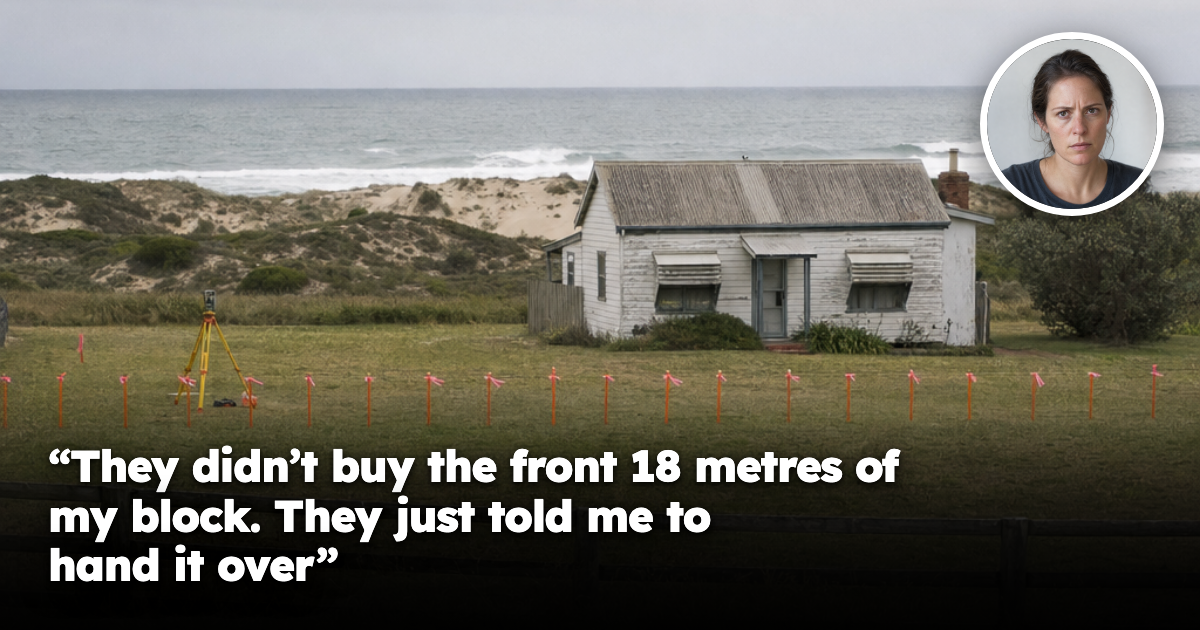
She had owned the block nineteen years and had never once been told part of it was spoken for.
She is 34, and she and her sister own it together — the last thing their grandmother left them, a wide coastal lot they rented out cheaply for two decades. This year they decided to split it in two and sell one half. Surveyor, town planner, drawings: $61,000 before a single application was lodged.
Eleven business days later, a letter arrived proposing that they surrender a strip along the front of the land to the State. Not sell it. Not lease it. Surrender it.
Her question was short, and she asked it twice:
"Nobody is buying this land. They're just taking it, and only because we asked to subdivide. How can that be how it works — and why did nothing we searched ever tell us?"
The short answer
Because the strip was never a secret. It was on a map she was entitled to look at, held somewhere she had no reason to go, and it was never going to matter until she asked the State for something. The exposure was created nineteen years earlier and sat inert — invisible in the contract, on the title, in the valuation and in the rent.
How a line ends up inside your boundary
Coastal land carries a second geography laid over the first. There is the boundary you bought, and there are administrative lines drawn by government — a district declared over a stretch of coast, and inside it a zone marked as at risk of erosion or tidal inundation. That zone must be shown on a document — the legislation's own example is a map or plan — kept available for public inspection.
So it is published, inspectable and free. What it is not is on your title. No dealing is registered against the land, a title search does not surface it, and nobody must tell a buyer it exists.
Worse: when the government moves that line, it must advise each affected owner. When it first draws the line, there is no equivalent duty — and when the property later sells, none to the buyer.
The same Act shows how deliberate that is. For a notice directing someone to fix or stop something, it requires the registrar of titles to be told, and to keep the record in a way that a search of the register will show the notice has been given. The Act knows how to make something searchable against land. It does that for the notice, and not for the map.
The trigger is your own application
The power only switches on when someone lodges an application to reconfigure a lot wholly or partly inside the declared district — where the land is also inside the at-risk zone, or within forty metres of the foreshore. A passive owner is untouched. Rent it, live in it, hold it forty years: nothing happens. Ask to subdivide, and the machinery starts.
The proposed surrender notice must go out within fifteen business days of the application being properly made. The owner then gets fifteen business days to make a written submission, which the decision-maker must consider alongside how the surrender would avoid or minimise detrimental impacts on coastal management.
Read that list for what is missing. The value of the land is not on it. Neither is the cost to the owner. There is no hardship limb.
If the answer is yes, and the Minister approves, a written requirement issues. It states the land and that it must be surrendered when the plan of subdivision is registered. It does not state a price, because there isn't one.
Seven words that aren't in the statute
We ran a mechanical check over the entire division that does this, searching for compensation, market value, payment, purchase, acquire, appeal and review. Seven searches. Seven results of zero.
That is no oversight, and the same Act proves it. A full compensation regime exists a few chapters later — market value before and after, a sixty-day decision, a right of appeal to a court. It is gated to a different trigger: it answers a prohibition on how you may use land. A surrender is not a prohibition on use — it is a transfer of title.
One thing points the other way. Every action taken under that division is expressly of no effect, and taken to have never been made or taken, if the application is refused or the approval lapses. Walk away from the subdivision and it was never made — which is why we told her she still had a decision to make, not a bill to pay.
Nobody misbehaved. The line was drawn under a lawful process, coastal erosion is a real physical problem, and retreating land is a poor place to add households.
What this means if you own anything near a coast
Two houses can sit in one suburb, share a median, a growth rate, a school catchment and a council, and be entirely different assets — because they do not share their development capacity.
One is a clean block where a subdivision is arithmetic. The next, on identical fundamentals, has an administrative line running eighteen metres inside its front boundary that costs its owner nothing until the day they try to unlock the value — and then costs them the strip, uncompensated, with no appeal. A suburb median has never once read a coastal map.
It is a familiar shape. We have covered a driveway that turned out to be a decision rather than a right, frontage improvements removed and sold to cover the cost of removing them, and a protection buffer measured from a building rather than a boundary. One lesson: the title tells you where your land stops, not what you may do with it.
It is why we measure at street level. Within one suburb, the effective-yield gap between the best street and the worst routinely runs 20–30% — achieved rents rather than asking rents, real vacancy duration, true days on market, genuine street-level supply. The data is not poor. The unit of measurement is wrong.
The part that should make you more confident, not less
Everything that cost her that strip was published, free and readable years before she needed it — the trigger, the fifteen-day windows, the absence of a price, the escape hatch. She lost nothing to a hidden rule. She lost time to an unread one.
That is the argument for doing property with data instead of hope. Risk you can read in advance is not a threat. It is a line item, a negotiating position, and an edge over every buyer bidding against you who never looked. The people who do badly in property are rarely the ones who took a risk — they are the ones who never found out which risk they had taken.
She and her sister have not withdrawn the application. They are running the numbers on a subdivision with the strip gone against the land held whole, and one answer will be better. The next block they buy, the coastal map gets pulled before the contract does.
If there's a specific street you're weighing up right now, check its Street Score first — it's free, takes ten seconds, and tells you whether that street is pulling the suburb average up or riding on it.
Frequently asked questions
Why can the State require part of a coastal block to be surrendered when the owner applies to subdivide?
Under the rule described in the article, the surrender power is triggered only when an owner lodges an application to reconfigure land in a declared coastal district and at-risk zone, or within 40 metres of the foreshore. If the Minister approves, the land must be surrendered when the subdivision is registered.
Does a title search show the coastal erosion or tidal inundation zone affecting the land?
No. The article says the coastal management line is shown on a map or plan kept for public inspection, but it is not on the title and does not appear in a title search. The owner was expected to look at that separate map.
Is there any compensation or appeal if the land must be surrendered?
Not under the division described in the article. The text says there is no price, no market value process, no hardship test, and no appeal or review for the surrender itself.
What notice and response time does an owner get after applying to subdivide coastal land?
The proposed surrender notice must be issued within 15 business days of a properly made application. The owner then has 15 business days to make a written submission, which the decision-maker must consider.
What is the main takeaway for someone buying or subdividing land near the coast in Australia?
A coastal block can look normal on title but still carry an administrative line that affects development capacity. The article’s key point is that the relevant risk sits in the coastal map, not the title, so it should be checked before buying or lodging a subdivision application.
General information only. It does not take your objectives, financial situation or needs into account, and nothing here is legal, financial, taxation or investment advice specific to your circumstances.