News · 22 August 2026 · 5 min read
"I inherited my father's house. Eight months later a stranger's ute was parked on the back paddock and I'd already agreed to it"
He inherited his father's house and four hectares of paddock. Eight months later a company was walking a survey grid on it - relying on a waiver his father signed four years earlier, which the law treats as if he had signed it himself.
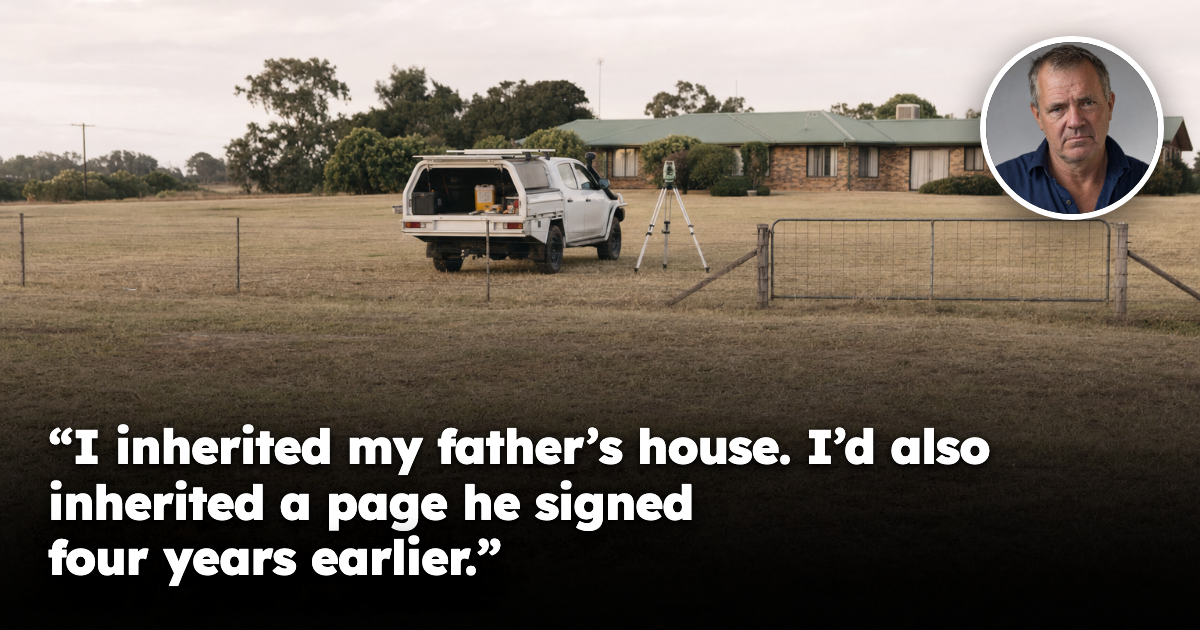
He is 58, and until last year had never owned a property in his life. Then his father died, and the house he grew up in — a low-set brick place at the edge of a country town, with four hectares of paddock behind it — became his. He rented it out rather than sell into a quiet market, and for eight months it was the easiest money he had ever earned.
Then a vehicle he did not recognise parked on the paddock. Two people in high-vis got out with a hand-held instrument and walked a grid. The agent rang back an hour later: the company had paperwork, it looked legitimate, and did he know there was a tenure over the land?
He did not. And what winded him was not that a company could walk onto his paddock. It was the single page in his father's records, signed four years earlier, waiving the requirement to be given notice before entry.
His question was blunt:
"I never signed anything. I never met these people. How can a document my late father signed mean I've agreed to something I didn't know existed?"
The short answer
Because a small number of these arrangements travel with the land rather than the person — and one travels by deeming the new owner to have signed it.
Most people assume the previous owner's private paperwork dies with the transaction. Usually that is right. Here it is not. Where a previous owner has given a waiver of the entry-notice requirement, the legislation provides that on a change of ownership each new owner is taken to have given that waiver. Not "may be bound by". Taken to have given it. The new owner is treated, in law, as the author of a document he has never read — a close cousin of the way a tribunal order about a tree binds whoever owns the land on settlement day, except an order is at least recorded. A waiver is a private page in a drawer.
There is one release valve, and he found it. The deeming stops applying if the holder becomes aware there is a new owner and fails to give that owner a copy within fifteen business days. His father had been dead eleven months; every record had changed names. That got him back to the table.
The part that decides which houses are affected
Here is where it stops being a story about paperwork and becomes a story about location.
The protection the law gives a homeowner against this kind of entry is a buffer — but it is not struck from the boundary of the lot. It is struck laterally from a building or an area, measured in metres. Land within two hundred metres of a permanent building used as a residence is protected — as is land within two hundred metres of a childcare centre, hospital, library, place of worship, community facility, business or school. A tighter fifty-metre ring applies to a bore, dam, principal stockyard or cemetery.
Read that again, because it is the whole ball game. The radius is drawn around the structure, not the title. Two houses on the same street, on identical lots, with identical zoning and an identical suburb median, can sit on opposite sides of that line purely because of where the dwellings were placed — and what happens to be standing next door. A block within two hundred metres of the school, or the shed the neighbour runs a business out of, picks up protection its twin does not have.
There is a second condition, less intuitive still. For a production-stage tenure, land is only protected if the use of that building or area started before the application for the tenure was made. The protection is date-stamped — not to your title, but to the day a third party lodged an application you were never party to. Build after that date and the ring never attaches.
That is a hard value factor. It decides whether a company can bring plant onto a paddock without your written consent — worth negotiating hard over, because conditions attached to consent become conditions of the tenure itself, and it cannot be withdrawn during its stated period. The leverage exists at signing, not afterwards. It belongs with the boundary that quietly moves without anyone redrawing your plan: a physical measurement doing legal work.
What he got
He was never going to stop the access, and we told him so on the first call. These tenures are granted by the State, they are lawful, and the company was doing nothing improper — it had a valid instrument and a waiver it was entitled to rely on until told otherwise.
What he had not used was a compensation entitlement. The holder is liable to compensate for deprivation of possession of the surface, for diminution of the land's value, for diminution of the use made or that may be made of the land or its improvements, for severance, and for cost, damage or loss — and to pay his reasonable negotiation costs, so advice cost him nothing.
He negotiated a conduct and compensation agreement: $34,000, access confined to one track, gates left as found, no entry during the six weeks his tenant agists horses. Those conditions now attach to the tenure. And because the agreement is recorded in the land register, the next buyer will find it — more than his father's waiver offered him.
What this means if you own property, or want to
The first: the seller's private agreements can be your problem. Conduct and compensation agreements, opt-out agreements and written access agreements bind successors and assigns — as do decisions of the court and of an arbitrator. A registered interest is only half the search; the other half is asking what the previous owner signed, much as a listing on a public register can sit outside your title entirely.
The second is why this business exists. A suburb median cannot tell you how far your dwelling sits from your rear boundary, whether a neighbour's bore sits fifty metres into your paddock, or what the seller signed. Those are parcel-level facts — the kind that produces the twenty to thirty per cent spread in effective yield we measure between the best and worst streets inside a single suburb, once you use achieved rents, real vacancy duration and true days-on-market.
A median has never once measured two hundred metres.
Every rule in his story was published, free and readable years before it touched him. The buffer distances, the date-stamp, the deeming provision, the escape hatch — none of it was an ambush. Risk you can read in advance is not risk. It is a line item, a negotiating position, and an edge over every buyer bidding against you who never looked.
He kept the house. He is looking at a second one two towns over — and the first thing he asked for was everything the current owner has ever signed.
If there's a specific street you're weighing up right now, check its Street Score first — it's free, takes ten seconds, and tells you whether that street is pulling the suburb average up or riding on it.
Frequently asked questions
Can a waiver or access agreement signed by a previous owner still apply after I inherit or buy a property in Australia?
Yes. The article says some arrangements travel with the land, and in this case the law treats the new owner as having given the waiver themselves. That means a previous owner’s signed waiver can still affect you after a change of ownership.
What makes a property protected from this kind of entry or tenure in the article?
Protection depends on distance from certain structures, not just the lot boundary. Land within 200 metres of a permanent residence, school, hospital, library, place of worship, community facility or business is protected, and a 50-metre buffer applies to a bore, dam, principal stockyard or cemetery.
Why did the inherited property in the story still allow company access even though the new owner never signed anything?
Because the father had signed a waiver four years earlier, and the legislation deemed each new owner to have given that waiver too. The company was able to rely on that paperwork until the owner raised the issue.
What compensation can a landowner seek if a lawful tenure affects their land in this situation?
The article says compensation can cover deprivation of possession, diminished land value, reduced use of the land or improvements, severance, and any cost, damage or loss. It also says reasonable negotiation costs are payable.
What should a buyer or heir check before settling or renting out a rural property like this?
They should look beyond the title and ask what the previous owner signed, including conduct and compensation agreements, opt-out agreements and written access agreements. The article says these can bind successors and assigns and may be recorded in the land register.
General information only. It does not take your objectives, financial situation or needs into account, and nothing here is legal, financial, taxation or investment advice specific to your circumstances.