News · 22 August 2026 · 6 min read
'They removed the sign and the wall from the front of my property — then sent me a bill for $18,400 and sold the rest'
She paid for the wall, the sign and the landscaping in 2004 and maintained them for twenty-two years. A crew removed them, an invoice for $18,400 followed, and the sign was sold to help pay for its own removal.
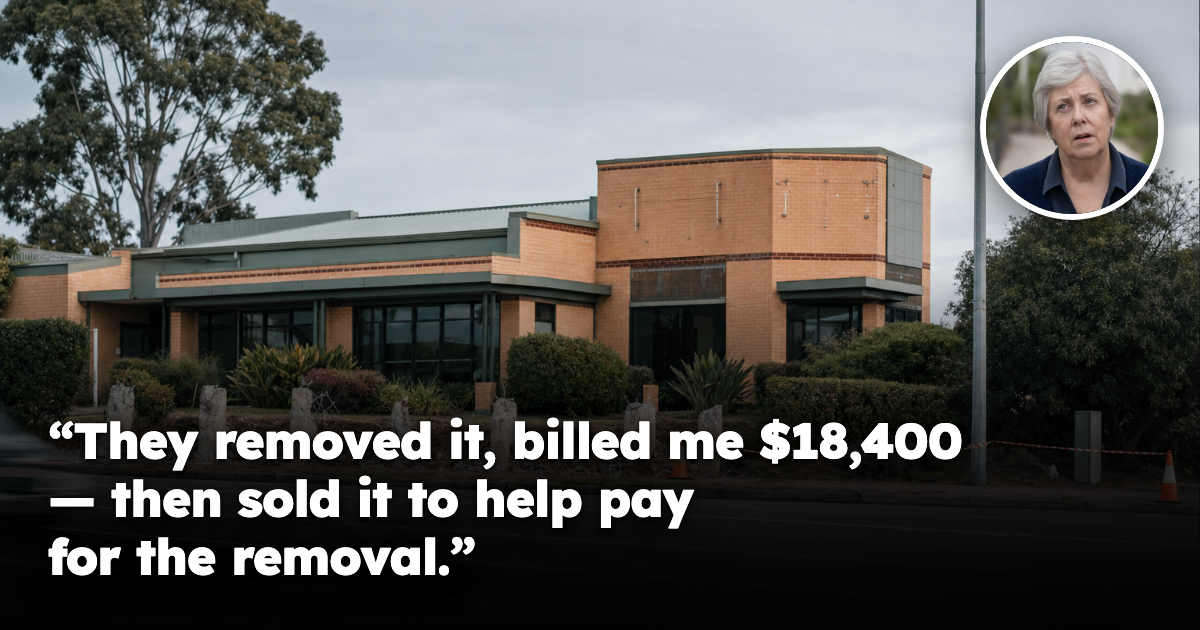
She is 69, self-funded, and has owned the same corner holding since 1998. One property, bought with her late husband when the road out the front was two lanes, and now the only thing between her and the aged pension.
Around 2004 they built the front up properly. A low rendered wall with the street number in it. A pylon sign at the corner so tenants could be found. Bollards, three lights, a strip of planting. All quoted, engineered and paid for, and in every valuation and lease she has signed since.
In March a letter arrived. In June a crew arrived with a truck. By day's end the sign, the wall, two lights and the bollards were gone. Nine weeks later came an invoice for $18,400 — then a second letter saying the sign had been sold and the money applied to the cost of taking it away.
Her question, in her words: "I paid for it, I maintained it for twenty-two years, and it was on the front of my own property. How can they take it, bill me for taking it, and then sell it?"
The answer nobody gives her until it has already happened
The wall was not on her property.
Not in the sense she means. Her title stops at the boundary. Everything beyond that line — even by a hundred millimetres, even where she has mown the grass for two decades — is on the road. And on a road, the law does not use the word "yours."
It uses a defined term, so wide it barely reads as a definition: a structure or other thing, on, over or under the road, plus any activity conducted there. The statutory examples run from a bridge and a tunnel down to an A-frame board. When one definition holds both the largest and smallest object a person could put on a roadway, it has stopped describing a category. It is describing a line.
Past that line sits an inversion most owners never encounter. The road authority may build, maintain and operate things there. Any other person must not — unless approved in writing, conforming to a published general permission, covered by a written arrangement, or permitted under another Act or a local law. Not "should seek approval." Must not.
And here is the sentence that catches long-term owners. The prohibited conduct is not merely constructing. It is constructing, maintaining, operating or conducting. Maintaining is its own offence; there is no grandfather clause. Rewiring a sign you inherited sits inside the same words as building it yesterday — like a repair order that attaches to the premises rather than the tenancy, the obligation came with the address.
Then it gets more expensive
Where a structure is there contrary to that rule, the authority may have it altered, relocated, made safe or removed — and the person is liable to pay the cost. No compensation limb, and no notice period stated in the provision.
If removed, the thing may be sold or destroyed. If sold, the money runs a fixed waterfall: removal and sale expenses first; then anything owing under a registered security interest over it; and only then the balance to the owner — or, if the owner cannot be found, into consolidated revenue. The same shape as a small rates debt turning into a sale of the whole parcel: the process is paid for out of the asset before the owner is reached.
Read plainly: her sign was sold, and the proceeds paid for its own removal before she saw a cent.
The part that should stop every investor
She could understand it if the answer were you never had approval. Many owners did have it. It helps less than they assume.
Where works were built under an approval, the authority may still direct they be altered, relocated, made safe or removed if it is of the opinion that they — by themselves or with other factors — are creating or may in the future create a traffic hazard, are reducing or may in the future reduce safety, or have become or may in the future become an obstacle to road works.
Future-conditional limbs, resting on an opinion. Nothing in that test can be failed today, and nothing in it can be passed permanently. "With other factors" means the trigger need not be your structure at all — it can be the traffic that grew up around it.
And the money limb for lawfully approved works? The authority may enter into an agreement with the owner for making a contribution towards the cost. Not must pay. Not compensation. Not market value. A discretionary agreement to contribute towards a bill the owner otherwise carries in full.
There is a review path — these are reviewable decisions, and she is using it. But review of a discretion is a very different asset from a right to be paid.
What this actually is: a street-level value factor
Here is the part that matters to anyone buying.
Two properties in one suburb share a median, a growth rate, a catchment and a council. They do not share their frontage. One sits on a local street where the verge is council land under a permissive local law. The next, on identical fundamentals, fronts a State-controlled corridor where every object past the title boundary is a defined encroachment, removable on an opinion, at the owner's cost — the same corridor where access itself turned out to be a decision rather than a right.
That never appears in a suburb report. It shows up in the things that pay you: whether a tenant can find you from the road, whether signage survives a lease renewal, what a valuer does with $60,000 of frontage improvements on land the owner does not own, and how fast the place re-lets once the sign is gone. Across one suburb, the effective-yield spread between best and worst street routinely runs 20 to 30 per cent once you measure achieved rents, real vacancy duration and true days on market. A median has never once read a road declaration.
The data is not poor. The unit of measurement is wrong.
The close
Nobody in this story misbehaved. The crew did the work it was sent to do. The rule exists because roads are held for everyone, and objects at the edge of a traffic corridor are a genuine safety problem, not an invented one. Every officer applied the law exactly as written.
And every word of it was published, free and readable years before it mattered to her — the definition, the permission inversion, the word maintain, the cost limb, the sale waterfall, the contribution clause. None of it happened by ambush.
That is the argument for buying on real information rather than headlines. A threat happens to you. A risk you can read is a line item — something you price, negotiate, or walk past while the underbidder who never looked pays full retail.
She will get some of it back. What she is really learning is that she owned the building, the land and the lease — and not the twelve metres of frontage that made all three work.
If there's a specific street you're weighing up right now, check its Street Score first — it's free, takes ten seconds, and tells you whether that street is pulling the suburb average up or riding on it.
Frequently asked questions
Why could the road authority remove the wall and sign even though they were in front of her property?
Because the title stops at the boundary, and the structures were on the road side of that line. Under the law described in the article, things on, over or under the road are not treated as the owner’s property in the usual sense.
Can a property owner in Australia be charged for removing frontage structures they built and maintained for years?
Yes, if the structure is contrary to the rule described in the article, the authority can have it altered, relocated, made safe or removed, and the owner is liable for the cost. The article says there is no compensation provision in that rule.
What happens if the removed sign or structure is sold after being taken away?
The sale proceeds are used first to cover removal and sale expenses, then any registered security interest over the item. Only the balance, if any, goes to the owner; if the owner cannot be found, it goes into consolidated revenue.
If a frontage sign or wall was approved years ago, can it still be ordered removed later?
Yes. The article says that even works built under an approval can still be directed to be altered, relocated, made safe or removed if the authority believes they are or may become a traffic hazard, reduce safety, or obstruct road works.
What is the main lesson for someone buying or valuing a property with roadside improvements?
Frontage improvements may add value, but they can also sit on land the owner does not control. The article’s key warning is to check the road boundary and the legal status of anything near the frontage, because that risk can affect signage, leasing, vacancy and value.
General information only. It does not take your objectives, financial situation or needs into account, and nothing here is legal, financial, taxation or investment advice specific to your circumstances.