News · 23 August 2026 · 5 min read
'I lived in that house for eleven years and cared for Mum in it. The letter said I had 30 days'
She cared for her mother in that home for eleven years. When her mother died, the reverse mortgage had to be repaid — and she discovered the law had only ever required that somebody else be told she had no right to stay.
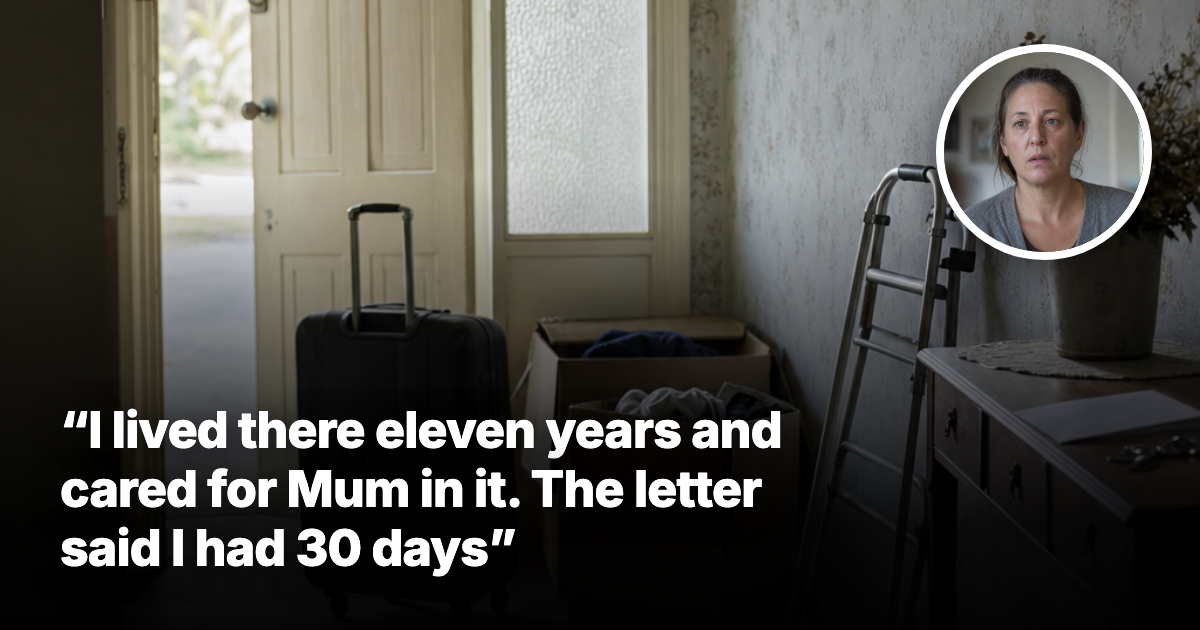
She is 49. For eleven years she lived in her mother's home — the last six as her mother's full-time carer, sleeping in the room she grew up in, doing the nights, the appointments, the long slow years nobody sees.
Her mother had taken out a reverse mortgage. The house was paid off, the pension didn't stretch, and the money came without repayments. Over nine years the balance grew to $318,000.
Her mother died in March. In May a letter arrived, addressed to the estate: the loan had to be repaid, the only way to repay it was to sell, and she had 30 days to make arrangements to vacate.
She had never signed anything, never borrowed anything. She had spent $27,000 of her own money on a bathroom rail, a ramp, a hot water system and the rates in the bad quarters. She was not a tenant, not a borrower, not on the title.
Her question, when she put it to us, was very short:
'I lived in that house for eleven years and cared for Mum in it. Nobody ever told me I had no right to be there. How is that possible?'
The answer nobody explains at the kitchen table
Here is the part that surprises almost everyone. The law governing reverse mortgages does contemplate exactly her situation. It contains a specific concept — a tenancy protection provision — meaning a term giving a person other than the borrower a right, enforceable against the lender, to occupy the property.
Where a contract does include that protection, the rules are genuinely strong. The borrower can nominate a person to be allowed to live there at any time, before or after signing. Once nominated, that person has the same right to occupy the property as the borrower would have had — and that right survives the borrower's death or permanent departure. The lender must keep a formal record of every nomination, and a later attempt to strip the protection out, or narrow who can be nominated, is void.
That is a real and serious protection, not a technicality. The problem is the sentence in front of it.
The mandatory terms only apply if the contract is to make provision for someone other than the borrower to occupy. The protective machinery switches on only after the lender has already chosen to offer it. Nothing compels a reverse mortgage to include it.
So what does the law require when a contract leaves a co-occupier with no right to stay?
It requires that the borrower be told, in writing, that the contract does not include a tenancy protection provision. That's it. It is an offence not to give that notice — strict liability, no excuses — but the remedy for the absence of the right is a disclosure that the right is absent. And the notice goes to the borrower, not to the person living in the house.
Her mother received that notice, correctly given, nine years earlier. She was 78, signing a stack of documents, and the daughter had not yet moved in.
Why the other protections didn't reach her
People assume the safety nets caught her. Several exist, and they are better than their reputation. A reverse mortgage cannot be enforced simply because someone else is living in the property, because the borrower didn't disclose them, or because the borrower left the home empty while it was still their main residence. Those default triggers are prohibited outright.
There is also a no-shortfall rule with teeth. Where the debt has grown beyond the property's adjusted market value and the lender receives that value, the borrower's obligations and the mortgage are discharged by force of the legislation, not by the lender's grace. Any excess must be paid back, and the lender cannot demand or accept another cent.
Every one of those protections is aimed at the debt. None of them is aimed at the door. It echoes the borrower who discovered how far one line in a mortgage can stretch the security she thought she'd given. Her mother's estate was protected from a shortfall. She was not protected from removal, because she had never been made a person the lender owed anything to.
Nobody misbehaved. The lender followed the contract, the notice was given, and the product did what it was designed to do — for many older Australians it converts a house into an income without forcing a sale during their lifetime. The gap isn't fraud. It's that the most consequential term in the document was an option, and the option was not taken.
What this has to do with buying well
It sounds like a family story rather than a property one. It isn't. Two houses in the same suburb share a median, a growth rate, a catchment and a council. They do not share their ownership history — who owns them, how they are financed, how old the owners are, and therefore how likely they are to come to market under pressure rather than by choice.
It is the same reason a buyer can inherit a debt that was never theirs, riding on the title itself. That is not sentiment. It is supply. A street of long-held, ageing, equity-rich ownership behaves differently to a street of recent mortgages: different turnover, different days on market, different vendor motivation, different negotiating room. It is why one suburb median can sit over two streets whose achieved outcomes diverge by 20–30% on effective yield once you measure achieved rents rather than asking rents, true days on market rather than the quoted figure, and genuine street-level supply rather than a postcode average.
A suburb median has never once read a loan contract. The data isn't poor — the unit of measurement is wrong.
The part that should make you optimistic
Everything that happened to her was published, free, and readable years before it mattered — the conditional opener, the nomination mechanism, the void-change rule, the disclosure duty, all of it available to anybody who thought to look.
We have written before about a record held by a third party that quietly decided where somebody could live. The pattern is identical, and so is the fix.
That is the whole distinction worth holding onto. A threat happens to you. A risk you can read in advance is a line item — something you price, negotiate around, or step past while the person bidding against you never looked.
Property rewards the people who read the boring parts. The families who ask, in writing, who is allowed to live here if something happens to the borrower are not being difficult — they're doing the highest-value five minutes of work in the entire transaction.
She has moved in with her brother while the house is sold. She is not bitter about the lender, and has not spent a day regretting the eleven years.
What she says now is simpler: nobody ever told her a document existed that would decide where she lived — and the question she needed to ask had only ever been six words long.
If there's a specific street you're weighing up right now, check its Street Score first — it's free, takes ten seconds, and tells you whether that street is pulling the suburb average up or riding on it.
Frequently asked questions
In an Australian reverse mortgage, can someone who lives in the home stay there after the borrower dies?
Only if the reverse mortgage contract includes a tenancy protection provision for that person. If it does, the nominated person can keep occupying the property even after the borrower dies or permanently leaves.
What happens if a reverse mortgage does not include tenancy protection for a family member living in the house?
The law only requires that the borrower be told in writing that the contract does not include that protection. It does not create a right for the other occupant to stay, and the notice is given to the borrower, not the person living there.
Can a lender force someone out of a home just because the borrower has died and the reverse mortgage needs to be repaid?
Yes, if the person living there has no contractual right to occupy the property. The protections in the article mainly deal with the debt and repayment, not a separate right for a co-occupier to remain.
What protections does a reverse mortgage give the borrower or estate if the debt grows beyond the home's value?
If the lender receives the property’s adjusted market value and the debt is higher than that, the borrower’s obligations and the mortgage are discharged by law. The lender cannot demand more than that amount.
What is the main lesson for families considering a reverse mortgage in Australia?
They should ask, in writing, who is allowed to live in the home if something happens to the borrower. The article says this is one of the most important questions because the right to stay may depend on whether the contract includes tenancy protection.
General information only. It does not take your objectives, financial situation or needs into account, and nothing here is legal, financial, taxation or investment advice specific to your circumstances.