News · 23 August 2026 · 6 min read
"I bought a finished house. Eleven months later the council sent me a $58,700 bill for a road I never asked for"
He bought a completed, certified, tenanted house. Eleven months after settlement the council sent him a $58,700 infrastructure charges bill for a development approval issued years before he had heard of the street — and the appeal right on the notice could not hear a word of his actual complaint.
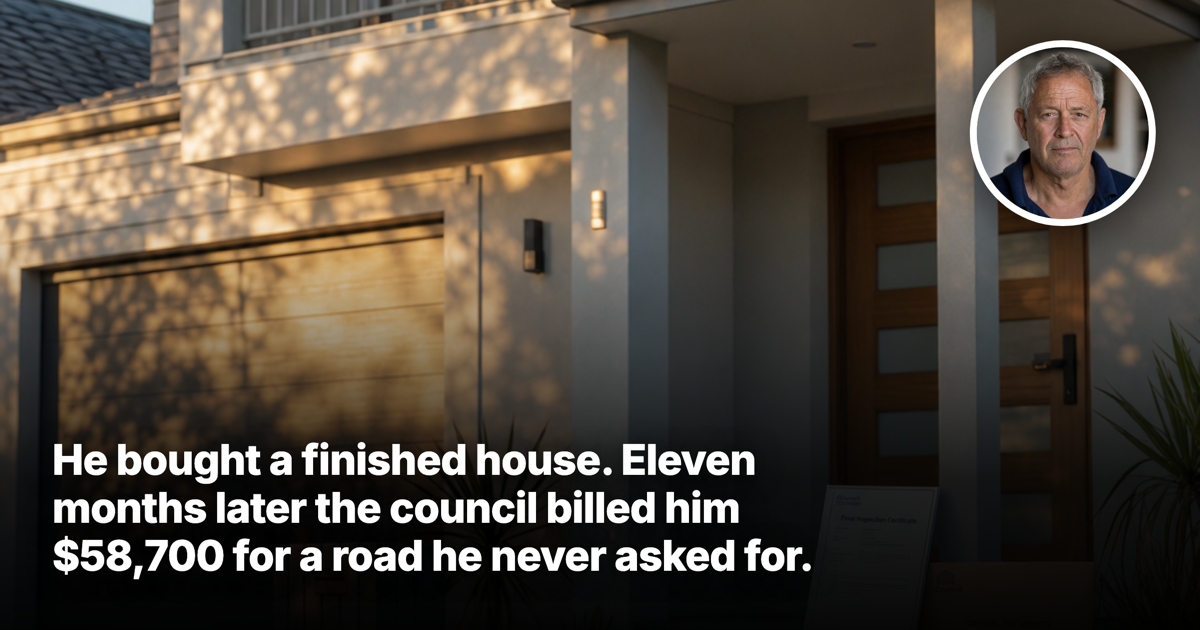
He is 63. He sold the family home after his kids moved interstate and did the sensible thing with the proceeds — bought one good property near a hospital and a train line, and rented it out. A near-new house on a new lot, completed, certified and tenanted within a fortnight.
Eleven months after settlement, an envelope arrived from the council. Not a rates notice. A demand for $58,700 in infrastructure charges — trunk roadworks, water, sewer and parkland — relating to a development approval issued three years before he had ever heard of the street.
"I didn't build it," he told us. "I didn't apply for anything, I didn't sign a condition, and I wasn't the person the notice was addressed to. How can a bill written to somebody else, for work finished before I got there, end up being mine?"
We get asked a version of this often. The answer is not that a mistake was made. It is that most buyers search for the wrong thing, in the wrong place, at the wrong time.
The two anchors in one sentence
When a development approval is granted, a council can issue a charges notice for the extra demand that development will place on trunk infrastructure — the arterial roads, mains and parks serving a whole area rather than one lot.
What is not understood is how the charge is secured. The legislation says it is payable by the applicant — and, in the very next line, that it attaches to the premises.
Two anchors, one sentence. The obligation is written against a person; the security against the dirt. When the person sells the dirt, only one of those anchors moves.
If that shape sounds familiar, it should. It is the structure behind an unpaid land tax bill that follows the title rather than the owner, and behind a registered management statement binding every successor in title.
The trigger that fires long after the notice
The second half of the problem is timing. A charges notice is given when the approval is granted, but does not become payable then. It becomes payable at a defined triggering event — when the plan of subdivision is approved, when the final inspection certificate or certificate of occupancy is given, or when a material change of use happens.
That gap can run for years. A notice can sit, valid and unpaid, through a subdivision, a build, a sale, a settlement and a tenancy — and then trigger.
Nor does it sit still. A council's charges resolution may include an automatic increase provision: a clause providing for increases in the levied charge from when it is levied to when it is paid. There is a statutory ceiling. But the effect is a debt growing quietly between the day it was imposed and the day someone is finally asked for it.
"There's an appeal right" — read the grounds
The notice told him he could appeal. He assumed that meant he could explain his situation to somebody.
He could not. An appeal against a charges notice may be brought only on a closed list of grounds: an error in applying the adopted charge, in working out extra demand, or in an offset or refund; that there was no decision about an offset or refund; that the timing of a stated refund is wrong; or — in the court, not the tribunal — that the amount is so unreasonable that no reasonable local government could have imposed it.
Read that list for what is missing. There is no ground of "I wasn't the applicant." No ground of "the road was already built." No ground of "nobody disclosed this to me." No ground of hardship. Those objections are not rejected as weak — they are not on the list.
This is the key point about statutory appeal rights: a right of appeal is not a right to be heard about your actual complaint. Here it is a right to have the arithmetic checked — and there is one shot at the informal route, because the council may give only one negotiated notice.
The part that is genuinely fair
None of this is a scandal. Trunk infrastructure is real and expensive, and somebody has to fund it. A charge that followed only the person would be avoided by simply selling — leaving every cost with ratepayers who never touched the development.
The legislation is also more generous than its reputation. Where a condition requires a developer to build trunk infrastructure serving other land too, the cost must be offset against the charge — and if the cost exceeds the charge, nothing is payable and the council must refund the difference. A landowner can apply to convert non-trunk infrastructure to trunk, and a refusal is separately appealable. Charges are capped, and the amount can be paid by instalments.
The notice must even state whether an offset or refund applies — with a quiet sting: that requirement falls away if the recipient has advised in writing that it need not be included. A person can sign away the only line telling them money might be owed to them.
What actually cost him the money
Nobody misled him. The council applied the law as written. The charge was lawful, the notice valid, the amount almost certainly correct.
What cost him $58,700 was that he searched the title and stopped. Titles record easements, covenants and mortgages. They do not record an unpaid charge sitting behind an old development approval, waiting for a certificate of occupancy. It is the same blind spot that catches owners when a council changes one line of a planning code: the event that moves the money is never the event you are watching.
This is where suburb-level research fails people. Two houses four hundred metres apart share a postcode, council, school catchment, median price and five-year growth rate — every number in a standard suburb report identical. What they do not share is their approval history: what was approved over that lot, what conditions attached, what was levied, what was triggered and what is still unpaid.
A suburb median has never once read a charges notice. Street-level work exists because the gap between the best and worst street in one suburb routinely runs to 20–30% in effective yield — achieved rents rather than asking rents, true days on market, real vacancy duration — and holding costs belong in that column. An unresolved statutory charge drags a property to the wrong end of that range.
The reframe
Every provision that caught him was published, free and in force while he was arranging his building and pest inspection. The fix is one more line on the pre-purchase list, in writing, before the offer: has any infrastructure charges notice been given over this land, has it been triggered, has it been paid, and does it index?
That costs nothing and takes a conveyancer one enquiry. It is also the question almost nobody at the open home is asking — which is exactly why it is worth asking.
Risk you cannot see is a threat. Risk you can read in advance is a line item — and a priced line item is an edge over every other buyer on that lawn.
He did not lose $58,700 to a dishonest vendor, a careless council or an unfair law. He lost it to a search nobody told him to run.
If there's a specific street you're weighing up right now, check its Street Score first — it's free, takes ten seconds, and tells you whether that street is pulling the suburb average up or riding on it.
Frequently asked questions
Why can a council infrastructure charges bill arrive after I’ve already bought a finished house in Australia?
Because the charge can be given when development approval is issued, but it only becomes payable when a later trigger happens, such as a certificate of occupancy, final inspection certificate or plan of subdivision approval. That means the debt can sit unpaid through a sale and settle after you take ownership.
If the notice was addressed to the original developer, can the charge still follow the property to a new owner?
Yes. The article says the legislation makes the applicant liable, but the charge also attaches to the premises, so the obligation can remain with the land even after it changes hands.
Can I appeal a Queensland infrastructure charges notice just because I wasn’t the applicant or didn’t know about the bill?
No. The article says the appeal grounds are limited to specific errors, such as how the charge was calculated or whether an offset or refund was handled correctly. Hardship, lack of disclosure and not being the applicant are not listed grounds.
What should I ask before buying a house or lot to avoid this kind of hidden charge?
The article says to ask whether any infrastructure charges notice has been given over the land, whether it has been triggered, whether it has been paid, and whether it indexes. It also says this should be checked before you make an offer.
Are there any offsets, refunds or payment options if infrastructure charges apply?
Yes. The article says costs for trunk infrastructure can be offset against the charge, and if the cost is higher, nothing is payable and the council must refund the difference. It also says charges are capped and may be paid by instalments.
General information only. It does not take your objectives, financial situation or needs into account, and nothing here is legal, financial, taxation or investment advice specific to your circumstances.