News · 19 August 2026 · 6 min read
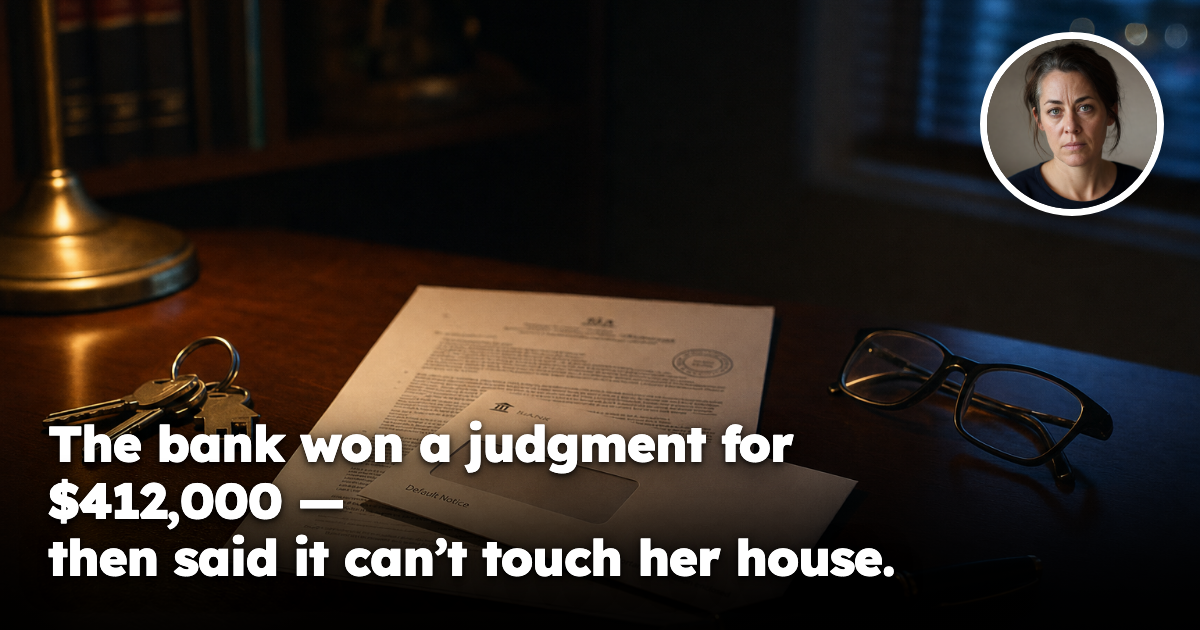
"The bank won a court judgment against me for $412,000. Then its lawyer told me it can’t touch my house"
A radiographer missed one $2,180 instalment and watched a $412,000 loan balance fall due. Then she learned the judgment against her legally cannot be enforced against the very property it is secured on — and why her solicitor found that far more worrying than reassuring.
We get asked about mortgage default constantly. Almost always the question is how do I stop them taking the property. This one arrived the other way around.
A 44-year-old radiographer bought an investment unit in 2019. Standard loan, standard terms. She had never missed a payment in her life.
Then her hours were cut, a tenant left early, and one instalment of $2,180 went unpaid.
She caught it eleven days later and paid. By then the whole balance — $412,000 — had been called up.
Six weeks later a solicitor told her the lender had a judgment for the full amount — and in the same breath, that it could not be enforced against the unit it was secured against.
Her question: "If they can't take the property, what did they just win — and why does my solicitor look more worried, not less?"
The provision almost nobody has read
There is a rule most borrowers, and many investors, have never encountered. Where a court gives judgment for payment of a debt secured by a mortgage, the borrower's interest in that property may not be taken in execution of the judgment.
The reach is wider than it appears. Not only the mortgaged property — it extends to any other property the borrower has mortgaged to that same lender. Pledge two properties to one bank, and a judgment cannot be executed against either.
It applies despite any agreement to the contrary. No clause, no signature, no fine print removes it.
So the lender won a judgment that is legally sterile against the only assets that could satisfy it.
Why that is not the good news it sounds like
The part that made her solicitor uneasy is one quiet carve-out: the bar on execution does not limit the lender's power of sale.
That power lives elsewhere — an implied power of every mortgagee to sell on terms it considers appropriate, with its own notice and timetable, untouched by the rule that just blocked the judgment.
So a lender has two routes. Sue you personally and obtain a judgment, which is then walled off from the security. Or simply sell the property — no court, no hearing, nobody testing anything.
The rule that looks like a shield is really a signpost. It tells you which door the lender will use — and it was never going to be the courtroom. We've written about what happens once that second door opens, including the duties a lender carries when it sells a mortgaged property.
The clock she never knew was running
The painful part is not the judgment. It is the six weeks before it.
There is a right — also unable to be contracted away — that fits her situation exactly. Where a borrower defaults on an instalment, and the loan terms make the whole balance immediately payable because of it, she cannot be required to pay that accelerated balance if she pays the missed instalment plus the lender's reasonable expenses caused by the default.
$2,180 plus costs. That is all it would have taken to un-accelerate $412,000. She had the money.
But the right has a deadline, and it is not a date. It expires when the lender exercises a power of sale, or starts a proceeding to enforce. Not thirty days. Not sixty. The moment the other side acts.
Before that moment, curing the default was something she could simply do. After it, the same relief becomes an application to a court, which may grant it if appropriate — weighing the conduct of the parties and anything else relevant. It stops being a right and becomes a request.
She paid on day eleven. The proceeding had been filed on day nine.
What the letter did and didn't tell her
She received a default notice, and it was compliant. Before a lender can sell, it must give notice stating the nature of the default and requiring it be remedied within 30 days — a requirement standing despite any agreement to the contrary. Real protection, genuinely unwaivable.
But that 30-day clock and the cure-right clock are two different clocks, and only one is printed on the letter. The visible one counts down toward a sale. The invisible one closes the instant a proceeding is filed — which can happen well inside the thirty days.
None of this makes the lender a villain. It advanced real money and was entitled to be repaid, and most arrears are cured quietly and never come near any of this. The rules are not a trap — just published somewhere she never thought to look, in language written for the party that reads it professionally.
The part that is actually about your asset
This is not really a story about a legal technicality. It is a story about which property you owned when the trouble arrived.
Every enforcement path above ends in the same question: what does the asset do under pressure? A property that re-lets in nine days at the rent you modelled absorbs a cut in hours. One that sits vacant eleven weeks and re-lets $60 under budget turns a wobble into a default.
That is not a suburb trait. It is a street trait.
Two properties, same postcode, same median, same school catchment, same headline yield. One sits on a street where tenants renew without negotiating and vacancies close in under a fortnight. The other is four hundred metres away, where turnover is the operating condition and every re-let costs three weeks and a rent reduction. The median averages them and reports one number describing neither.
This is why we built our research engine around street- and suburb-level data rather than medians — achieved rents, real vacancy duration, true days-on-market, supply and demand measured street by street. Across one suburb, the effective-yield spread between best and worst streets routinely runs 20–30% — the margin between an asset that carries you through a bad quarter and one that hands you a default notice.
A suburb median has never once made a mortgage payment.
The same principle runs through what happens when the debt belongs to a public authority, and how a deadline converts silence into a legal admission.
The reframe
The execution bar, the 30-day notice, the cure right, the discretionary relief, the point at which one becomes the other — all of it is published and readable long before it is urgent. None of it is hidden. It simply isn't taught, and isn't printed on the letter.
That is why property remains such a strong asset for people who do the work. Risk you can read in advance is risk you can price, and priced risk isn't a threat — it's an advantage over every buyer who never looked. The right asset, on the right street, backed by data deeper than a median, turns a rough quarter into just that instead of a court file.
She never lost the unit. The default was cured, the relief granted, and she still owns it.
But she spent six weeks believing the worst news was a judgment for $412,000 — when it had happened on day nine, in an office she'd never visited, in a document she never saw.
If there's a specific street you're weighing up right now, check its Street Score first — it's free, takes ten seconds, and tells you whether that street is pulling the suburb average up or riding on it.
Frequently asked questions
If a lender gets a court judgment for a mortgage debt in Australia, can it take the property that secures the loan?
Not under the rule described in the article. If the debt is secured by a mortgage, the borrower’s interest in that property may not be taken in execution of the judgment, and the same applies to other property mortgaged to that lender.
What can a bank still do if it can’t enforce the judgment against the mortgaged property?
The lender’s power of sale is not limited by that rule. It can still sell the property under the mortgage, using its own notice and timetable, without needing to rely on the court judgment.
Can a borrower stop an accelerated mortgage debt by paying the missed instalment late?
Yes, but only before the lender takes enforcement action. The article says a borrower who has defaulted can avoid having to pay the whole accelerated balance by paying the missed instalment plus the lender’s reasonable default-related expenses, but that right ends once the lender files proceedings or starts exercising a power of sale.
Is the 30-day default notice the same thing as the borrower’s right to cure the default?
No. The 30-day notice is the lender’s required notice before a sale, while the cure right ends when the lender starts enforcement action. The article says those are two different clocks, and the filing of proceedings can end the cure right before the 30 days are up.
Why does the article say the issue is really about the property’s location and performance?
Because whether a property can carry debt under pressure depends on how it performs in the real market, not just the suburb median. The article says street-level factors like vacancy time, rent achieved and re-letting speed can make the difference between staying afloat and receiving a default notice.
General information only. It does not take your objectives, financial situation or needs into account, and nothing here is legal, financial, taxation or investment advice specific to your circumstances.