
News · 21 August 2026 · 5 min read
'I had the refinance approved and the payout figure in writing. Then a lender I don't bank with told my bank what to do with my mortgage'
She had the refinance approved and the payout figure in writing. Then a lender she had never applied to gave her bank a direction about her own mortgage — and the law says that direction wins.
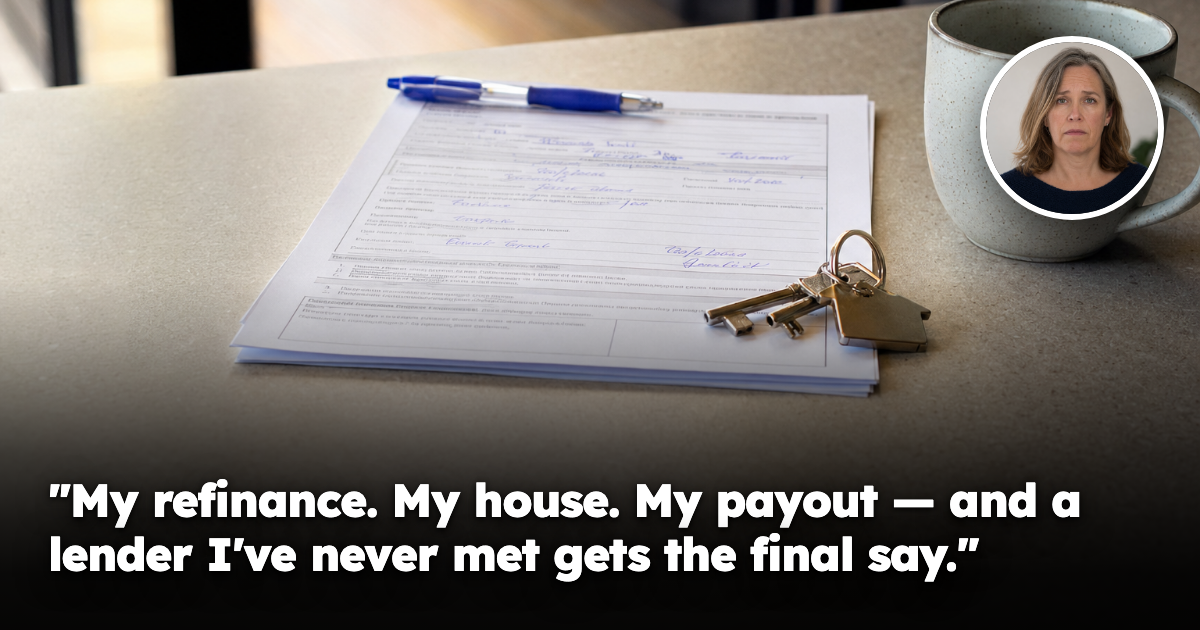
She had done the hard part already.
A 47-year-old bookkeeper, three years into separating from a marriage of nineteen, had spent those years untangling one thing at a time. The family home sold and split. The car loan closed. The joint credit card closed twice, because the first time it wasn't. What was left was the investment property — a three-bedroom house bought in 2014, the only asset they'd agreed on.
The consent orders gave it to her. Her job was to refinance into her own name. New lender approved, valuation done, payout confirmed in writing, settlement booked for a Thursday.
On the Tuesday her broker rang. The discharge wasn't going ahead — not because her lender had refused, not because her new lender had pulled out, but because a third lender she had never applied to, and didn't owe a cent to in her own name, had given her bank a direction about her mortgage. And her bank was going to follow it.
Her question, asked twice because the first answer didn't sound like English:
'It's my property, my loan and my payout. How can a lender I don't bank with tell my bank what to do with my own mortgage?'
The answer nobody explains before you sign
Here's the part almost every borrower gets wrong, and it isn't their fault.
When you refinance, you assume one thing dies and another is born: old loan paid out, old security discharged, new lender registers a fresh mortgage. Clean break. That's one option. It isn't the only one.
The law gives a borrower a useful right: where you're entitled to discharge your mortgage, you can require your existing lender, instead of discharging it, to transfer that mortgage to someone you nominate. You keep the security alive and hand it over rather than killing it — saving time and avoiding a gap where the property sits unsecured. A real protection.
Then comes the sentence that reshaped her Thursday.
The same power is given to a subsequent mortgagee — the holder of any later security over the same property. That lender may also require your first lender to transfer the mortgage, to a person that lender directs. Same asset, same right, different hand on the wheel.
When the two conflict, the legislation doesn't weigh them up, doesn't ask a court, and doesn't ask you. It states an order of precedence: the subsequent mortgagee's requirement prevails.
Not "may prevail". Not "unless the mortgagor objects". Prevails.
If more than one later lender is in the queue, they're ranked too — the earlier security wins. Nowhere in that ordering does the person who owns the house appear.
In her case the later security was old and small: a facility taken out during the marriage, secured against the investment property, in her ex-husband's business name. She had signed as an interested party and forgotten it existed. Nobody was in default. It just sat there — a registered interest carrying a right outranking hers.
Two more details worth knowing before you need them
The transfer is on the same terms on which the lender would have had to discharge the mortgage. The amount owing doesn't change; nobody could inflate her payout. What changed was who held the security over her house — which, when ending a financial relationship, is the entire point.
There are two circumstances where the right — hers or theirs — can't be used at all. One is where a lender is already in possession. The other is more insidious: where the mortgage contains an enforceable condition in favour of a lender restraining the borrower's trade or business, or any other collateral benefit or advantage in favour of a lender. A clause drafted for the lender switches off the borrower's right. The better the lender's paperwork, the thinner your protection.
The counterweight — and this one is genuinely on your side
None of this means lenders hold all the cards, and it'd be dishonest to stop there.
The same body of law abolished one of the harshest old doctrines in mortgage lending: consolidation. A borrower discharging a mortgage over one property is entitled to that discharge without paying money owing under a separate mortgage over a different property. One property, one payout — your lender can't hold clear title on house A hostage to arrears on house B. An unglamorous protection that saves portfolios every year, and almost nobody knows it's there.
There's a similar mercy where a loan term has expired but the lender kept accepting interest for at least three months and you've met every other obligation: the principal can't be called up. Notice is required, and must run at least three months.
So it isn't a stitch-up. It's an ordered system with a real protection, a competing right you didn't know about, and a ranking rule resolving the clash without asking you.
What this means for investors
Two houses in the same suburb share a median, a growth rate, a school catchment and a council. They don't share their encumbrance structure — how many registered interests sit over the title, whose they are, in what order they were created, and therefore whose rights outrank whose when you want to move. One is a single-lender asset you can refinance in a fortnight. The next, on identical fundamentals, carries a decade-old second security handing a stranger a say in your next transaction.
A suburb median has never once read a title search.
That's why we work at street and parcel level. Across one suburb, the spread in effective yield between best and worst street routinely runs 20–30% once you use achieved rents, real vacancy duration and true days-on-market instead of averages. Structure behaves the same way: a value factor, measurable before you commit — the discipline that makes a lender's power of sale survivable rather than fatal, and the same reason priority between two lenders is worth understanding before you draw a dollar. It's also why what a judgment debt can and can't reach belongs in the same conversation.
Nobody in her story behaved badly. Her bank followed a rule it must follow. The other lender used a right the law deliberately gave it — a later lender about to be leapfrogged needs some way to protect its security. Her broker did the work properly. The gap wasn't misconduct, but an old registered interest nobody had gone looking for.
Her refinance completed eleven weeks late, after that facility was refinanced away separately. Extra interest at the old rate, a second valuation, the legal work: she puts it at $9,400. The house has since done what good houses do.
This is the case for buying property with your eyes open rather than staying out. Every rule in her story was published, free and readable years before it mattered. The ranking, the competing right, the abolished doctrine, the notice period — none of it happened by ambush. Risk you can read in advance isn't a threat. It's a line item, a negotiating position, an edge over every buyer bidding against you who never looked.
She got the asset. She just paid eleven weeks for a search that would have taken an afternoon.
If there's a specific street you're weighing up right now, check its Street Score first — it's free, takes ten seconds, and tells you whether that street is pulling the suburb average up or riding on it.
Frequently asked questions
How can a lender I never applied to affect my refinance in Australia?
If there is a later registered mortgage or security over the same property, that lender can direct your existing lender to transfer the mortgage instead of discharging it. The law says the later mortgagee’s requirement prevails, even over the borrower’s preference.
What is the difference between discharging a mortgage and transferring it to another lender?
A discharge ends the old mortgage, while a transfer keeps the security alive and hands it to another lender nominated under the law. The article says this can avoid a gap where the property sits unsecured.
Can my existing lender use another debt on a different property to block a discharge?
No. The article says consolidation has been abolished, so a borrower seeking discharge over one property is entitled to that discharge without paying money owed under a separate mortgage over a different property.
Are there situations where the right to discharge or transfer a mortgage does not apply?
Yes. The article says the right cannot be used where a lender is already in possession, or where the mortgage contains an enforceable condition favouring the lender that restrains the borrower’s trade or business or gives the lender a collateral benefit.
What practical risk should property owners and investors check before refinancing?
They should check the title for any registered interests and understand the order they were created in, because earlier registered later mortgages can outrank your refinance. The article shows that an old, forgotten security can delay settlement and add costs.
General information only. It does not take your objectives, financial situation or needs into account, and nothing here is legal, financial, taxation or investment advice specific to your circumstances.