News · 19 August 2026 · 5 min read
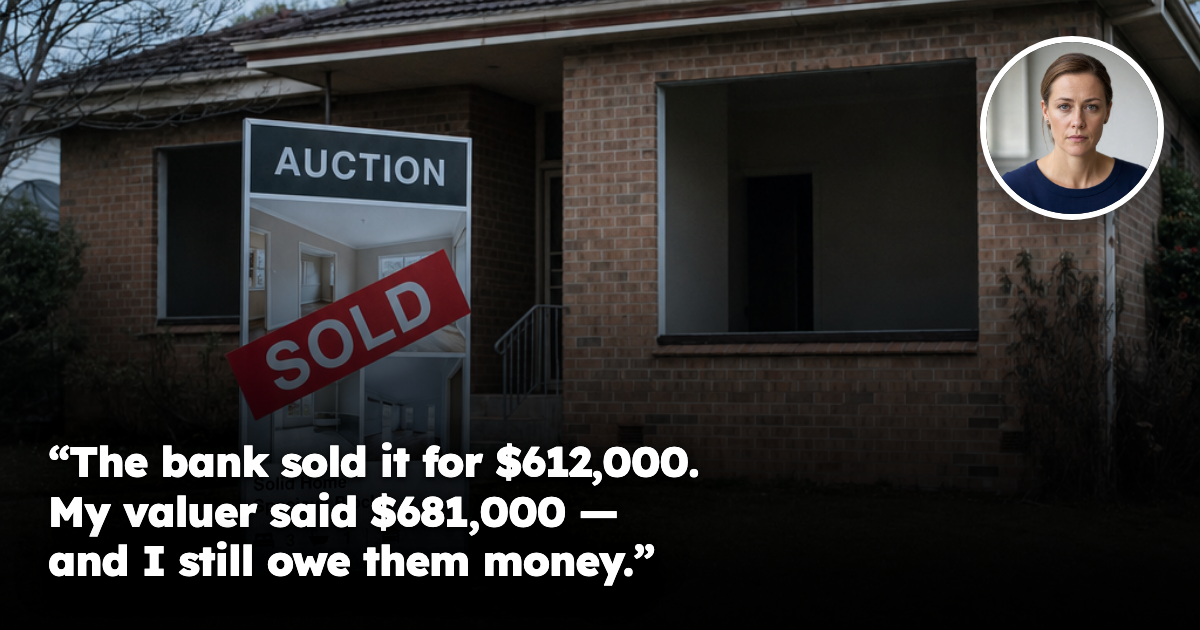
'The bank sold my investment property for $612,000. My own valuer said $681,000 — and I still owe them money'
There is a statutory duty on a lender to take reasonable care to sell a repossessed property at market value, and no clause in any loan contract can remove it. But the buyer never has to check that the duty was met — so breaching it cannot give the house back.
She had the valuation in her hand when she rang us. That was the part she kept returning to.
A woman in her early forties, a theatre nurse, one investment property bought in 2021. A marriage ended, one income became a different income, and after eleven months she fell behind. She rang her lender, filled in the hardship form, agreed to a reduced-payment arrangement and kept to it for two quarters. Then the arrangement lapsed, the arrears were larger than it had assumed, and a letter arrived giving her thirty days to fix it.
She could not. The property was listed, marketed for four weeks and sold at auction for $612,000.
Her own valuer — engaged three weeks earlier, at her cost — had put it at $681,000. After sale costs and the loan payout there was no balance left for her. Instead there was a shortfall of roughly $31,000 she still owed, plus a receiver's fee she had not budgeted for.
Her question is one almost nobody asks before they need to:
"There's a legal duty to sell it for what it's worth. I have a valuation saying they didn't. Doesn't that undo the sale?"
The short answer
No. And the reason is one of the sharpest asymmetries in property law.
The duty she is thinking of is real, and stronger than most owners realise. When a lender exercises a power of sale, it must take reasonable care to ensure the property is sold at market value. Not a courtesy, not an industry code — a statutory duty, and it applies despite any agreement to the contrary. No clause in any loan document can remove it.
For certain categories of mortgage the obligation is spelled out in checkable steps: adequately advertise the sale, obtain reliable evidence of value, maintain the property including reasonable repairs, and sell by auction unless another method is genuinely appropriate. Penalties attach. The lender must also give the borrower formal notice about the sale within twenty-eight days.
So she is right that a duty existed. Where the reasoning breaks is what happens when it is breached.
The buyer never had to check
Sitting a few lines below that duty is a provision protecting the person who bought the house. A buyer at a mortgagee sale need not inquire whether the power of sale was properly exercised — expressly including whether the required notice was ever given.
Read the two together and the structure is clear. The duty binds the lender absolutely. Breaching it does not touch the buyer's title. The sale stands.
What she has instead is a compensation claim against the lender, available to anyone who suffers loss from a breach of that duty or an improper exercise of the power. That is a genuine remedy, worth pursuing. But it is a money claim, brought afterwards, by someone who no longer owns the asset, and the burden of showing reasonable care was not taken sits with her.
This is the sentence that changed how she thought about it: the duty is unwaivable, but breaching it cannot give the house back.
Two numbers she had not seen coming
The first is the order the money comes out. Sale proceeds are held in trust and applied in a fixed sequence: the reasonable expenses of selling, then principal, interest and other amounts owing under the mortgage, and then — last — the balance to the owner. The owner is not a creditor in that queue. The owner is what is left over.
The second is the receiver. Where a lender is entitled to take possession it may appoint one, and the statute does something almost nobody expects: it makes the receiver the agent of the borrower, not of the lender that appointed them. The remuneration is a percentage of the gross amount of all money the receiver receives — not of profit, not of surplus — and where the appointment is silent on the figure, it applies by default. It ranks above the interest owed to the very lender who appointed them.
Her receiver's costs came to about $28,400. She paid an agent who was legally hers, appointed by someone else, out of money she never touched.
Her instinct was that being reasonable throughout should have counted for something. It did, just not where she was looking. The hardship arrangement, the notice period and the duty were all real. What none of them do is convert a price into a result.
What this means if you own property with debt against it
Three things are worth taking from her situation, and none are about distress.
The protections that matter are unwaivable, so read for them, not around them. A striking amount of mortgage law works this way: the lender's powers apply subject to whatever the contract says, while the borrower's protections apply despite it. Knowing which is which tells you where the leverage sits before you need it.
The thirty days is a design feature. A default notice must state the nature of the default and require it remedied within thirty days, and no sale can proceed until that period runs without remedy. That window is the most valuable thing an owner in trouble has, and its value collapses if spent hoping.
And the price a forced sale achieves is a property fact, not a market fact. This is where our own work sits. Two houses in the same suburb — same median, same growth rate, same catchment — will not perform the same way under a compressed four-week campaign. One sits on a street where stock is thin, days-on-market is short and buyer depth is genuinely there; a fast sale clears near value. The other is two hundred metres away with a longer selling cycle and shallower demand, where four weeks is not enough to find the right buyer. Same suburb metrics. Completely different downside.
We measure that gap at street level for exactly this reason. Across one suburb, the spread in effective yield between the best and worst streets — on achieved rents, real vacancy duration and real days-on-market, not asking prices — routinely runs 20–30%. A median cannot see which street you are on. A forced sale absolutely can.
That is not an argument against borrowing to invest. It is an argument for knowing which asset you are borrowing against. The notice period, the duty, the proceeds order and the receiver's percentage are all published and readable years before anyone needs them. A risk you can read is a risk you can price, and careful buyers keep acquiring good assets on good streets precisely because so few people ever go looking.
Her position is recoverable, and she is pursuing the valuation question properly. But she said something at the end that has stayed with us.
She had read every page of the loan contract in 2021. She had never once read the law that sat behind it.
Related reading: when the government resumes your land and deducts the uplift, the encroachment rule reaching three times market value, and the compensation regime with no minimum floor.
If there's a specific street you're weighing up right now, check its Street Score first — it's free, takes ten seconds, and tells you whether that street is pulling the suburb average up or riding on it.
Frequently asked questions
If a lender sells a repossessed property for less than an independent valuation, does that automatically undo the sale in Australia?
No. The lender may still have breached a statutory duty to take reasonable care to sell at market value, but that does not unwind the buyer’s title. The remedy described in the article is a compensation claim against the lender.
What must an Australian lender do when selling a repossessed property?
The article says the lender must take reasonable care to sell at market value, including adequate advertising, obtaining reliable evidence of value, maintaining the property with reasonable repairs, and generally selling by auction unless another method is genuinely appropriate. The lender must also give formal notice about the sale within 28 days.
Can a loan contract remove the lender’s duty to sell a repossessed property properly?
No. The article says the duty is statutory and applies despite any agreement to the contrary, so no loan clause can remove it.
If a repossessed property sells for less than the debt, what happens to the proceeds?
The sale proceeds are applied in a fixed order: reasonable selling expenses first, then the mortgage amounts owed, and only after that does any remaining balance go to the owner. If there is not enough, the borrower can still owe the shortfall.
What is the borrower’s main chance to stop a forced sale in time?
The article says the key window is the default notice period. The notice must state the default and give 30 days to remedy it, and no sale can proceed until that period has run without the default being fixed.
General information only. It does not take your objectives, financial situation or needs into account, and nothing here is legal, financial, taxation or investment advice specific to your circumstances.