News · 21 August 2026 · 6 min read
"I billed my tenant $2,940 in water over three years. A plumber told me I was never allowed to charge a cent of it"
He forwarded the water bill for three years and his tenant paid it. Then a plumber asked one question about the shower — and the entire entitlement collapsed on a word the Act never defines.
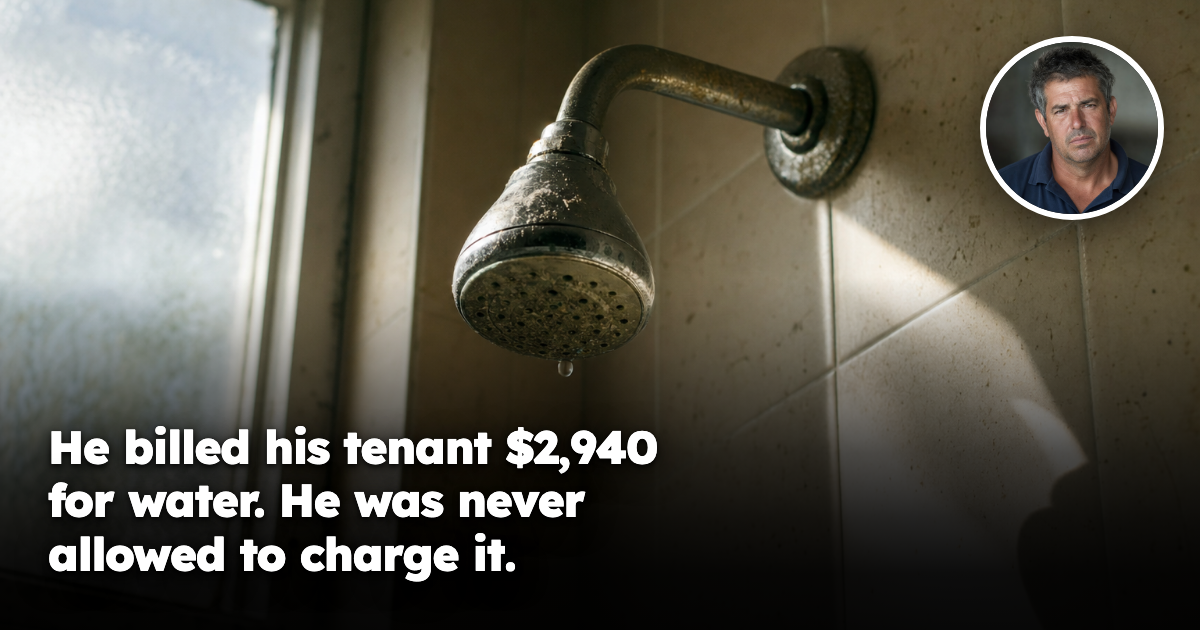
He is 52, a diesel mechanic, and owns exactly one investment property — a three-bedroom brick house on a generous block, bought in 2017 with what he calls "eleven years of overtime."
He has never had a bad tenant, never been to a tribunal, and replaced the hot water system before it failed rather than after. Every quarter for three years he did what his managing agent told him to: received the water bill, forwarded the consumption portion, and the tenant paid it. Roughly $245 a quarter. About $2,940 all up.
Then a plumber came out to fix a dripping laundry tap, looked at the shower, and asked him a question he had no answer to.
His question to us was blunt: "The lease says water is payable and every invoice came from a real water authority. How can any of it be wrong?"
It is one of the most misunderstood provisions in Australian tenancy law, and it catches careful landlords far more often than careless ones.
The three gates nobody reads as three gates
The right to pass water consumption on to a tenant is not one permission. It is a stack of conditions, and every one has to hold at the same time.
The tenant must be enjoying or sharing the benefit of the water service. The premises must be individually metered — one meter, that property, nothing shared with a neighbouring dwelling or common area. And the agreement must state that the tenant pays for water consumption.
Most owners get all three right. His agent did. Then comes the fourth condition, and it is the one that undoes people.
The adjective that decides everything
The legislation says a tenant may be required to pay all of the water consumption charges for a period only if, during that period, the premises are water efficient.
Not "reasonably efficient." Not "efficient in the owner's opinion." And critically, the Act does not tell you what water efficient means. It says the premises are water efficient only if they comply with the water efficiency requirements prescribed under a regulation — a separate instrument, sitting somewhere else, that the landlord never signed, never received at settlement, and which can be amended without a word of the Act changing.
That is the trap. The document he read said he could charge. The document that decided whether he could charge was not the document he read.
In his case it came down to fittings: showerheads and taps original to a build older than the requirements themselves. Nobody had checked them for flow. The plumber took one look and knew.
What he actually owed — and why it isn't nothing
Here is the part that surprises people on both sides of the argument.
Failing the efficiency test does not simply void the charge. Where the premises are not water efficient during a period, the tenant may only be required to pay the amount that is more than an amount payable for a reasonable quantity of water.
Read that carefully. The landlord does not lose everything. He loses the ordinary part and keeps only the excess. The reasonable baseline — the water a normal household in that property would use — becomes his cost. Anything genuinely above it can still be recovered.
So the question stops being "was he entitled to bill?" and becomes "what is a reasonable quantity of water for this property?" That is not a national number. The law lists what must be weighed: usage and charges for comparable premises in the same local government area, the area of the land, the terms of the agreement, the presence or absence of water saving devices, and the number of people living there.
A bigger block lawfully justifies more water. A four-person household justifies more than a single occupant.
The three smaller rules that catch nearly everyone
The fixed charge is never passable. Only the variable part — assessed on the volume actually supplied — can go to the tenant. The fixed service charge for having the connection at all stays with the owner, permanently. If you have been forwarding the whole bill, part of it was never recoverable no matter how efficient the house is.
No invoice, no entitlement. The owner must give the tenant a copy of the water supplier's own document within four weeks of receiving it. If the tenant never received it, the tenant is simply not required to pay. The entitlement is conditional on the paperwork, not on the water.
Part-periods die at handover. Where a tenancy starts or ends mid-billing-cycle, that partial period is only recoverable if a meter reading was taken at the right moment and recorded in the condition report — at commencement, or when vacant possession is handed back. A number nobody wrote down on a day that has passed cannot be recreated. That window closes with the front door.
What this really tells you about buying
None of this is a scandal. The efficiency rule exists for an obvious reason: a tenant cannot fix a showerhead they do not own, and charging someone for waste they have no power to stop is not defensible. His agent was not negligent. His tenant was not gaming him.
But look at what the statute concedes when it has to resolve one of these disputes. It does not reach for a state average. It reaches for comparable premises in the same local government area, and then for the area of the land. The law itself accepts that the right answer is local and parcel-specific.
That is the argument for street-level data, written into the legislation by accident.
Two houses in one suburb share a median, a growth rate, a school catchment and a council. What they do not share is lot size, fittings age, plumbing vintage, household composition, or the real holding costs that never appear in a market report. It is the same gap that decides what a fixed-term lease actually costs when it ends early, who wears the bill when an urgent repair happens before anyone can approve it, and what happens to a property once a tenancy stops in the middle.
Across a single suburb, the spread between the best and worst streets on real achieved numbers — rents actually collected, genuine vacancy duration, true days on market — routinely runs 20 to 30 per cent. A suburb median has never once paid a water bill.
The close
He is not out of pocket in any way that matters. The baseline was reconciled, the fittings replaced for under $600, and the property has been compliant since. His tenant renewed.
What changed was how he buys. He now treats a property's physical detail — fittings, lot area, metering, recorded condition on day one — as part of the asset rather than an afterthought handled by someone else. That detail is exactly what turns a headline yield into a real one.
And that is the opportunity here. Every rule he tripped over was published, free and readable long before it mattered. It was not hidden. It was unexamined — by him, and by almost every buyer bidding against him. Risk you can read in advance is risk you can price, and priced risk is not a threat. It is an edge.
He had walked past that shower a hundred times on inspection day. He had just never thought of it as a number.
If there's a specific street you're weighing up right now, check its Street Score first — it's free, takes ten seconds, and tells you whether that street is pulling the suburb average up or riding on it.
Frequently asked questions
When can an Australian landlord charge a tenant for water consumption at all?
The tenant can only be required to pay water consumption if the premises are individually metered, the tenant benefits from the water service, and the agreement states the tenant pays for water. Even then, the premises must also be water efficient during that period.
What happens if the rental property is not water efficient?
The landlord cannot pass on all of the water consumption charges. The tenant may only be required to pay the amount above a reasonable quantity of water for that property, based on factors like local comparable premises, land size and household occupancy.
Can a landlord pass on the fixed part of a water bill to a tenant?
No. Only the variable consumption component can be passed on to the tenant. The fixed service charge for having the connection stays with the owner.
Does the tenant have to pay if they were never given the water bill?
No. The landlord must give the tenant a copy of the water supplier’s invoice within four weeks of receiving it. If that does not happen, the tenant is not required to pay.
What special rule applies when a tenancy starts or ends in the middle of a billing period?
A partial water bill is only recoverable if a meter reading was taken at the correct time and recorded in the condition report. Without that reading, the amount for that part-period cannot be reliably claimed.
General information only. It does not take your objectives, financial situation or needs into account, and nothing here is legal, financial, taxation or investment advice specific to your circumstances.