News · 21 August 2026 · 5 min read
"I paid $224,000 towards a house over six years. Then I found out the seller had mortgaged it"
She paid $224,000 towards a $310,000 house over six years with no bank involved, then found the seller had mortgaged it to a lender she'd never heard of. What she'd actually been inside the whole time was one of the most protective arrangements in property law.
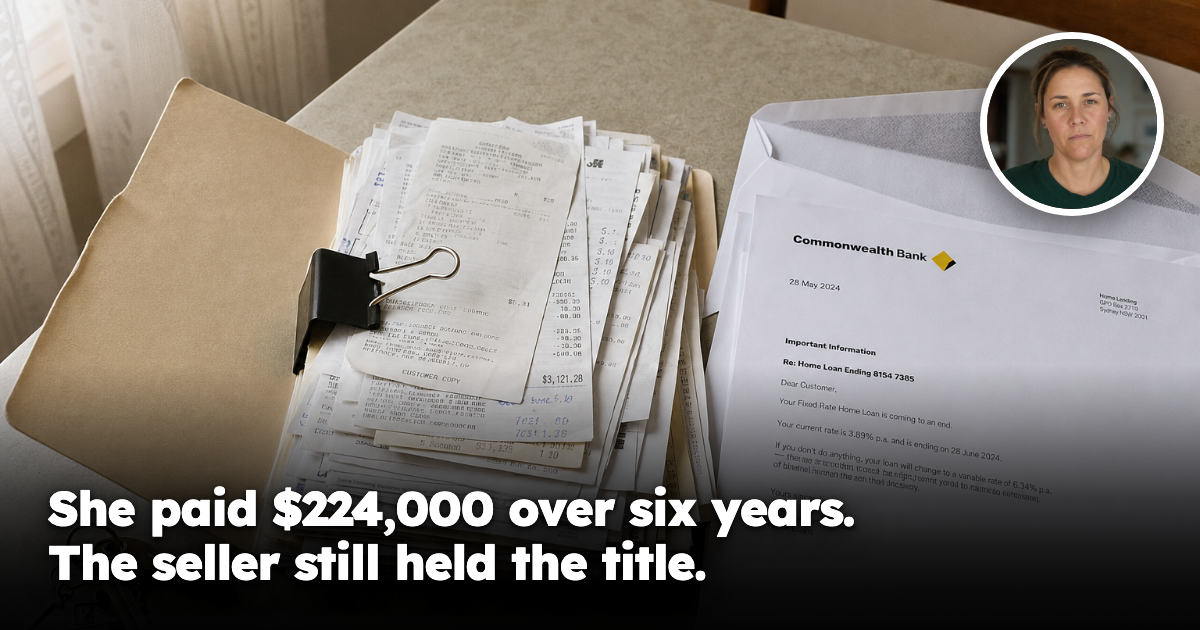
She had the folder ready before she sat down. Six years of receipts, in order, held together with a bulldog clip.
The arrangement had made sense in 2019. She was 36, a veterinary nurse, one income, and a deposit that was never going to catch a rising market. A seller offered something different: move in now, pay him each month, and the house becomes yours when the balance is paid. No bank. No approval. A one-page schedule she thought was better than a handshake, because it was written down.
She paid $290 a week, plus rates, insurance and every repair. Six years. $224,000 against a $310,000 price — two-thirds of the way to a house.
Then a letter addressed to the seller arrived and she opened it by mistake. A lender, referring to a mortgage over the property — hers, as she thought of it — registered eleven months earlier. She had never heard of them, and had never been asked.
The question
"I've paid $224,000 towards this house. The title is still in his name — it was always going to be until the end. Now he's mortgaged it to someone I've never heard of. He owns it, so presumably he can do what he likes with it. Have I just been paying rent for six years?"
She was braced for yes. What she had stumbled into was one of the most protective arrangements in property law — and she had been inside it since the day she signed, without either party using the words.
The answer
Start with what her contract actually was.
There is a category of land contract defined by two things and nothing else: the buyer is bound to make one or more payments by instalment of the purchase price, and is not entitled to receive a transfer of the title in exchange. That's the whole test. Pay by instalments, don't get title when you pay — you are in the category.
There is no form, no registration, no approval, no label, nothing on the contract that says so. Her schedule never used the term and neither did the seller, and it made no difference: the category is satisfied, not applied for.
Two details matter. A deposit is capped — 10% of the price, 20% for a proposed lot — and anything beyond that ceiling stops being a deposit. And "instalment" excludes money paid for rates, outgoings, maintenance, an extension of time, or interest. The category turns on what the money was for, not how often it left her account. Her $290 a week was principal against a stated price. It counted.
Now the part she didn't expect.
The seller must not, without the buyer's consent, sell or mortgage the land.
Read that with the title in mind. He is the registered owner — and the rule removes his ability to deal with his own property, because someone else has been paying for it. Consent isn't a formality: it is only given by the buyer's notice confirming she received a notice from the seller stating the terms of the proposed sale or mortgage, and that she consents on those stated terms. A permission buried in a contract isn't consent. Silence isn't consent.
Where land is mortgaged in breach, the contract becomes voidable by the buyer — and if she voids it, she may recover as a debt any deposit or instalment she has paid. Not damages to be argued over. A debt: a liquidated number, and she has six years of receipts for it.
Two more limbs sit beside it. The seller cannot terminate for a missed instalment until 30 days after a formal default notice — and if she pays inside that window, the right to terminate is extinguished and she is taken not to have been in default at all. A buyer not in default can also compel transfer by giving notice of a settlement day at least three months out.
All of it applies despite any agreement to the contrary. It cannot be drafted around — which is precisely why almost nobody drafting these arrangements mentions it.
Then the cheapest line in the story. From the day she signed she could have lodged a caveat forbidding registration of any document affecting the land until settlement — and it sits outside the rules that make ordinary caveats lapse. A few hundred dollars, once, and the mortgage in that letter could not have been registered. She didn't fail a test; she never knew there was a lever, unpulled, for six years.
What this means for you
The instinct is to read this as a warning against vendor finance. It isn't. These arrangements move people into houses no lender would have, and plenty of sellers run them honestly and transfer title as promised. This seller may well have refinanced intending to discharge it at settlement. Nothing here assumes bad faith.
The point is simpler. Her protection was never in the document she signed. It was in the category she was in — readable, in full, years before it mattered.
Which is the shape of the harder question underneath: what was she actually buying?
A six-year commitment to one address is a bet on one street, not one suburb. Two houses in the same postcode share a median, a growth rate, a school catchment and a council — and behave like different assets. In a single suburb the gap in effective yield between the best and worst street runs 20–30%: achieved rents not asking rents, real vacancy duration not a headline rate, true days on market. That's the layer a median cannot show you, because a median exists to average away exactly the differences you're buying.
A suburb median has never once been the thing anyone paid instalments on. People buy an address.
The close
Everything that decided her position was published. The definition, the deposit ceiling, the consent mechanics, the voidability, the debt remedy and the caveat right sat in plain language while she wrote cheques and assumed the worst.
That's the argument for buying property, not against it. The rules governing the biggest transaction most people make are free to read, and the risks that look like ambushes are usually just the parts nobody opened. Risk you can read is risk you can price — and priced risk isn't a threat, it's an advantage over every buyer who never asked.
We've written before about the duties a lender carries when it sells a mortgaged property, how a debt you've never heard of can rank ahead of your own, and who really controls an insurance payout on a mortgaged home. The thread is the same: the outcome rarely turns on the document you signed.
She came in believing she had spent six years renting. She had actually spent six years accruing a right nobody told her she held — and the only thing she'd truly lost was the few hundred dollars it would have cost to make it unbreakable on day one.
If there's a specific street you're weighing up right now, check its Street Score first — it's free, takes ten seconds, and tells you whether that street is pulling the suburb average up or riding on it.
Frequently asked questions
Was this buyer actually just renting for six years under the arrangement described?
No. The article says the deal was an instalment land contract, not ordinary rent, because she was paying part of the purchase price in instalments and was not to receive title until the balance was paid.
Can a seller mortgage the property in an instalment land contract without the buyer agreeing?
No. The article says the seller must not sell or mortgage the land without the buyer’s consent, and a consent buried in the contract does not count.
What happens if the seller mortgages the property anyway?
According to the article, the contract becomes voidable by the buyer. If the buyer voids it, she may recover any deposit or instalments she has paid as a debt.
Could the buyer have stopped the mortgage from being registered?
Yes. The article says she could have lodged a caveat forbidding registration of any document affecting the land until settlement, which would have blocked the mortgage from being registered.
What protection does a buyer have if the seller misses a payment or tries to end the contract?
The seller cannot terminate until 30 days after a formal default notice. If the buyer pays within that window, the right to terminate is extinguished and the buyer is treated as not having been in default.
General information only. It does not take your objectives, financial situation or needs into account, and nothing here is legal, financial, taxation or investment advice specific to your circumstances.