News · 1 September 2026 · 4 min read
Victoria promised renters a fairer deal. Why is the rent data still missing?
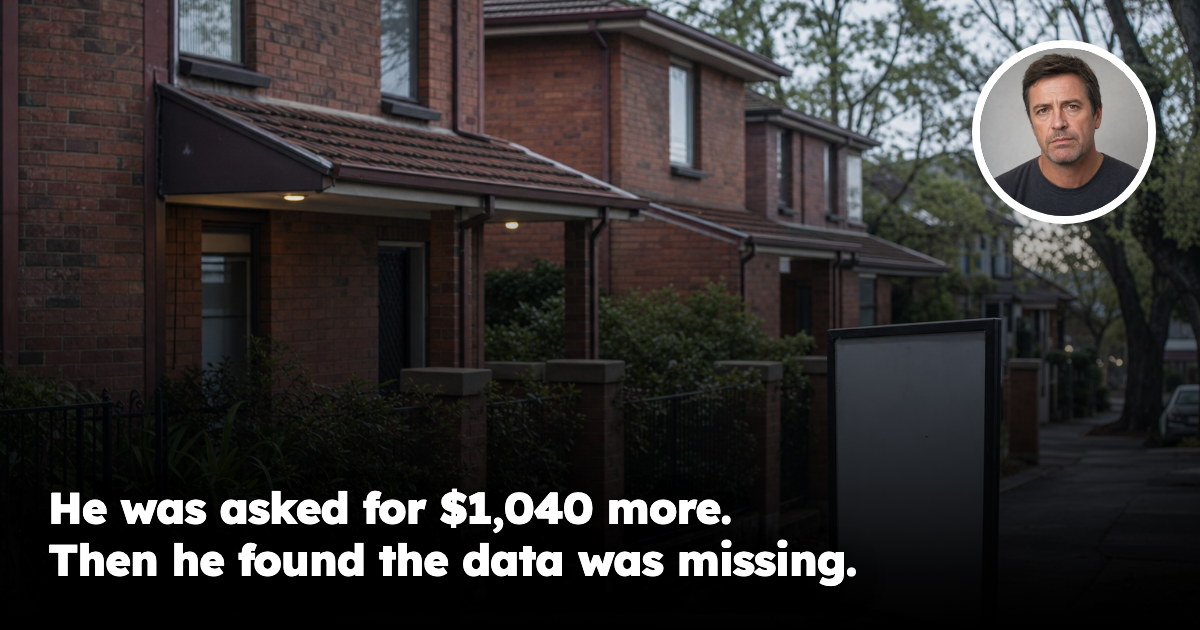
A Victorian father was asked for a $1,040 annual rent increase while the data needed to test it was delayed.
Victoria promised renters a fairer deal. Why is the rent data still missing?
When a Victorian renter is asked for another $20 a week, the argument is usually immediate: the owner says costs have risen, the renter says wages have not, and both sides reach for a different statistic.
That is what happened to a recently redundant 45-year-old father we’ll call Daniel. His lease renewal arrived with a $1,040 annual increase. He could absorb it only by cutting back on his children’s weekends and delaying a planned move closer to school. His question was simple: if the government says it is improving rental fairness, why is it still so hard to see the numbers behind one home’s increase?
The question: who is supposed to know whether the increase is fair?
Victoria has spent years changing the rules around renting, while the public data used to judge the market has often arrived slowly, in broad averages, or after the decision has already been made. Recent reporting about a delay in the state’s rental data drew criticism because reliable, timely information is not a luxury in a tight market. It is the difference between negotiating from evidence and guessing.
The frustration cuts both ways. A renter needs to know whether a proposed increase is in line with comparable homes. An owner needs to know whether a higher asking rent will actually be achieved, or whether it will create a longer vacancy and a more expensive changeover. A policy maker needs to know whether a rule is improving supply or simply shifting pressure from one household to another.
When the data arrives late, the people with the least time and bargaining power carry the greatest risk.
The answer: averages are not enough — and delay makes them worse
A statewide or suburb-wide median can be useful, but it cannot answer Daniel’s real question. Two homes with the same postcode can have very different tenant demand. One may be a quiet, walkable street with reliable transport and a strong pool of families waiting for a lease. Another may be beside a noisy arterial, exposed to parking pressure or a long construction project. That is the same street-level value gap seen in nearby homes.
That difference shows up in the outcomes investors actually experience: days on market, enquiry volume, vacancy between tenants and the rent discount needed to secure a lease. It can also show up in the resale market. A headline saying “rents are rising” does not tell an owner whether their exact asset can command the increase without losing a good tenant.
Ripehouse Advisory’s research approach starts closer to the ground. Street-level heatmaps, vacancy signals, supply and demand measures, days-on-market patterns and the R-Score framework help separate a broad market story from an address-level result. In one Melbourne comparison, nearby streets inside the same suburb showed a double-digit difference in asking-rent movement over the same period. The point is not that every home will follow one number; it is that the postcode average can hide the investable detail.
That is why delayed official data is more than an administrative annoyance. It weakens the negotiating position of renters, makes responsible owners look opportunistic when they may be following stale evidence, and encourages investors to buy the headline rather than the asset.
What should a renter or owner do now?
First, ask for comparable evidence rather than arguing from outrage. Compare similar homes by bedrooms, parking, condition, outdoor space, transport access and lease timing. A renovated townhouse cannot be assessed against an older flat simply because both sit in the same suburb.
Second, test the cost of a vacancy. If an extra $20 a week causes a three-week vacancy, advertising, cleaning and letting costs can erase the annual increase. A stable tenant has an economic value that does not appear in a simple rent chart.
Third, treat government data as one layer, not the whole decision. Look for the direction of local vacancy, the amount of new competing supply, the time comparable listings remain advertised and the gap between asking and achieved rent. For an investor, the same checks should be repeated before buying, not only when a lease is due. A weekly rent and vacancy read can help establish the broad direction, while the address-level evidence decides whether the headline applies.
Finally, keep the paper trail. A clear record of the proposed rent, comparable properties, repairs, notices and dates matters when a dispute moves beyond a conversation. Better information cannot remove every disagreement, but it can expose a demand that has no market support.
The bigger issue
Victoria can pass stronger rental protections and still leave people feeling powerless if the evidence arrives after the argument. Fairness needs rules, but it also needs usable information: current enough to matter, detailed enough to reflect a real street, and transparent enough for both sides to test.
For property investors, this is not a reason to abandon the market. It is a reason to become more exacting. The opportunity is rarely in copying a statewide headline. It is in finding the right asset on the right street, understanding its tenant depth and supply risk, and pricing the decision with better data than the crowd. The R-Score and sold-price framework is useful when that final shortlist is being built.
If there's a specific street you're weighing up right now, check its Street Score first — it's free, takes ten seconds, and tells you whether that street is pulling the suburb average up or riding on it.
Market data & R-Scores for locations in this article
Drill Down Into the Markets Mentioned Above
Inspect live monthly R-Scores, median prices, rental yields, and street-by-street scores for the cities and council areas referenced in this article:
Frequently asked questions
Why is the missing Victorian rent data such a problem for renters and landlords?
Because a delayed statewide average arrives after the rent decision has already been made. Renters lose a way to test whether an increase is fair, and owners lose a way to judge whether a higher asking rent is actually achievable.
Can a suburb-wide rent average tell me if my rent increase is reasonable?
Not on its own. The article says two homes in the same postcode can have very different demand, vacancy risk and days on market, so address-level evidence is more useful than a broad median.
What should I compare if I want to check whether a rent rise is justified in Victoria?
Compare similar homes by bedrooms, parking, condition, outdoor space, transport access and lease timing. The article says a renovated townhouse should not be judged against an older flat just because they are in the same suburb.
What risk does a landlord face if they push for a rent increase without local evidence?
They may create a longer vacancy, which can be more expensive than the increase itself. The article notes that advertising, cleaning and letting costs can offset the extra rent if a tenant leaves.
What information matters most besides government rent data when making a rental decision?
Look at local vacancy, new competing supply, how long similar listings stay advertised, and the gap between asking rent and achieved rent. The article says government data is only one layer, not the whole decision.
General information only. It does not take your objectives, financial situation or needs into account, and nothing here is legal, financial, taxation or investment advice specific to your circumstances.