News · 1 September 2026 · 4 min read
She paid $86,000 for the quiet side of the suburb. Then the road plan changed.
A 24-year-old woman paid $86,000 less for a home, then found a road reservation that changed the exact-address risk.
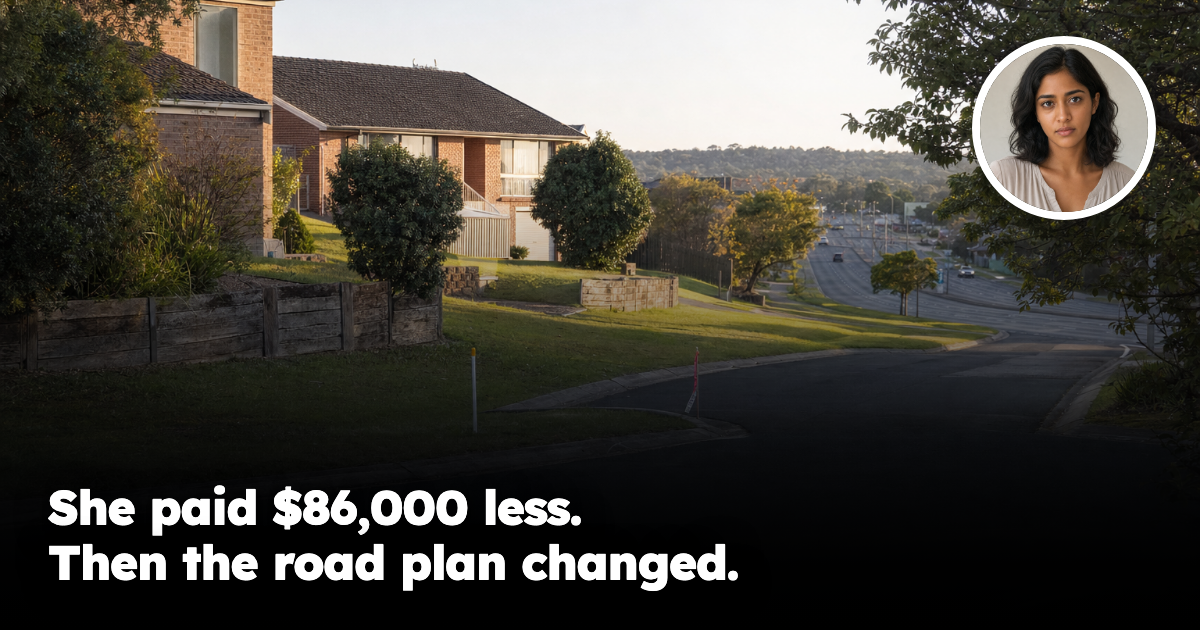
She paid $86,000 for the quiet side of the suburb. Then the road plan changed.
A 24-year-old new migrant thought she had found the sensible compromise: the same suburb, the same train line, the same basic floor plan — but $86,000 less than the homes on the “good” side of the main road.
Six months later, she found a thin line on a planning map. It was not a construction notice. It was not a bulldozer on the street. It was a future road-widening reservation that ran close enough to change how buyers viewed the property.
Her question was blunt: had she bought a bargain, or had she paid too much for a problem that the suburb-wide numbers could not see?
The question behind the price gap
This is the kind of mistake that catches careful buyers. The suburb can be performing well. Vacancy can be low. Rents can be rising. The median can be moving in the right direction. Yet two houses five minutes apart can belong to completely different markets.
The reservation did not automatically mean the house would be acquired or that a road would definitely be built. That distinction mattered. Planning maps often show a possible future corridor, a safeguarding area or a long-term transport option. A proposal, an adopted plan, a funded project and active construction are four different levels of certainty.
But uncertainty is still a property characteristic. A future buyer may ask the same question she asked: “What exactly can happen here?” If the answer takes an hour of phone calls and document searches, some buyers simply move to the next listing.
That can reduce the buyer pool before it reduces the suburb median.
Why the suburb median missed it
A median is useful for understanding a broad market. It is a poor substitute for checking the address.
RHA’s street-level review compared recent sales on both sides of the corridor, then separated homes by setback, traffic exposure, lot usability and planning constraint. The quiet-side properties had deeper buyer interest and shorter marketing periods. Properties exposed to the reservation were not uniformly discounted, but the weaker examples needed a sharper price to attract attention.
In the comparison set, the gap between otherwise similar homes was about $86,000. That was not a universal “road reservation discount”. It was the observed difference between two groups of assets with different access, noise and future-use risk. A different suburb, street or stage of planning could produce a different result.
The important insight was the spread. A suburb-level report could say the area was healthy. A street heatmap showed where the health stopped.
What should a buyer check?
First, identify the exact planning instrument affecting the lot. Is it a concept, a corridor safeguard, an adopted reservation, a notice of acquisition or an active project? Do not collapse those categories into one frightening headline.
Second, check the physical relationship. A line on a map may sit behind the property, across the frontage or well outside the usable land. Measure the distance and look at access, parking, setbacks, private open space and any likely construction interface.
Third, test the resale question. Who is the next buyer? An owner-occupier may react strongly to traffic, noise or uncertainty. A tenant may care more about transport access and weekly rent. An investor needs to understand whether the property attracts a deep tenant pool without relying on optimistic assumptions.
Fourth, compare the address with the best nearby alternatives. If a buyer can spend the same money on a quieter parallel street, the affected property needs a compensating strength: a better layout, a larger block, stronger rent or a price that properly reflects the risk.
Finally, keep checking after settlement. Planning status changes. A dormant reservation can be removed; a vague corridor can become a funded project. The relevant evidence is the current record, not a decade-old listing description.
Was it a bad investment?
Not necessarily. The mistake would be treating a whole suburb as one asset class. If the property was bought with the constraint understood, priced against genuinely comparable addresses and supported by durable tenant demand, the same road plan may already be reflected in the price.
The opportunity is in the detail. Investors who can distinguish a real, priced-in constraint from a dramatic-looking but remote line on a map can find quality assets that other buyers reject too quickly. The reverse is also true: a “cheap” property is not cheap if the next buyer inherits an unanswered question.
The best property decisions are not made from a suburb headline. They come from the right street, the right comparable evidence and a clear view of what can change around the exact address. That is how uncertainty becomes a price to investigate — and sometimes an opportunity to buy well.
If there's a specific street you're weighing up right now, check its Street Score first — it's free, takes ten seconds, and tells you whether that street is pulling the suburb average up or riding on it.
Frequently asked questions
What does a road reservation mean for a house in Australia?
A road reservation is a planning line that can indicate a possible future corridor or transport option, but it does not automatically mean the house will be acquired or that a road will definitely be built. The key is to check whether it is only a concept, an adopted reservation, a notice of acquisition or an active project.
Why can two homes in the same suburb have very different prices?
Because suburb medians can hide street-level differences such as traffic exposure, setback, lot usability and planning constraints. In the article, homes on the quieter side of the road sold for about $86,000 more than similar homes affected by the reservation risk.
What should a buyer check before purchasing a property near a planned road change?
They should identify the exact planning instrument, measure how close the reservation is to the lot, and consider how it affects access, parking, setbacks and private open space. It is also important to test how the property will appeal to future buyers or tenants.
Does a road reservation automatically make a property a bad buy?
Not necessarily. The issue is whether the risk is understood and already reflected in the price compared with genuinely similar nearby homes. If the property still has strong tenant demand or another clear advantage, it may still be a workable purchase.
Why is it important to keep checking the planning status after settlement?
Because planning conditions can change over time. A dormant reservation can be removed, while a vague corridor can later become a funded project, so the current record matters more than an old listing description.
General information only. It does not take your objectives, financial situation or needs into account, and nothing here is legal, financial, taxation or investment advice specific to your circumstances.