News · 1 September 2026 · 4 min read
She watched the mould spread. Why did the $27,000 repair wait?
A long-term apartment owner watched a leak become a $27,000 repair dispute. The records, building and exact street all matter.
She watched the mould spread. Why did the $27,000 repair wait?
The question
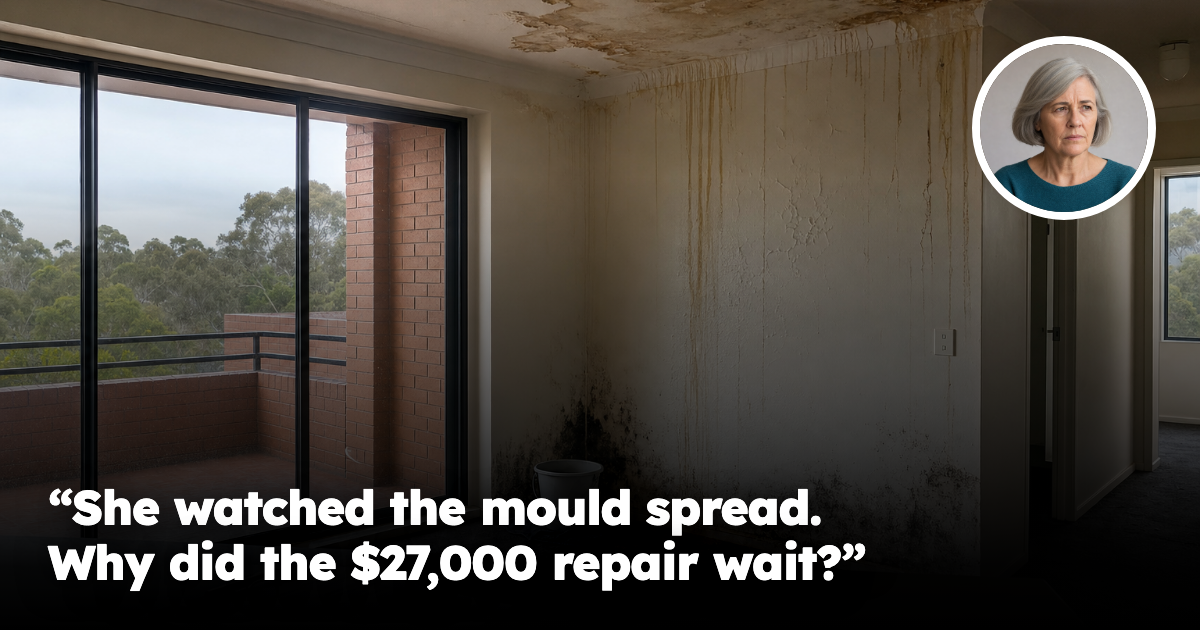
A 68-year-old long-term apartment owner watched a leak turn into stained plaster, damp skirting boards and mould. The repair estimate reached $27,000. Then the argument moved from the wall to the paperwork: was the problem inside her lot, part of common property, or a failure to act early enough?
It is the kind of building dispute that makes people ask whether apartments are still sensible investments. The harder question is whether the building was ever being assessed as an asset, rather than just as a set of walls.
The answer
Water damage rarely stays the same price for long. A small roof, balcony, plumbing or façade defect can become a much larger project once timber, plaster, electrical fittings and adjoining lots are affected. Delay also makes responsibility harder to establish. Every meeting, report, photo, invoice and notice can matter when owners are trying to work out who should pay.
The first step is not to accept the cheapest repair quote. It is to establish the source and path of the water. An independent building inspection should identify whether the defect is ongoing, whether previous patching failed, and what work is required to stop the cause before cosmetic repairs begin. A new coat of paint cannot solve an active leak.
The second step is to separate three numbers: the immediate make-safe cost, the full rectification cost, and the likely cost of delay. That third number is the one owners often ignore. A room that cannot be used, a tenant who leaves, repeated call-outs, insurance excesses and a special levy can push a tolerable repair into a serious cash-flow event.
Strata records should be read as carefully as the inspection report. Look for repeated references to leaks, waterproofing, façade work, concrete cancer, roof membranes, engineer reports and motions deferred. One isolated repair is not automatically a bad investment. A pattern of acknowledged defects followed by postponed decisions is much more serious.
What the street-level data can reveal
The building is only half the asset. The exact street determines how much demand remains while a defect is being resolved and how quickly the property can recover after the work is complete.
Ripehouse Advisory’s research compares achieved sales, rent, vacancy, days on market, buyer depth and competing supply at street and building level. Two apartment blocks can share a suburb median but have very different outcomes. A quiet, well-connected street with limited competing stock may retain tenant and buyer depth during a repair cycle. A building beside a noisy arterial, with several new towers completing nearby, may face a much larger discount even when the defect itself is identical.
That is why a suburb-level average is not enough. The relevant questions are: how many comparable apartments are available within the same walkable pocket, what rents are actually being achieved, how long do similar listings sit, and are buyers willing to return once the repair certificate is complete? Those answers help distinguish a temporary building problem from a weak underlying asset.
What should an owner do?
Start a defect file. Keep dated photographs, moisture readings, correspondence, meeting minutes, quotes and every response from the strata manager. Ask for the relevant maintenance plan, insurance position and history of prior repairs. If the source is disputed, commission an independent report before arguing about liability.
Then model the property under three scenarios: repair within three months, repair within twelve months, and repair requiring a special levy. Include lost rent, vacancy, borrowing costs and the effect of selling into an unresolved dispute. The purpose is not to panic. It is to replace a vague fear with a decision that can be tested.
For an investor considering a purchase, inspect the common areas, read the strata minutes and ask direct questions about unresolved defects. A clean apartment inside a poorly maintained building is not a clean investment. Conversely, a building with a known, funded and properly managed repair can offer a better entry point than a superficially perfect property with hidden risk.
The opportunity
The lesson is not that apartments should be avoided. It is that building risk must be priced at the address level. The strongest property decisions combine physical due diligence with evidence about the street’s demand, resale audience and competing supply.
The right apartment, in the right building and on the right street can remain a durable investment through a repair cycle. Headlines create fear; disciplined records and street-level data create an opportunity. For the full framework, download Ripehouse Advisory’s Top Five Investment Markets ebook, or book a discovery call to test a specific address against the numbers.
If there's a specific street you're weighing up right now, check its Street Score first — it's free, takes ten seconds, and tells you whether that street is pulling the suburb average up or riding on it.
Frequently asked questions
If an apartment has water damage, what should be checked first before agreeing to repairs?
The first step is to establish the source and path of the water, not just accept the cheapest quote. An independent building inspection should determine whether the defect is ongoing and what work is needed to stop the cause before cosmetic repairs begin.
Why can a leak turn into a much bigger and more expensive strata dispute?
Water damage can spread into timber, plaster, electrical fittings and adjoining lots, which increases the repair scope. Delay also makes it harder to establish responsibility, and added costs like lost rent, insurance excesses and special levies can grow quickly.
What records matter most in an apartment leak or mould dispute in Australia?
Dated photos, moisture readings, correspondence, meeting minutes, quotes and every response from the strata manager are important. Strata records should also be checked for repeated references to leaks, waterproofing issues, façade work, concrete cancer, roof membranes, engineer reports and deferred motions.
How can an owner tell whether the problem is just a one-off repair or a bigger building risk?
One isolated repair is not automatically a bad sign, but a pattern of acknowledged defects followed by postponed decisions is more serious. The article suggests reading strata records and looking for repeated, unresolved maintenance issues over time.
Why does the exact street matter when buying an apartment with a building issue?
Street-level demand can affect how well a property holds up during a repair cycle and how quickly it recovers afterwards. The article says to compare achieved rents, vacancy, days on market, buyer depth and competing supply at street and building level, not just the suburb median.
General information only. It does not take your objectives, financial situation or needs into account, and nothing here is legal, financial, taxation or investment advice specific to your circumstances.