News · 24 August 2026 · 5 min read
'I went to the tribunal like everyone says to. They told me I couldn't even apply — I was never in the queue'
She kept the renovation going after her husband died. When the builder stopped turning up, she did what everyone says to do — and found out the tribunal door has a government antechamber in front of it, locked behind a certificate nobody had ever mentioned.
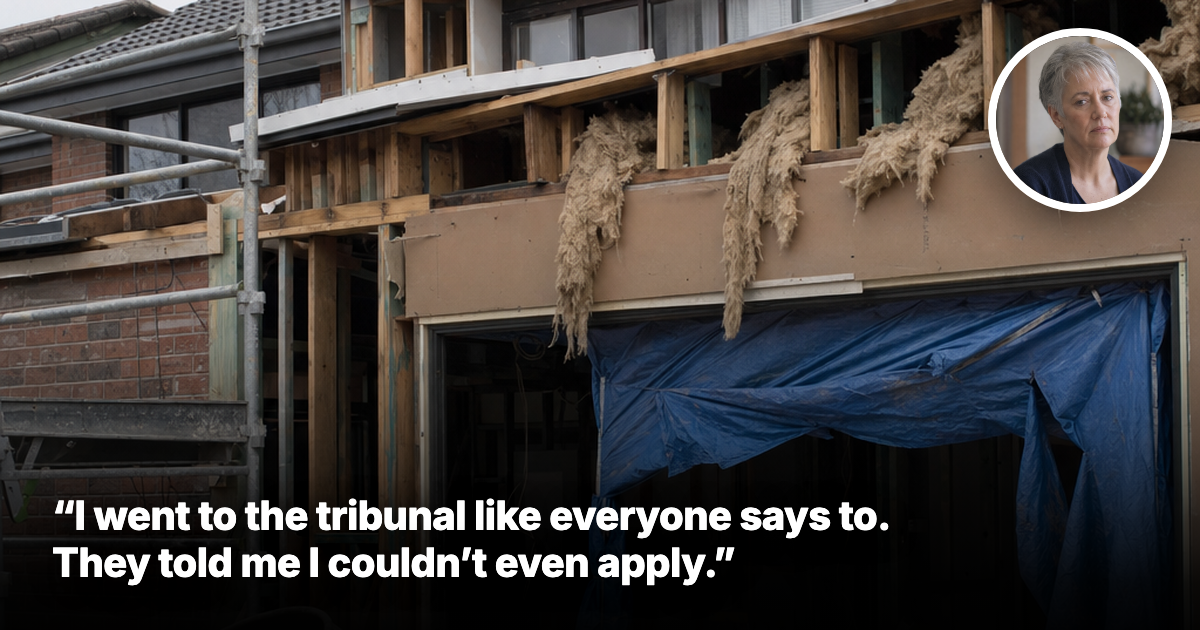
'I did everything in the right order. I kept paying, I kept records, I went to the tribunal like everyone says to. And they told me I couldn't even apply — I needed a certificate from a process nobody had ever mentioned. Fourteen months, and I was never actually in the queue. How is a person supposed to know that?'
She is 61, and she asked us this last month. Her husband died suddenly in March, halfway through a $387,000 renovation of the home they had raised their kids in — kitchen, two bathrooms, the back of the house opened up. She kept the build going because stopping felt like losing twice.
The builder slowed. Then he stopped turning up. She had paid $61,000 in variations by then, and the house sat half-sheeted through winter, tarps where the bifold doors were meant to be.
She did what every bit of advice on the internet says to do. She gathered her records, wrote her chronology, and sat down to lodge a tribunal application.
The form asked for a certificate she had never heard of.
The door she was never actually standing in front of
Here is what nobody tells you about building disputes in this country: for most of them, you cannot simply apply to the tribunal. The law requires you to go through a government-run dispute resolution process first — a conciliation service, run by a public officer — and the tribunal will not accept your application unless that process has issued you a specific certificate. The application must arrive with a copy of it attached.
No certificate, no application. No application, no hearing. The tribunal door everyone points you toward has an antechamber in front of it, and the only key is a piece of paper most homeowners have never been told exists.
She had spent fourteen months writing letters to a builder who had stopped answering, believing she was "exhausting her options" before the tribunal. She was never in any queue at all.
The part that punishes you for being reasonable
It gets sharper. The dispute resolution service can assess your dispute as "not suitable" and reject the referral — and one of the stated grounds is that you failed, without reasonable excuse, to take reasonable steps to resolve the dispute yourself before coming to them.
Read that again. The system standing between you and the tribunal can turn you away for not having tried hard enough on your own first — which is precisely what most decent people do for months, sometimes years, before they ask anyone for help. Her fourteen months of patience were not just wasted. Under the wrong assessment, they could be recorded as the reason the process would not take her.
There is a review path — a written submission within ten days of the certificate, an internal review, a decision within ten business days. A ten-day clock, running from a document most recipients do not understand, on a deadline most recipients miss.
The agreement that evaporates
Say you do everything right. You refer the dispute, it is accepted, you sit across a table, and the builder agrees to come back and finish. That agreement gets written into a formal record — actions, dates, signatures.
If he does not show up, you can give notice that the action was not taken. And here is what the law says happens next: the record of agreement ceases to have effect. Not "is breached." Not "can be enforced." It evaporates, as a matter of law, and the only thing that survives is the paper trail proving it existed.
You can even ask to withdraw from the process entirely — and the officer running it can refuse to let you, if what your dispute has revealed looks like evidence the builder broke building law. You can walk in. You cannot necessarily walk out.
And if you do walk out with permission, no certificate can be issued. The tribunal door closes behind you.
To be fair about why it exists
Nobody designed this to be cruel. Most building disputes genuinely do settle faster and cheaper across a table than across a tribunal, and the filter keeps thousands of matters a year out of a system that would otherwise collapse under them. The rejection ground exists to stop people outsourcing arguments they never tried to have. The builder in her story was not a cartoon villain — his business was failing, and he was drowning in his own way.
The injustice is not the design. It is that the system assumes a knowledge nobody is required to give you. No one is obliged to tell you the certificate exists. Not the builder, not the contract, not the tribunal website's front page. You find out the way she did — at the end of your patience, at the bottom of a form.
What it means for you
Her dispute was always going to turn on one house, on one street, with one contract. But the outcome is being decided by something even more local than that: a process attached to her address and her paperwork, invisible from every angle a buyer or owner ever inspects.
We see the same shape in the data every week. Two houses four hundred metres apart can share a suburb, a median price, a school catchment and a growth rate — every number in a standard suburb report identical — and be completely different assets underneath. The best and worst streets in a single suburb routinely show a 20 to 30 per cent spread in effective yield once you measure achieved rents, real vacancy and true days on market instead of averages. A suburb median has never once stood in a queue, signed a variation, or discovered a certificate requirement at month fourteen.
That is why the boring questions are the valuable ones. Before you sign a building contract, ask the questions she now asks everyone: if this goes wrong, what is the exact sequence — who do I call first, what certificate do I need, what clock starts when? If you are mid-dispute, find out whether your matter needs the conciliation gate before you spend another month being reasonable. And if you are buying, remember that the contract clauses that decide whether a builder can recover variations, the cooling-off rights that can sit dormant for years, and even winning at the tribunal and actually collecting are all different problems with different gates.
She has her certificate now. The tribunal application went in last month, fourteen months after it should have. The house will be finished by someone else, and the numbers will be what they are.
The lesson she keeps repeating is the one worth keeping: risk you cannot see is a threat. Risk you can read in advance is a line item — and a priced line item is an advantage over every other owner who assumes the door everyone points to is the door you actually walk through.
She did everything in the right order. She just did it in front of the wrong door — because nobody had ever told her the right one existed.
If there's a specific street you're weighing up right now, check its Street Score first — it's free, takes ten seconds, and tells you whether that street is pulling the suburb average up or riding on it.
Frequently asked questions
Why couldn’t the homeowner go straight to the tribunal over her building dispute in Australia?
For most building disputes, the tribunal will not accept an application until the matter has gone through a government-run dispute resolution process first. The application must include a specific certificate from that process.
What is the certificate she needed before filing with the tribunal?
It is a certificate issued by the government conciliation or dispute resolution process showing the matter has gone through the required first step. Without it, the tribunal application cannot be lodged.
Can a homeowner be rejected from the dispute resolution process for not trying hard enough to resolve the issue first?
Yes. The article says one stated ground for rejection is failing, without reasonable excuse, to take reasonable steps to resolve the dispute before seeking help. That means months of chasing the builder may still be assessed against the homeowner.
What happens if the builder agrees to return and finish the work during conciliation, but then doesn’t come back?
The agreement is recorded formally, but if the builder does not do the agreed action and notice is given, the record of agreement ceases to have effect. The paper trail remains, but the agreement itself does not continue.
What should someone check before signing a building contract or starting a dispute?
The article says to ask the exact sequence if something goes wrong: who to call first, what certificate is needed, and what clock starts when. It also warns that building disputes, contract variation rights, cooling-off rights and tribunal recovery are separate issues with different gates.
General information only. It does not take your objectives, financial situation or needs into account, and nothing here is legal, financial, taxation or investment advice specific to your circumstances.