News · 25 August 2026 · 5 min read
“The quote was fixed at $168,000. Then one inspection found a $28,000 problem.”
A renovator was quoted $168,000 for a fixed-price project. Then demolition exposed a hazardous-material problem that added $28,000 — revealing what fixed price actually fixes.
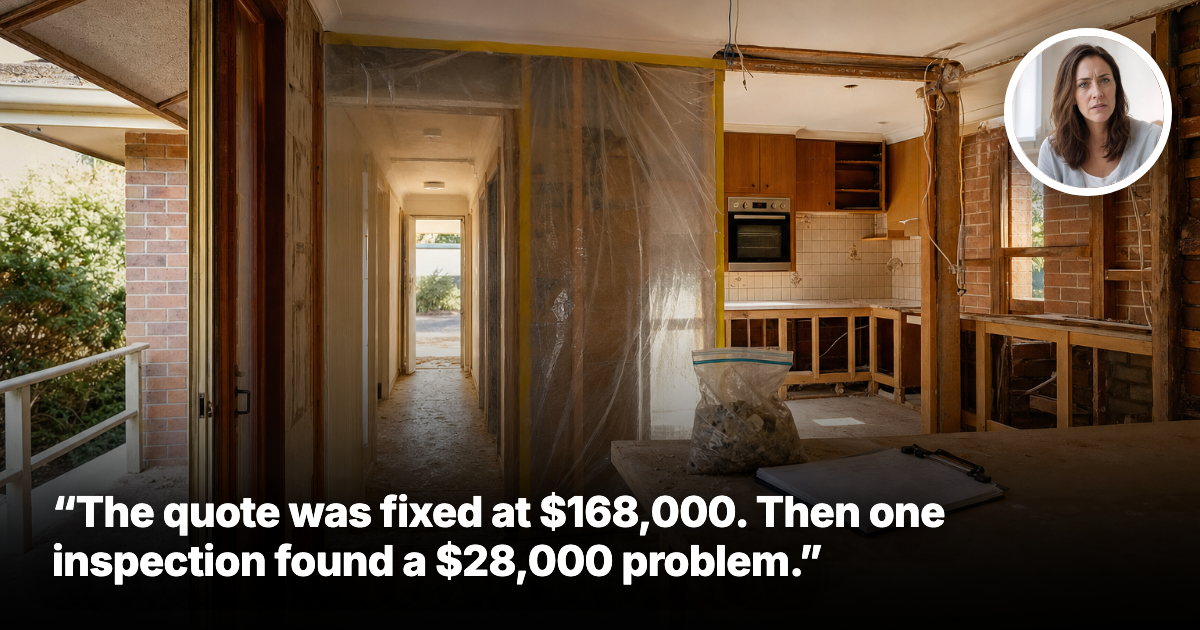
A 43-year-old woman had done what renovation advice tells buyers to do. She bought a tired brick house, allowed for a substantial refurbishment and obtained a fixed-price building quote before work began.
The quote was $168,000.
Then the demolition plan changed.
The builder found suspect material in the old eaves and around a service area. Testing and licensed removal added almost $28,000. The kitchen had not become more ambitious. The extension had not grown. A cost that had looked like part of the builder’s risk had become her problem because the existing building contained something nobody could safely price from a walk-through.
Her question was blunt: “If the contract is fixed price, how can I suddenly owe another $28,000 before the first wall is even rebuilt?”
The answer: fixed price does not mean fixed unknowns
A fixed-price building contract usually fixes the price of the work described in the contract. It does not magically convert an unseen hazardous material, unstable structure, concealed service or missing approval into ordinary included work.
The critical words are not “fixed price”. They are the scope, exclusions, assumptions and variation process sitting behind those words.
If the quote assumed that demolition would reveal ordinary, safe materials, and testing later establishes that specialist removal is required, the contractor may have a legitimate reason to seek a variation. That does not make every variation fair. It means the investor has to separate three questions:
1. Was the condition genuinely unknown and incapable of reasonable discovery before signing?
2. Does the contract clearly allocate that risk to the owner or builder?
3. Was the proposed extra work priced and approved through the agreed process?
Those questions matter more than the marketing label on the front page.
Hazardous material is also not a place to save money by improvising. In an older house, a visual inspection cannot reliably identify every material that needs testing. If a result indicates a regulated hazard, the removal method, clearance process and disposal obligations can add time as well as money. A builder who stops work until the issue is resolved may be protecting the household, the workers and the future buyer—not simply padding the account.
That is the uncomfortable part of the story. The extra $28,000 was painful, but proceeding without proper testing could have created a much larger problem: unsafe work, a stalled project, an insurance dispute or a future sale where the renovation could not be properly evidenced.
The line between a real variation and a lazy variation
Owners are often told to “get everything in writing”. That is too vague to be useful. For each proposed change, ask for five specific things:
- the physical condition that triggered it;
- photographs or test results;
- the contract clause that says who carries the risk;
- the exact work being added or removed; and
- the price, time effect and approval deadline.
Do not approve a sentence that says “allow $28,000 for asbestos” if the document does not say whether that includes testing, containment, removal, transport, disposal, clearance and making good. A low-looking variation can simply move the expensive part into the next invoice.
The same discipline applies to structural work. “The footing needs upgrading” is not a complete explanation. The owner needs to know what was discovered, who assessed it, what design or certification is required and whether the number is a firm price or an estimate.
The lesson from the building contract where variation recovery hit a legal bar is not that every builder is untrustworthy. It is that a contract can be technically signed and still commercially unreadable. A number is not a budget until its assumptions are visible.
Why suburb data would not have saved her
This is also where property research has a blind spot. A suburb median can tell you what comparable homes have sold for. It cannot tell you whether the house behind one particular front door contains hazardous material, has an unapproved alteration or needs a specialist demolition sequence.
Two houses can sit four hundred metres apart and share the same suburb median, school catchment, council area and headline growth rate. Yet one may have a clean renovation path and the other may carry a $28,000 pre-construction surprise. At street level, the difference can show up in buyer depth, days on market and the discount demanded for a project that looks difficult.
Ripehouse Advisory’s street and suburb data is useful precisely because it starts where broad averages stop. A street heatmap, achieved days-on-market pattern and supply-and-demand picture can help an investor test whether the finished property is likely to attract enough buyers and tenants to justify the building risk. It cannot inspect a wall—and no data platform should pretend that it can—but it can prevent an investor from underwriting a renovation solely from a postcode median.
That distinction is important. Physical due diligence and market due diligence solve different problems. You need both.
What she would do differently next time
Before signing, she would commission a targeted pre-demolition assessment where the age and construction method justified it. She would ask the builder to list every allowance and exclusion in plain language. She would keep a contingency separate from the deposit and not count it as available renovation profit. She would also make approval authority explicit: who can instruct work, in what form, and up to what dollar amount?
She would still use a fixed-price contract. Fixed pricing can be valuable because it makes the known scope easier to finance and compare. The mistake is treating it as a substitute for understanding what the known scope excludes.
The recent cost-plus renovation blowout shows the obvious version of the risk. This case is harder because the contract looked safer. The property sale where a hidden condition changed the buyer’s numbers shows the same principle from another angle: an asset is not just its suburb statistics; it is the physical and legal detail attached to the particular asset.
The $28,000 did not make the house a bad investment by itself. It changed the feasibility calculation. Once the revised cost, holding period, end value and local buyer demand were placed in the same spreadsheet, the decision became clearer: continue, renegotiate the scope or stop before spending more.
That is the pro-investment lesson. Renovations are not the enemy. Unpriced assumptions are. The investors who build durable portfolios do not avoid every difficult property; they identify the risk early, price it honestly and buy only when the right house, the right street and the right margin still work together.
If there's a specific street you're weighing up right now, check its Street Score first — it's free, takes ten seconds, and tells you whether that street is pulling the suburb average up or riding on it.
Frequently asked questions
What does a fixed-price building contract actually cover in an Australian renovation?
It usually fixes the price of the work described in the contract, not every unknown issue hidden in the existing building. If demolition reveals hazardous material, unstable structure, concealed services or missing approvals, those may fall outside the original fixed price.
Why can a renovator be asked to pay more after demolition if the quote was fixed?
Because a condition that could not be reasonably discovered before signing may trigger a variation. The key issue is whether the contract clearly allocated that risk and whether the extra work was priced and approved through the agreed process.
What should I ask for before approving a renovation variation?
Ask for the condition that triggered it, photos or test results, the contract clause allocating the risk, the exact work being added or removed, and the price, time effect and approval deadline. That makes it easier to tell a real variation from a vague one.
Does suburb or median data help identify hidden renovation problems?
No. Suburb data can help assess market demand and resale potential, but it cannot tell you whether a specific house contains hazardous material, unapproved alterations or other concealed issues. You still need physical due diligence on the property itself.
What is the main lesson from the $28,000 extra cost in this story?
A fixed-price quote is only as good as its scope, exclusions and assumptions. The extra cost changed the feasibility of the project, so the investor needed to reassess the numbers before deciding whether to continue, renegotiate or stop.
General information only. It does not take your objectives, financial situation or needs into account, and nothing here is legal, financial, taxation or investment advice specific to your circumstances.