
News · 25 August 2026 · 5 min read
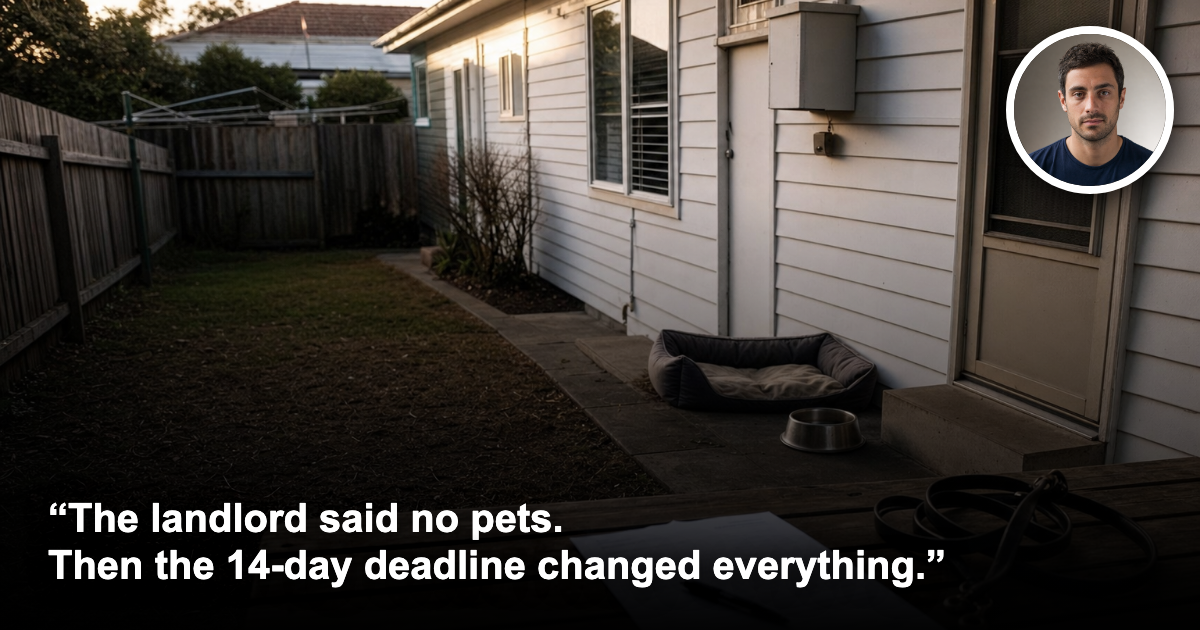
“The landlord said no pets. Then the 14-day deadline quietly changed everything.”
A renter was asked for an $1,800 pet bond after a landlord missed a 14-day approval deadline. The rules around pet requests, refusal grounds and conditions are more specific than many owners or tenants realise.
The question
A 27-year-old man had spent nearly a year looking for a rental that would accept his elderly dog. When he finally found one, he submitted the pet request in writing before moving in.
The lessor’s first response was blunt: “No pets.” There was no explanation, no reference to the property’s fencing, and no written decision in the required form. Then the conversation stopped.
Fourteen days passed. Then fifteen. On day seventeen, the property manager called and said the dog could stay — but only if the tenant paid an $1,800 “pet bond”, increased the rent by $35 a week and agreed to replace every carpet at the end of the tenancy.
His question was simple: “Can they change the rules after ignoring my request, and can they charge me to keep the dog?”
The answer
The short answer is that a pet request is not an invitation for a landlord to impose whatever price or condition they prefer.
A tenant can request approval for a stated pet in the approved form. The lessor has 14 days to respond. The response must say whether the request is approved or refused. If it is refused, the response must identify the permitted ground and explain why that ground applies. If conditions are proposed, they must be stated in the written approval.
If the lessor does not respond within the time allowed — or responds without the required information — the pet is treated as approved. A message saying “no pets” is not enough on its own. Silence is not a permanent veto that can later be converted into a more expensive approval.
That does not mean every pet must be accepted without limits. The premises may be unsuitable because they lack appropriate fencing or open space. A pet may create an unacceptable health or safety risk, breach a body corporate rule, contravene another law, or be likely to cause damage that could not practically be repaired for less than the existing bond. A tenant can also be refused for failing to agree to a reasonable condition that is actually permitted.
The key is that the refusal must fit one of the available grounds. “No pets allowed” is not a free-standing ground merely because it is written in an advertising template.
What can a reasonable condition look like?
The rules separate a genuine pet-related condition from a disguised rent increase.
A dog that is not ordinarily kept inside may be required to stay outside. If the animal can carry parasites that could infest the premises, professional fumigation at the end of the tenancy may be a reasonable condition. If the pet is allowed inside, professional carpet cleaning at the end may also be reasonable.
Those conditions are different from a blanket demand for brand-new carpets, an extra cash deposit or a higher weekly rent. The condition must relate to keeping the pet, be reasonable having regard to the animal and the premises, and appear in the written approval.
The tenant remains responsible for nuisance caused by the animal and for damage it causes. Damage caused by the pet is not treated as ordinary fair wear and tear. Approval is not a licence to let the dog destroy the property; it is a controlled permission with responsibilities on both sides.
The part many renters miss
Pet approval can continue for the life of the pet. It is not automatically wiped out because the tenancy agreement is renewed, the owner changes, or the managing agent changes. That matters when a rental is sold: the new owner does not necessarily get to start the pet application from zero simply because the name on the paperwork has changed.
For property owners, this is why a rental file needs more than a lease and a bond receipt. The file should show the request, the response, the precise conditions and any evidence supporting a refusal. A casual email from an old agent can become a live property issue years later. It belongs beside the records discussed in our guide to repeated rental breaches, because compliance is easiest to prove when the file is complete.
For tenants, the practical lesson is equally direct. Keep the request, the date it was sent, every response and every proposed condition. Do not treat a phone call as the whole record. A written timeline is often more valuable than an angry exchange after the fact. The same discipline matters when an owner enters a property: consent and access records can matter just as much as the lease itself.
Ripehouse Advisory’s property research treats a rental as a street-level asset, not just a suburb median. Two otherwise similar houses can have very different tenant demand, vacancy exposure and achievable rent because of fencing, outdoor space, floorplan and nearby noise. Those same physical details can decide whether a pet request is easy, difficult or impossible. A suburb-level vacancy number will not tell an owner whether the yard can safely hold a dog; a street-and-property review might.
That is also why a property’s value cannot be reduced to its headline rent. A $35 weekly premium looks attractive until it creates a smaller tenant pool, higher turnover or a dispute over an invalid condition. The best investment is often the asset whose practical rules are understood before the lease is signed. A useful diligence file should also preserve the tenant-history records that explain how the asset actually performs between leases.
The investment takeaway
The rental market is full of apparently small clauses that become expensive when nobody reads the procedure behind them. Pet approval is one of those clauses: there is a deadline, a written-response requirement, limited refusal grounds and a clear boundary around extra charges.
For an investor, that is useful certainty. Assess the actual dwelling, the street’s tenant demand and the property’s constraints before buying. For a tenant, it is a reason to document the request instead of accepting an improvised charge. The right property, on the right street, understood through the right data, still creates durable investment opportunity — and good decisions begin with knowing which rules have already started running.
If there's a specific street you're weighing up right now, check its Street Score first — it's free, takes ten seconds, and tells you whether that street is pulling the suburb average up or riding on it.
Frequently asked questions
In Australia, what happens if a landlord doesn’t answer a pet request within 14 days?
If the lessor does not respond within the 14-day period, or responds without the required information, the pet is treated as approved. A simple “no pets” message is not enough on its own.
Can a landlord in Australia add a pet bond, extra rent or a big carpet replacement condition after saying no to a pet?
Not just because they missed the deadline. The article says a pet request is not an invitation to impose whatever price or condition the owner prefers, and a higher weekly rent or extra cash deposit is not a proper pet condition.
What reasons can a landlord use to refuse a pet request?
A refusal must fit one of the permitted grounds, such as unsuitable fencing or open space, an unacceptable health or safety risk, a body corporate rule, another law, or likely damage that could not practically be repaired for less than the existing bond.
What kind of pet conditions are considered reasonable?
Examples in the article include keeping a dog outside if it is not ordinarily kept inside, professional fumigation if parasites are a risk, or professional carpet cleaning if the pet is allowed inside. The condition must relate to the pet and be stated in the written approval.
If a property is sold or the managing agent changes, does pet approval start again?
No. The article says pet approval can continue for the life of the pet and is not automatically wiped out by a lease renewal, owner change or managing agent change. Keeping the written request, response and conditions is important.
General information only. It does not take your objectives, financial situation or needs into account, and nothing here is legal, financial, taxation or investment advice specific to your circumstances.