News · 19 August 2026 · 6 min read
'My plans were approved by everyone who assessed them. The build was refused anyway — because a stranger never signed a form'
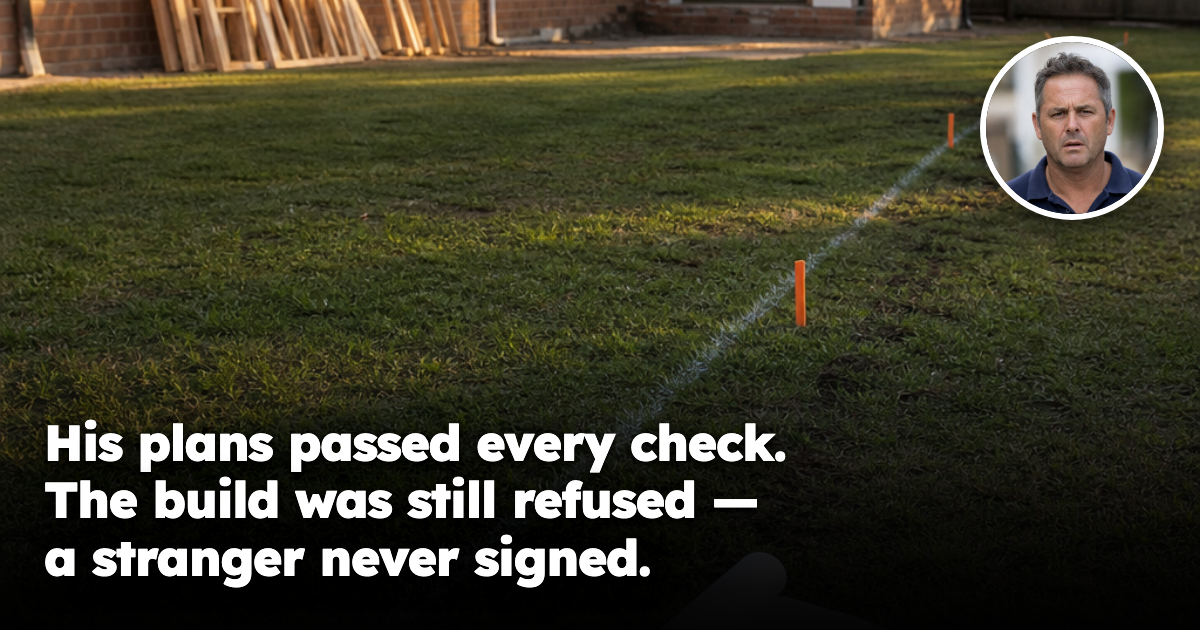
He spent $34,000 on design, engineering and survey work for a rear extension. Every technical assessment came back compliant. It still could not be approved, because one signature was missing — and the person who held it owed him nothing.
A client sent us a question this year that we now use as a teaching example, because it exposes something almost nobody checks before buying.
He is 47, an electrical contractor, and he had done this properly. He bought the block in 2019 — a brick house on a generous rear yard, in a suburb he had researched for two years. The plan: a rear extension with a fourth bedroom, second bathroom and family room opening onto the yard.
He engaged a designer, an engineer and a surveyor. Over eleven months he spent roughly $34,000 getting the documents to where everyone agreed the design worked.
And it did work. Every technical assessment came back compliant. There was no dispute about a single figure.
The application could not be approved anyway.
The question he asked us
His email was three sentences long, and the last one is the reason we are writing this:
"Nobody told me my approval depended on somebody else's permission. Who actually decides what I can build on land I own?"
It is a better question than he realised, and the answer surprises most owners.
The answer: the prohibition binds the decision-maker, not you
Where land is subject to a registered easement — or, in some cases, a registered statutory covenant held by a public authority — the legislation governing building approvals does not merely ask the assessor to consider that fact. It says the assessment manager must not approve the application unless each registered holder has consented to the building work.
Read that carefully, because three words carry the entire outcome.
"Must not approve." A prohibition, not a consideration. No balancing exercise, no "have regard to". A compliant, well-designed proposal is simply not approvable. And the prohibition is aimed at the assessor, not at you. Your land use isn't restricted — the decision has been relocated to somebody else.
"Each." Not the main holder, not a majority. Every registered holder. One block can carry more than one.
"Consented to the building work." Consent to this design, not a general blessing of the site. Change the design materially and you may be asking again.
His block had a registered easement across the rear — the exact strip his family room was designed to sit near. He knew it existed; he had read the title. This is a different animal from a private restrictive covenant capping what may be built, where a council refuses on the merits. What he had not understood was that the easement did not merely tell him where he could not build. It handed a third party a say over what he built nearby, and that party had no obligation to consider his renovation, his timeline, or his $34,000.
The two details that make this bite harder
First: the consent is ranked alongside a permit. The legislation defines the easement holder's consent as a relevant authorisation — the same category, in the same provision, as a development permit itself. Not a courtesy letter. The supporting documents must state whether it is necessary. It is a gate on the application form, not a problem discovered later.
Second — and almost nobody knows this — the statute expressly contemplates that such an authorisation can "lapse or be withdrawn." A consent obtained is not a consent kept. The permission your approval stands on is held by another party, and the law anticipates it may not be there when you next need it.
Why there is exactly one exception — and why that matters
There is a single carve-out in the provision, drafted with real precision: it applies only to certain classes of residential building, only where the covenant is a specific type of noise covenant held by the State, and only where the relevant building standard deals with reducing noise from outside.
That narrowness is the point. The drafter clearly knew how to create an exemption — and created exactly one, built to fit a single situation. Everything outside that one narrow door sits inside the veto. One carefully-constructed exception is far stronger evidence of deliberate design than a long list would be.
The contrast elsewhere in the same legislation is striking. There are circumstances where fire-safety building work may be approved even though it is inconsistent with the local planning scheme — the law will override an entire planning instrument when life safety demands it. It will not override one private signature attached to an easement. That tells you where this requirement sits in the hierarchy.
It is worth separating this from two constraints that look similar. A designation that changes how you must build is attached to the land by an authority and never stops the build — it makes it dearer. A safety certificate running on a timer attaches to a structure you own. Easement consent is neither: no designation, no certificate, no expiry. Just a signature you do not hold.
What it means for you
Here is the part that connects to how we assess property, and it is the reason this is a street question rather than a suburb question.
Two houses can share every metric in a market report. Same suburb, same median, same growth rate, same school catchment, same council, same zoning. What they do not share is the registered instruments attached to their individual titles and where the infrastructure physically runs beneath them.
One block has a clear rear yard and unconstrained upside. The block over the fence has a services easement across the only part of the yard worth building on, and every future improvement runs through a consent held by someone with no interest in the owner's plans. These are not the same asset. And a median cannot see an easement.
This is what street-level data exists to surface. In our research we routinely find a 20–30% spread in effective yield between the best and worst streets inside a single suburb — measured on achieved rents, real vacancy duration and true days on market. Development potential is one of the largest drivers of that spread, and registered constraints on title are one of the largest drivers of development potential. Invisible at suburb level; decisive at property level.
To be clear about the other side: easements exist for good reasons. Infrastructure has to run somewhere, and whoever maintains it must be able to reach it. The consent requirement is a legitimate protective mechanism doing a sensible job. An easement is not a defect. Plenty of easement-affected blocks are excellent investments — bought at the right price, with the constraint understood in advance.
His build went ahead, incidentally. The design was amended, the consent obtained, and it cost a further $18,500 and seven weeks — money he would not have spent had he asked the question before he bought.
Which is the lesson, and the reason we stay optimistic about property. Every one of these facts is published, registered and readable before you make an offer — a title search with the registered instruments attached is cheap and fast. Nothing is hidden. It is simply unexamined by almost every competing buyer.
Risk you can read is risk you can price. And a priced risk is not a threat — it is an edge over everyone bidding beside you who never looked.
He had walked past that strip of lawn a thousand times. He never once wondered whether someone else had a say in it.
If there's a specific street you're weighing up right now, check its Street Score first — it's free, takes ten seconds, and tells you whether that street is pulling the suburb average up or riding on it.
Frequently asked questions
Why was the rear extension refused even though the design met all the technical requirements?
Because the block had a registered easement, and the law said the assessment manager must not approve the work unless every registered holder consented. A compliant design still could not be approved if that signature was missing.
Do you need permission from an easement holder before building near that part of your land?
In the situation described, yes. The consent is treated as a relevant authorisation, so it is a formal condition of approval rather than a courtesy letter.
Can easement consent be withdrawn after it has been given?
Yes. The article says the statute expressly contemplates that this kind of authorisation can lapse or be withdrawn, so the permission is not necessarily permanent.
Is a registered easement the same as a private restrictive covenant or a planning rule?
No. The article says a restrictive covenant is a different issue, and some planning or fire-safety rules can be overridden in ways an easement consent cannot. An easement can give a third party a veto over nearby building work.
What should a buyer check before relying on future renovation or extension plans?
A title search with the registered instruments attached, including any easements or other constraints, before making an offer. The article says these risks are published and readable in advance, but many buyers never check them.
General information only. It does not take your objectives, financial situation or needs into account, and nothing here is legal, financial, taxation or investment advice specific to your circumstances.