News · 16 August 2026 · 5 min read
'My neighbour's trees have taken all the light out of my living room. I assumed there was nothing I could do — I was wrong'
He lost his afternoon light over six years and assumed the law had nothing to say about it. There is a process, it is fast, and it does not need a lawyer. But the thing that makes it interesting to an investor is what it will not do — because the gap between what the law repairs and what it refuses to pay for is exactly where amenity quietly disappears from a price.
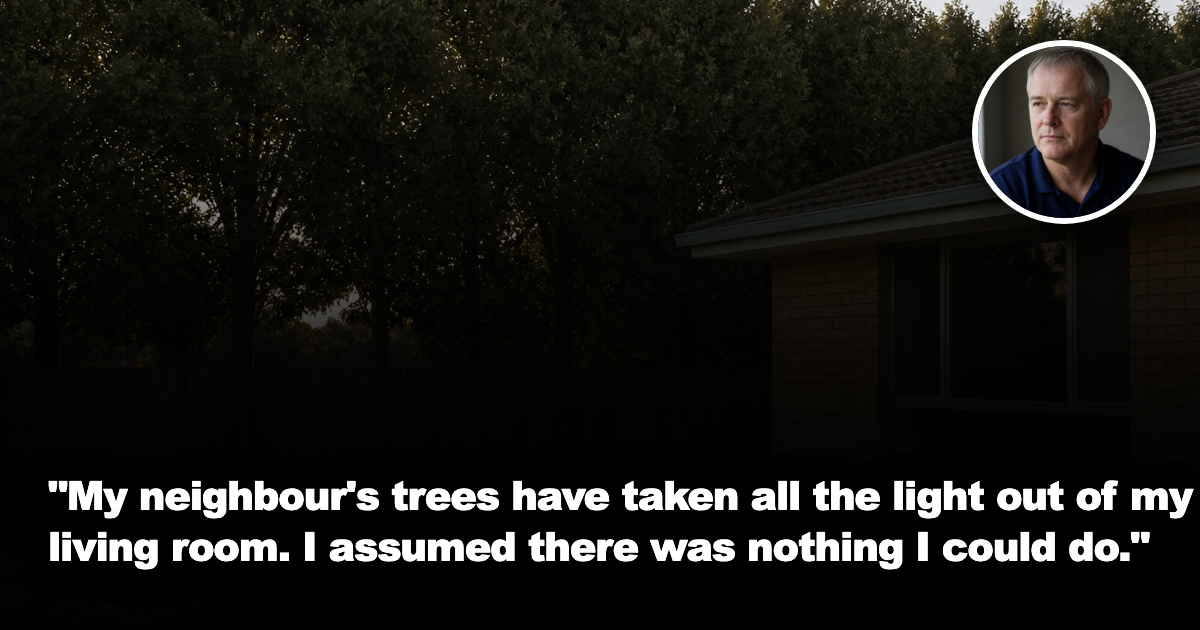
He has owned the house for twenty-two years. The living room faces north, which was most of the reason he bought it, and for fifteen years the afternoon sun came through the back windows from about two.
It doesn't any more. A row of trees on the block behind has closed over the fence across roughly six years — not planted maliciously, not neglected, just growing. Nothing has fallen. No pipe is cracked. No wall has moved. He has lost the light.
When he wrote to us, he wasn't angry. He was resigned.
"I've accepted there's nothing I can do about it. It's their tree, on their land, and it hasn't damaged anything. I just want to know how much it's costing me when I sell."
He was right about the valuation question and wrong about the first part.
There is a process, and light is expressly part of itIn several Australian states there is dedicated legislation for disputes between neighbours about trees and hedges, run through a specialist court in a fast, deliberately accessible way. Self-representation is common. Matters are usually dealt with within about three months.
Critically, it runs on two separate limbs, and almost everybody only knows about one.
The first is damage and injury — available where a tree has caused, is causing, or is likely in the near future to cause damage to your property, or is likely to injure someone. The orders here carry money: remove the tree, grind the stump, remove the roots, prune the limbs, install a root barrier, pay for the roof tiles the falling limb broke, pay to repair the sewer pipe, the cracked path, the damaged wall. Compensation for the damage is available.
The second limb is the one he didn't know existed. It applies where a hedge on adjoining land is severely obstructing sunlight to a window of a dwelling on your land, or severely obstructing a view from it. The orders are real: prune the trees and keep them at a specified height, width or shape; or remove them and replace them with a different species; and make the neighbour pay for the work.
The asymmetry nobody mentions
Here is the detail that turns this from a neighbour story into a property one. On the amenity limb, an order for compensation for the obstruction is not available.
Read that against the other limb. If the tree cracks your path, you can be paid. If the tree takes six years of afternoon light out of your living room, you can have it cut back — and that is all. The law will repair amenity. It will not price it.
That's a design choice, and it has a specific consequence: amenity loss never arrives as an invoice. A damage claim generates a quote, a receipt, a paper trail. Lost light generates nothing. It shows up later and indirectly, in a slower sale, a shorter list of interested buyers, and a price the owner attributes to "the market."
Four gates, all of which sit on a title — not a suburb
The remedy is narrower than it sounds, because the court's power is fenced by conditions every one of which is decided at the level of an individual property: the tree or hedge must be on privately owned land (a council tree on the verge is a different conversation); it must be in an urban zone to which the legislation applies; it must be on land adjoining yours; and it must meet the statutory definition — for the hedge limb that includes a height floor of about 2.5 metres, so an affected owner sometimes has to wait for the problem to get worse before the application is properly on foot.
And then the test itself: sunlight to a window of a dwelling. Not the suburb. Not the street. Not even the block. A window.
The cleanest example of street-level data we've written about
Two houses can sit side by side, share a postcode, a median, a council, a catchment and a station, and back onto the same row of the same neighbour's trees — and one has an enforceable right while the other has nothing. Because one has habitable windows facing that boundary and the other has a garage wall, a laundry and a high bathroom window.
That is the whole Ripehouse Advisory argument in one sentence, expressed for once in law rather than in data: the thing determining the outcome is smaller than any unit a suburb report can measure. It's the same reason a single street tree ten metres from a house measures differently than the same tree at twelve, and the same reason two blocks on one street with different aspect are not the same asset.
When we model streets, the spread between the best and the worst inside a single suburb routinely runs 20–30% on effective yield — measured on achieved rents, real vacancy duration and real days on market, not advertised figures. Amenity drives much of that spread, and it is invisible in the median precisely because it is never invoiced.
What we told him to do
1. Establish the four gates first — zoning, private ownership, adjoining land, definition. A title search on the neighbouring property is inexpensive and gives you the lot, the plan and every owner's full name. An application against the wrong party fails on the paperwork.
2. Build the evidence the court asks for: photographs, video, a shade diagram, an arborist where needed, and for light specifically, an expert in sunlight loss to windows.
3. Don't cut anything yourself. Pruning or removing a tree generally needs council permission first, and bushfire-prone land has its own rules.
4. Assume you won't recover your costs. Costs orders are generally not made and expert fees are worn by whoever commissioned them. The process is cheap to run and not free to prove.
5. Talk first. A final hearing generally won't be listed until the court is satisfied you tried to resolve it.
The part that should change how you buy
He has a remedy. It's faster and cheaper than he assumed, and he'll probably use it.
But notice what it cost him: six years of the main reason he bought the house, which no order can give back, and which the law has explicitly decided not to pay him for.
That is an argument for property, not against it — and specifically for property chosen properly. Everything that decided this was knowable on the day he bought: which way the windows face, what sits on the neighbouring title, how that land is zoned, how tall it will get. The remedy is reactive. Selection is not.
The best asset is the one that never needs the order — and like the question of who actually owns the ground your fence sits on, whether yours is has a definite answer that no suburb-level number will ever contain.
If there's a specific street you're weighing up right now, check its Street Score first — it's free, takes ten seconds, and tells you whether that street is pulling the suburb average up or riding on it.
Frequently asked questions
Can I do anything in Australia if my neighbour’s trees are blocking the sunlight to my living room window?
Yes. In several Australian states, there is a specialist process for disputes about trees and hedges that can deal with severe obstruction of sunlight to a window of a dwelling. The court can order pruning, removal or replacement of the hedge or trees.
Does the law let me claim compensation for losing sunlight from a neighbour’s trees?
No, not on the amenity limb described in the article. The law can repair the obstruction by ordering the trees cut back or removed, but it does not provide compensation for the loss of light itself.
What has to be true before this neighbour tree process applies?
The tree or hedge must be on privately owned adjoining land in an urban zone where the legislation applies, and it must meet the statutory definition. For sunlight disputes, the obstruction must be to a window of a dwelling, not just a general loss of amenity.
What evidence do I need if I want to make an application about blocked light?
The article says you should build evidence with photographs, video, a shade diagram, and, for sunlight matters, an expert in sunlight loss to windows where needed. A title search on the neighbouring property is also recommended to identify the correct owner and lot details.
Can I just prune the neighbour’s trees myself if they are blocking my light?
No. The article says you should not cut anything yourself, because pruning or removing a tree generally needs council permission first, and bushfire-prone land has its own rules.
General information only. It does not take your objectives, financial situation or needs into account, and nothing here is legal, financial, taxation or investment advice specific to your circumstances.