News · 19 August 2026 · 6 min read
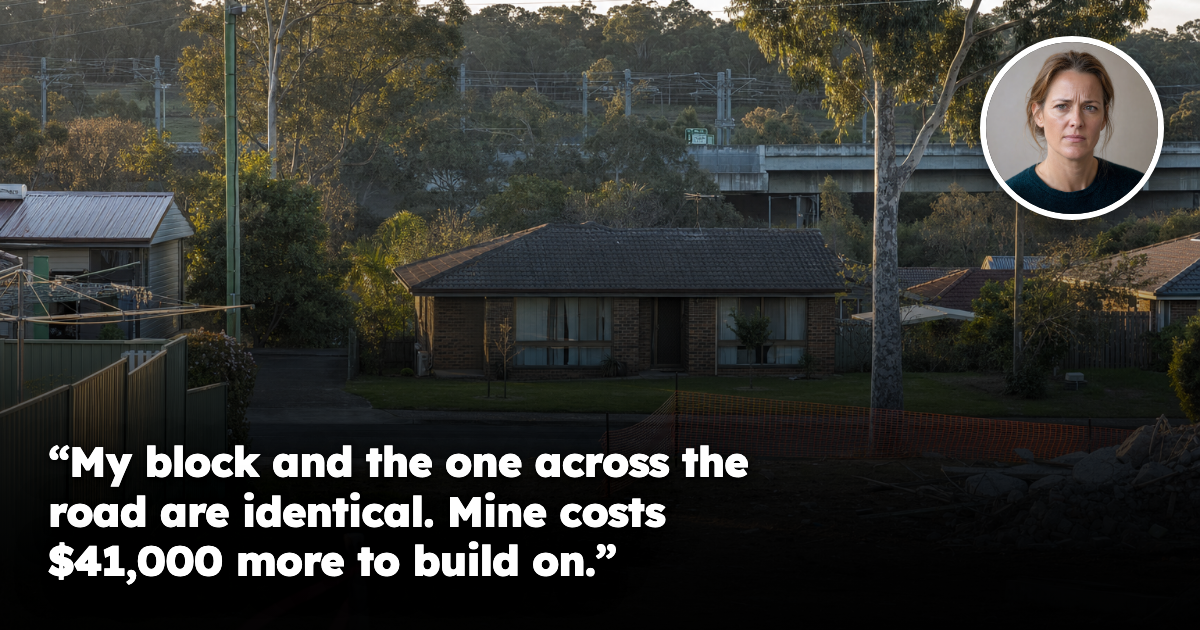
'My block and the one across the road are identical. Mine costs $41,000 more to build on — because of a line on a map'
Two blocks face each other across the same street, in the same suburb, with the same median and the same council. One of them carries a permanent construction premium on every dwelling that will ever be built on it. The difference is twenty-eight metres and a designation almost nobody reads before they buy.
We get asked a version of this constantly, and almost nobody sees it coming, because the thing that causes it is invisible from the footpath, absent from every listing, and missing from every suburb report ever written.
A woman in her late thirties came to us this month with a knockdown-rebuild she had spent two years planning. She is a physiotherapist, and she bought the old three-bedroom house in 2018 intending to replace it. She engaged a designer and sent the plan to three builders.
The quotes came back higher than she had modelled — consistently, by the same margin, from all three. One builder's explanation was a single line she has since read about forty times:
"Your block is inside a transport noise corridor, so the design has to meet the acoustic construction requirements. That's the difference."
The extra was around $41,000 — mostly glazing, wall and roof construction, and mechanical ventilation, because a house that has to keep noise out cannot rely on open windows for airflow.
Her question was the obvious one:
"There is a block directly across the road from mine. Same street, same size, same suburb, same council. It is not in the corridor. How can a road be loud on one side and not the other?"
The answer: it is not a noise map. It is a legal designation with a hard edge.
A transport noise corridor is not a description of how loud a place is. It is a designation — a formal act, made by an authority, published in a gazette notice, recorded in the local planning scheme. Land is either inside it or outside it. There is no gradient.
And it exists for one purpose: it switches on building assessment provisions aimed specifically at reducing noise inside certain classes of building — houses, townhouses and units. It does not stop you building. It changes how the building must be constructed, and that is where the money goes.
So her block is not "louder". Her block is inside a line, and the block across the road is outside it.
Why the line falls where it does — and the part that surprises everyone
There are two different authorities that can designate land as a transport noise corridor, and they do not have the same reach.
A local government may designate land within 100 metres of a road under its control, extending to more than 100 metres but not more than 200 metres only if noise at that distance has actually been measured, in an approved way, at at least 58 decibels — and only if the road carries an annual average daily traffic rate of at least 3,000 vehicles.
The state transport authority may designate land within 100 metres of railway land or a State-controlled road — extending to more than 100 metres but not more than 250 metres where noise has been measured at at least 70 decibels from rolling stock, or at least 58 decibels from traffic.
Read those side by side and the asymmetry is stark. The outer ceiling is 200 metres for a council road and 250 metres for a railway or State-controlled road. Fifty metres of difference, for identical noise, decided entirely by which authority controls the strip of bitumen or track at the end of your street. And the council limb carries the traffic-volume precondition; the state limb carries no equivalent volume requirement at all.
Her street backs onto infrastructure controlled by the state. Her block sits at 186 metres. The block across the road sits at 214 metres. The corridor's outer edge runs between them.
And this is why a suburb report could never have told her
This is the point we make to every investor who asks why we work at street level, and this case is as literal as it gets.
Two blocks. Same suburb, same median, same growth rate, same school catchment, same council, same postcode — same everything a suburb report contains. A twenty-eight-metre difference decides that one carries a permanent construction premium on every dwelling that will ever be built on it, and the other does not. A median averages blocks on both sides of the line, destroying precisely the information that mattered.
It is the same reason we measure achieved rents, real vacancy duration and genuine days-on-market at street level. Inside one suburb, the gap between the best and worst streets routinely runs to 20–30% on effective yield — and the causes are almost always physical and specific: what the block is near, what runs under it, what has been drawn across it.
We have written before about how much a single line on a plan can change an asset — a public road running through a suburban backyard, and a road project that takes part of a front yard and deducts the uplift from the compensation.
The disclosure duty that runs to the wrong person
Now the genuinely counter-intuitive part.
The designation is published and is recorded. The authority must include a record of the corridor in the planning scheme, identifying the land and the noise levels — and that record must be set out in a way that readily allows an applicant for a building development approval to identify whether their land is inside a corridor.
Read that phrase again. The readability duty is aimed at the person applying to build. Not the person deciding whether to buy. By the time the law guarantees the information will be easy to find, you already own the land.
There is a second wrinkle. Land in a corridor must be identified specifically in the gazette notice — or only generally in it, and specifically in separate documents merely described in it. Your address does not necessarily appear anywhere in the notice that binds it.
None of that is a scandal. It is a public-health instrument doing a sensible job, and the construction it requires genuinely works — the resulting house is quieter and cheaper to run. Being inside a corridor is not a defect, and plenty of corridor blocks are excellent investments. Her build went ahead. It is the same lesson as the pool certificate that quietly expires: the obligation was always there, and nothing announced it.
What it means for you
The distance bands, the decibel thresholds, the traffic-volume precondition and the corridor records are all published documents. They can be read before an offer, not after a quote. A risk you can read is a risk you can price — and a priced risk is not a problem, it is a negotiating position. She would still have bought the block. She would have bought it for less.
Property does not punish investors for the risks they priced. It punishes them for the ones they never went looking for — which is exactly why buyers who do the street-level work keep acquiring good assets from sellers who only ever read the suburb report.
She is building. She simply paid $41,000 to learn something sitting in a public record the whole time she owned the land.
She had walked across that road hundreds of times. She never once wondered whether the law thought the two sides were the same place.
If there's a specific street you're weighing up right now, check its Street Score first — it's free, takes ten seconds, and tells you whether that street is pulling the suburb average up or riding on it.
Frequently asked questions
What is a transport noise corridor in Australia, and does it stop you from building on the land?
A transport noise corridor is a formal legal designation recorded in planning documents and gazette notices. It does not stop development, but it changes how certain homes, townhouses and units must be built to reduce noise inside the building.
Why can two blocks on opposite sides of the same street have different construction costs?
Because the corridor boundary is a hard legal line, not a gradual noise map. One block can sit inside the designated corridor while the block across the road sits outside it, even if everything else looks identical from the street.
How far can a transport noise corridor extend from a road or railway in this article?
For a local government road, it can extend up to 200 metres in limited cases; for railway land or a State-controlled road, it can extend up to 250 metres. The exact reach depends on the authority and the measured noise levels.
What extra building costs can come with being inside a transport noise corridor?
The article says the premium can be around $41,000 for a knockdown-rebuild. The extra costs came mainly from glazing, wall and roof construction, plus mechanical ventilation because the house cannot rely on open windows for airflow.
How can a buyer check whether a block is inside a transport noise corridor before buying?
The corridor is published and recorded in planning documents, so it can be checked before an offer is made. The article says this information is designed to be readable for someone applying to build, not necessarily obvious from a standard suburb report.
General information only. It does not take your objectives, financial situation or needs into account, and nothing here is legal, financial, taxation or investment advice specific to your circumstances.