News · 18 August 2026 · 6 min read
'They valued my land at $96,000 and paid me $61,000 — because the road they built made the rest “better”'
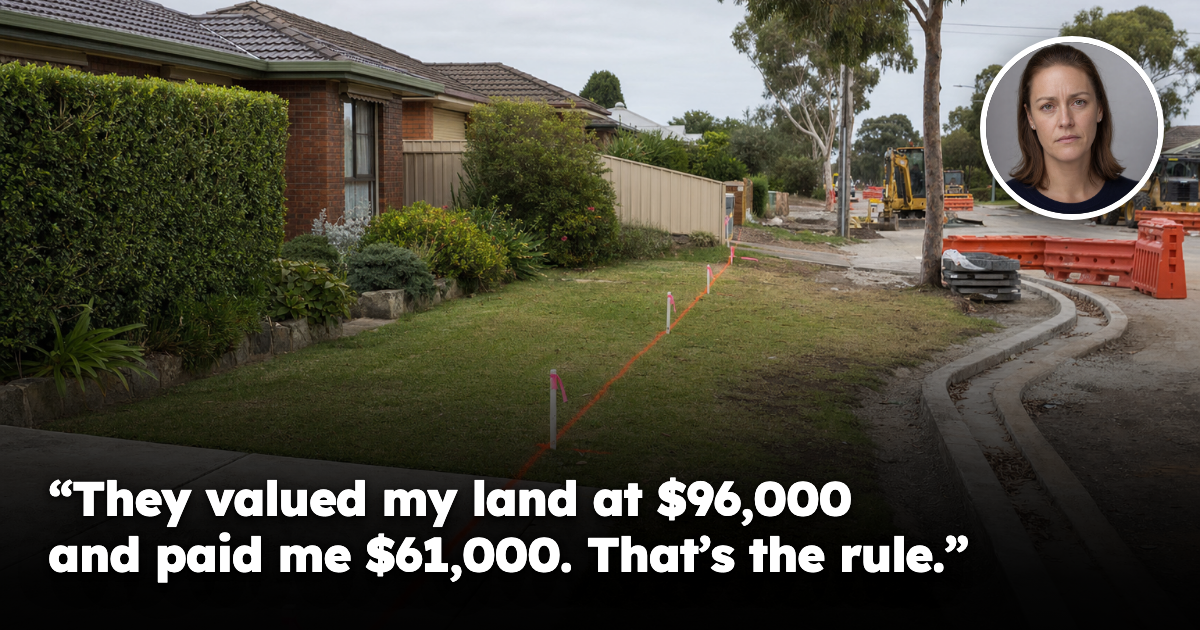
She objected inside the deadline, stated her grounds, asked to be heard and turned up. Her valuer assessed the land taken at $96,000. The assessment came back at $61,000, reduced because the finished road would improve what was left of her block. The part she actually wanted to argue about was never allowed to be on the table — and that is not a loophole, it is how the statute is written.
She did everything the notice told her to. She still lost $35,000 — and the rule that took it isn't a loophole. It's the design.
The question we were asked this week
An owner in her early forties came to us with a letter and a spreadsheet. She bought one investment property in 2016 — her one good decision, she calls it — and a notice arrived saying a strip along the front was required for a road widening. Not the house. 214 square metres of front garden and the driveway crossover.
She read the notice properly. She objected in writing inside the deadline, set out her grounds, and wrote the line the notice said she had to write if she wanted to appear in person. She turned up. She was heard.
Her valuer assessed the land taken at $96,000. She had spent $11,300 on legal and valuation fees getting to that number. The assessment came back at $61,000 — reduced by $35,000, on the basis that the finished road would make what was left of her block more valuable.
Her question, word for word: "I objected on time, I turned up, I was heard. Then I found out the one thing I actually wanted to argue about was never allowed to be on the table. How is that an objection?"
The answer: the price was never part of the objection
Here is the part almost nobody knows until it happens to them.
When an authority proposes to take your land, the notice must tell you that you may object, and give you a deadline that cannot be less than thirty days from the date of the notice. The objection has to state your grounds and the facts you rely on. And if you want to be heard, you have to say so in the objection itself — turning up on the day is not enough if you didn't write it down.
Then the same notice tells you this: any matter concerning the amount or payment of compensation is not a ground of objection.
You may argue the land isn't needed. You may argue the purpose is wrong, that the design could take a different strip, that the works could be pushed twenty metres north. What you may not argue, at the stage where a human being is actually listening, is the money. That is a separate track — claim it, and if you can't agree, take it to a court that decides valuations.
There is a second thing worth knowing. The body that considers your objection is the authority doing the taking. It hears you, or reads the report of its own delegate, and forms its own opinion about whether the land is required. It may discontinue. It may amend the plan. Objections genuinely do change projects, and it is worth doing well. But the decider and the applicant are the same entity.
Then the set-off: the rule that took her $35,000
The compensation regime itself is broader than most owners expect. It doesn't just pay for the dirt. It reaches severance damage where a taking cuts a parcel in two, injury to the land you keep, professional fees, stamp duty on a replacement purchase, mortgage discharge and re-establishment costs, removal, reconnecting services, and lost business profits. There is even a catch-all for other economic losses flowing directly from the taking — the drafters' own illustration is the cost of school uniforms for children enrolled at a new school after being moved. Genuinely humane drafting.
But sitting inside that same assessment rule is the provision that produced her $35,000.
In working out what you are paid, the assessor must take into account, by way of set-off, any increase in the value of the land you still own that is caused by the very works the land was taken for. Better road, better access, better frontage — if the project lifts what remains, that lift comes off your cheque.
And it only runs one way. If the uplift exceeds the value of what was taken, you are not asked to pay the difference. You simply receive less. The gain can shrink compensation to nothing; it can never become a bill, and it can never be banked as a windfall. A valve, not a scale.
So both of her instincts were right and both were useless in the room she was standing in. She thought a four-lane road at her front fence would hurt the property. Whether it helps or hurts is a valuation argument — and valuation was the one thing the objection could not be about.
What this actually means for investors
This is where the answer stops being legal and starts being about where you buy.
Whether a project "enhances" the land you keep is not a suburb-level fact. It is a street-and-frontage-level fact. Two houses on the same street, same suburb, same median, same council, same school catchment can lose an identical depth of front yard to the same project and end up with opposite results. One gains a signalised entry, a wider verge and a better approach. The other ends up hard against a through-road with a left-in-left-out crossover, headlights across the bedrooms and a permanent noise line. One has an "enhancement" that can be set off; the other has an injury it can claim for.
No suburb metric can tell those two apart, because a median averages them together. That is the whole argument for street-level data: in our own numbers, the spread in effective yield between the best and worst street inside a single suburb routinely runs 20–30% once you use achieved rents, real vacancy duration and real days-on-market instead of the headline. Corridor exposure, frontage orientation and access geometry live at exactly that resolution — and a compensation assessor will price them whether you did or not.
Practical, and cheap: read a notice the day it arrives, because the clock is short and starts on the date of the notice, not the day you open it. If you want to be heard, write that you want to be heard. Put your professional fees in the claim — they are contemplated. And if you hold the property as an investment, replacement-purchase costs are expressly claimable for investment land, not just for homes.
Then do the boring thing that matters more than all of it: before you buy, look up the corridor. Planned road reservations, widening lines and infrastructure alignments are published documents, readable years before a notice lands in anyone's letterbox.
That is the reason to stay in this asset class rather than run from it. A risk you can read is a risk you can price. The thirty-day fuse, the exclusion of price from the objection, the set-off and the one-way valve are all sitting in public, in writing, before anyone commits a dollar. Almost nobody looks — which is precisely why disciplined buyers keep acquiring good assets, on the right side of the right street, from sellers who never checked what was drawn across the front of the block.
She hadn't missed a deadline, a form or a signature. She just assumed an objection meant she could object to the part costing her money.
Related reading: what happens when a strip of public road runs through a backyard nobody knew wasn't theirs, the objection process that does reach the money when a rates bill doubles, and the boundary rule that pays out at three times market value.
If there's a specific street you're weighing up right now, check its Street Score first — it's free, takes ten seconds, and tells you whether that street is pulling the suburb average up or riding on it.
Frequently asked questions
If a road widening notice arrives in Australia, can I object to the amount of compensation in that objection?
No. The objection process is for contesting whether the land is needed, the purpose, or the works, not the amount of compensation. Any dispute about payment is dealt with separately through the compensation process and, if needed, a court that determines valuations.
What do I need to do if I want to be heard after receiving a land acquisition notice?
You must object in writing within the deadline and state that you want to be heard in the objection itself. Turning up on the day is not enough if that request was not included in the written objection.
Why was the owner’s compensation reduced from $96,000 to $61,000?
The assessment took into account that the completed road would increase the value of the land she kept. Under the compensation rules, that increase is set off against the amount payable, which reduced her payment by $35,000.
Can an uplift in the remaining land ever create a bill for the owner?
No. If the increase in value of the land you keep is greater than the value of the land taken, the uplift can reduce compensation to nothing, but it does not become money you must pay back.
What costs can be claimed when land is partly acquired for a road project?
The article says the compensation regime can include professional fees, stamp duty on a replacement purchase, mortgage discharge and re-establishment costs, removal, reconnecting services, lost business profits and other direct economic losses. It also notes that replacement-purchase costs are expressly claimable for investment land.
General information only. It does not take your objectives, financial situation or needs into account, and nothing here is legal, financial, taxation or investment advice specific to your circumstances.