News · 18 August 2026 · 5 min read
'The pool passed inspection when we built it. Now I'm told I can't lease the house at all — and I can't get a second opinion'
She could have sold the house that week. She was not allowed to lease it. The difference between those two sentences is one rule almost no owner of a pool property has read — plus a three-month window in which calling a second inspector is an offence.
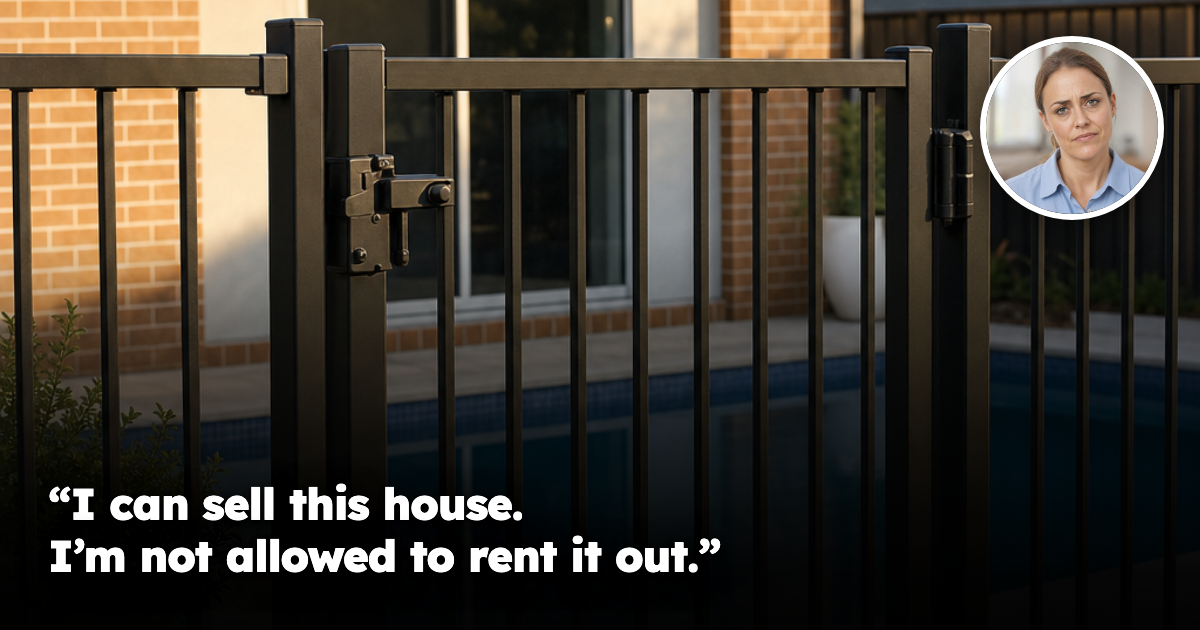
The pool was not the problem. That is what she keeps coming back to.
It was built in 2019 by a licensed builder, under a development approval, with a final inspection at the end. The fence went in at the same time — self-closing gate, latch at the height the installer said it had to be. She has the paperwork in a folder. She is the kind of owner who has a folder.
She is in her late thirties, a hospital pharmacist, and the house is her only investment property. Her tenants of four years gave notice in June. Her property manager found a new family inside a fortnight, at $40 a week more than the old rent — then rang and said she couldn't sign the lease.
Her question, more or less verbatim: "The pool was approved. It was inspected. Nothing about it has changed in six years. How can I be allowed to sell this house but not allowed to rent it out?"
She was asking about the pool. The rule is about the certificate.
The law does not ask whether your pool is safe. It asks whether a current certificate says so. Those are different questions, and only one of them has a date attached.
A pool safety certificate expires on a timer. Two years for a pool used by a single dwelling. One year if two or more dwellings on the land have a right to use it. When the clock runs out, the pool has not changed. Its legal status has.
Hers had lapsed — quietly, because a certificate had been obtained once, at construction, and nobody diarised the renewal.
The asymmetry: you may sell it, but you may not let it
If she wanted to sell, the law has a workaround. Before settlement she must either hand the buyer a copy of a current certificate, or — if there isn't one — give a notice in the approved form to the buyer and to the regulator. Disclose it, and the sale proceeds.
If she wants to lease, there is no workaround. The owner must not enter into an accommodation agreement for the premises unless a certificate is in effect. Full stop. No disclosure alternative. No "the tenant knows and doesn't mind". No clause the agent can insert. The transaction is simply not available to her.
One asset. Two exits. One of them is open on disclosure and the other is closed on a date.
Then the second surprise: she wasn't allowed to shop around
She booked an inspector. He failed the pool — the gate's self-closing mechanism had weakened, and a planter sat where it could be used to climb. Neither is unusual or expensive.
What he handed her was a nonconformity notice: a formal document stating that the pool is not complying, exactly how it isn't, and precisely what must be done to fix it. She has three months to ask that same inspector to come back.
And during those three months, asking anyone else to inspect the pool for a certificate is an offence, carrying its own penalty.
Read that again. The person who failed you is the only person allowed to pass you, and the law puts a penalty behind it. Most people assume a bad result means you call someone else. Here, calling someone else is the thing you are specifically not permitted to do.
There is an escape hatch, and it costs nothing: a written request to the regulator asking that someone else be allowed to reinspect, and if the regulator agrees, you're free. Almost nobody knows it exists, because it sits one subsection below the prohibition and nobody reads that far.
There is also a trap in doing nothing. Let the three months lapse without requesting a reinspection and the inspector is obliged to notify your council and send them a copy of the notice. Inaction is the one option that actively reports you.
The bit that quietly matters most for value
The certification regime does not regard the pool as the water. It regards the pool as the water plus its barriers — the fencing, and the walls of any building that enclose it.
That single definition is why two houses in the same suburb, on the same median, in the same catchment, are not the same asset.
House A has a freestanding pool mid-yard, fenced on all four sides by its own barrier. Nothing anyone renovates inside the house can affect its compliance.
House B's pool sits against the rear wall of the dwelling, and that wall — with its windows and its sliding door — is legally part of the pool barrier. Change the door. Add a window. Re-glaze during a renovation. You have just performed work on a pool barrier, and the certificate is now a live question. Same suburb, same median, same growth rate. One property has a maintenance item. The other has a structural constraint on every renovation it will ever have.
This is the gap suburb data cannot see. A median averages both houses into one number. So does a growth rate, a vacancy rate, a days-on-market figure. None of them know where the fence line runs.
It is the same reason the effective yield spread between the best and worst streets inside one suburb routinely runs 20–30% once you measure achieved rents, real vacancy duration and real days on market rather than advertised figures. Lettability is not a suburb attribute. It is a property attribute, turning on a physical fact — where the barrier is — and an administrative one: whether a certificate is in date. Neither appears in the data most buyers rely on. Both are knowable before you commit a dollar.
What she actually did
She rang the original inspector, agreed the two repairs, and had them done. The gate mechanism was $310. She moved the planter herself. Reinspection passed. The lease was signed eleven days after the phone call that started all of this — eleven days of vacancy she had not budgeted for, all avoidable with a calendar reminder.
The reason to tell it anyway is that none of it was hidden. The expiry period is published. The sale-versus-lease asymmetry is published. The three-month lock-in is published, and so is the written request that releases you from it. Every one of those rules was readable years before it cost her a fortnight's rent.
That is the case for property done properly, not against it. The risks that hurt investors are almost never the unknowable ones — they are the published ones nobody went looking for. A risk you can read is a risk you can price, and a risk you can price is one you can buy at a discount from a seller who never checked. Careful buyers keep acquiring good assets on exactly those terms.
For a related read: the trap of a structure that was never approved in the first place, the referral consents sitting under a block before you build, and why a $210,000 renovation can move a valuation almost nothing.
She had walked past that pool gate at every inspection for four years. She never once wondered when its paperwork ran out.
If there's a specific street you're weighing up right now, check its Street Score first — it's free, takes ten seconds, and tells you whether that street is pulling the suburb average up or riding on it.
Frequently asked questions
Why can a house with a pool be leased one day but not the next in Australia?
Because the law requires a current pool safety certificate before you enter into a lease. If the certificate has expired, the pool itself may still be unchanged, but the property is not legally leasable until the certificate is in effect again.
What’s the difference between selling a pool property and leasing it when the certificate has expired?
For a sale, the owner can still proceed by giving the buyer the required disclosure if there isn’t a current certificate. For a lease, there is no disclosure workaround: the owner must not sign the accommodation agreement without an in-force certificate.
If a pool inspector fails the inspection, can I hire another inspector straight away?
Not during the three-month period after a nonconformity notice is issued. In that time, asking someone else to inspect for a certificate is an offence unless the regulator gives written approval for another inspector to do it.
What happens if I do nothing after receiving a pool nonconformity notice?
If you let the three months pass without requesting a reinspection from the same inspector, the inspector must notify the local council and send them a copy of the notice. Doing nothing is the option that actively escalates the issue.
Why does the pool barrier matter so much to a property’s value and lettability?
The certification regime treats the pool as the water plus its barriers, including fencing and any walls that enclose it. That means the pool can create a live compliance issue for renovations and can affect whether a property can be rented, even if suburb data looks the same.
General information only. It does not take your objectives, financial situation or needs into account, and nothing here is legal, financial, taxation or investment advice specific to your circumstances.