News · 2 September 2026 · 4 min read
The $96,000 school-zone line she could not see: did one street decide the value?
A woman finds a $96,000 gap between two homes on opposite sides of a school-zone boundary. The real test is whether the premium creates durable street-level demand.
The $96,000 school-zone line she could not see: did one street decide the value?
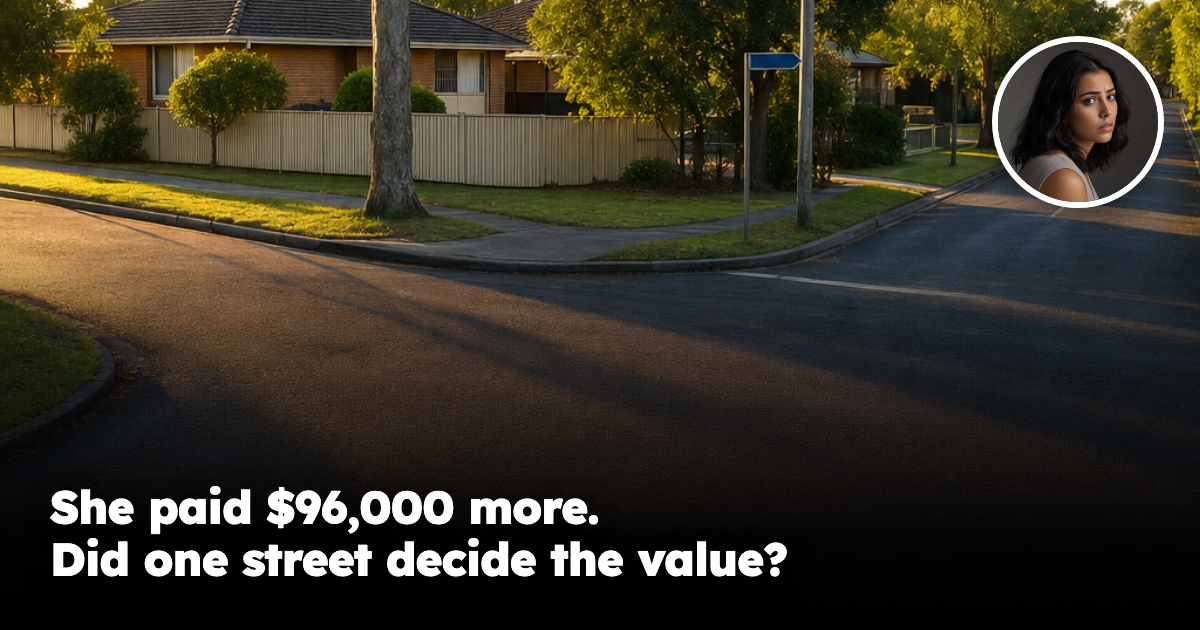
A 27-year-old woman thought two homes in the same suburb were interchangeable. They had similar floor plans, similar blocks and the same train station on the map. Then she discovered that one address sat inside a popular public-school intake area and the other sat across the road.
The difference in asking price was $96,000.
She asked the question that catches investors and home buyers alike: was the premium buying a genuine demand advantage, or was it simply a fashionable postcode story that would disappear when the next boundary review arrived?
The boundary was invisible at the inspection
The two streets looked almost identical. Both had older brick homes, narrow verges and a mixture of renovated and original properties. The boundary did not follow a creek, a railway or a major road. It turned at a residential intersection, leaving one side inside the preferred intake area and the other outside it.
The woman had a $720,000 budget and wanted a home that could be held for several years before she decided whether to rent it out. The cheaper property offered a larger backyard and a better kitchen. The more expensive property needed work, but the agent repeatedly described its school-zone position as the reason buyers were prepared to stretch.
She wanted to know whether a school-zone premium was an asset she could measure or just a sales line.
The answer: a boundary can be valuable, but it is not permanent land
A school intake area can change the pool of households willing to pay for an address. But it does not turn every property inside the line into a superior investment, and it does not make every property outside it worthless. The value sits in the depth and durability of demand at that exact address.
The first test is verification. A buyer should check the current official intake map using the complete address, not rely on an agent's verbal description, a nearby listing or a suburb name. Boundaries can be reviewed, and an address that appears close to a school may still fall outside the relevant area. The practical question is not simply “how far is the school?” It is “which address is recognised for enrolment today, and how exposed is that position to change?”
The second test is the premium. In Ripehouse Advisory's street-level analysis, we compare matched properties on either side of a boundary: achieved sale prices, achieved rents, days on market, vacancy, competing listings and the depth of buyer enquiry. That matters because suburb-level medians blend together streets with completely different demand drivers.
In the woman's comparison, the inside-boundary homes had sold for about $96,000 more on average across a matched sample. They also attracted more family inspections and spent roughly 13 fewer days on the market. But the rental gap was only $25 a week. The premium was therefore being driven mainly by owner-occupier demand, not by a proportionate increase in rental income.
That did not make the expensive home a bad purchase. It changed the risk. The buyer was paying for a deeper resale audience and a particular family decision, while receiving only a modest income advantage. If the boundary remained relevant and the house stayed competitive, that could support liquidity. If the line changed or the school became less oversubscribed, the premium could narrow quickly.
What a buyer should measure before paying the premium
Start with the map and the rules. Save the current address-specific result, check whether the intake area is designated or subject to a temporary arrangement, and ask what happens if enrolment demand exceeds available places. A school-zone claim should be treated like a title or easement claim: something to verify in writing before money changes hands.
Then inspect the homes that buyers actually choose. Compare at least three groups: addresses inside the boundary, addresses immediately outside it, and the best non-school-zone alternatives in the same suburb. Look for a persistent price gap across achieved sales, not a single auction result. Check whether the inside-zone homes lease faster or simply sell for more to families who intend to live there.
The street-level picture may reveal a less obvious opportunity. An outside-zone property on a quieter street, with better parking and stronger transport access, may attract a stable tenant pool even if it cannot command the family premium. An inside-zone property on a busy road may carry the school benefit but lose part of it through noise, poor outdoor space or difficult access.
The same discipline applies to other invisible boundaries: flood overlays, heritage controls, catchment edges, council parking zones and future road reservations. Two properties can share a suburb statistic while carrying different legal, physical and emotional demand.
For a closer look at why nearby addresses can separate in value, read our street-level value gap analysis and the station premium that stopped short of the platform.
The opportunity is in pricing the line correctly
The woman did not need to predict the next hot suburb. She needed to decide whether the extra $96,000 bought durable demand, enough resale depth and a price that still left room for the property to perform.
That is the investable lesson. A school-zone boundary can create a real micro-location advantage, but only the right asset on the right street can convert it into resilient value. Property investment rewards the buyer who measures the exact address instead of paying blindly for the suburb label.
If there's a specific street you're weighing up right now, check its Street Score first — it's free, takes ten seconds, and tells you whether that street is pulling the suburb average up or riding on it.
Frequently asked questions
Why can two houses across the road from each other have such different prices if they look almost the same?
Because a school intake boundary can change which households are willing to pay more for a specific address. In the article, the inside-boundary homes sold for about $96,000 more on average, showing that value can be driven by street-level demand rather than the suburb alone.
How can I check whether a property is actually inside a public school zone in Australia?
Use the current official intake map for the full address, not just the suburb name or an agent’s verbal description. The article says boundaries can change, so the address-specific result should be verified in writing before relying on it.
Does paying more for a school-zone property also mean better rental returns?
Not necessarily. In the example, the rental gap was only $25 a week even though the sale-price premium was about $96,000, which suggests the extra value was mainly from owner-occupier demand rather than a matching income boost.
What is the main risk of buying a home because it sits in a school intake area?
The premium may narrow if the boundary changes or the school is no longer as oversubscribed. The article also notes that a school-zone position does not make every inside-boundary property automatically superior if the house itself is less competitive.
What should a buyer compare before deciding whether the school-zone premium is worth it?
Compare inside-boundary homes, immediately outside-boundary homes, and the best alternatives in the same suburb. The article recommends looking at achieved sale prices, rents, days on market, vacancy, competing listings and buyer enquiry to see whether the price gap is durable.
General information only. It does not take your objectives, financial situation or needs into account, and nothing here is legal, financial, taxation or investment advice specific to your circumstances.