News · 31 August 2026 · 4 min read
The $140,000 street-level gap hiding inside one “same suburb” search
A newly single parent finds a $140,000 gap between two similar homes in one suburb. The street-level question is whether the discount reflects opportunity or a narrower resale audience.
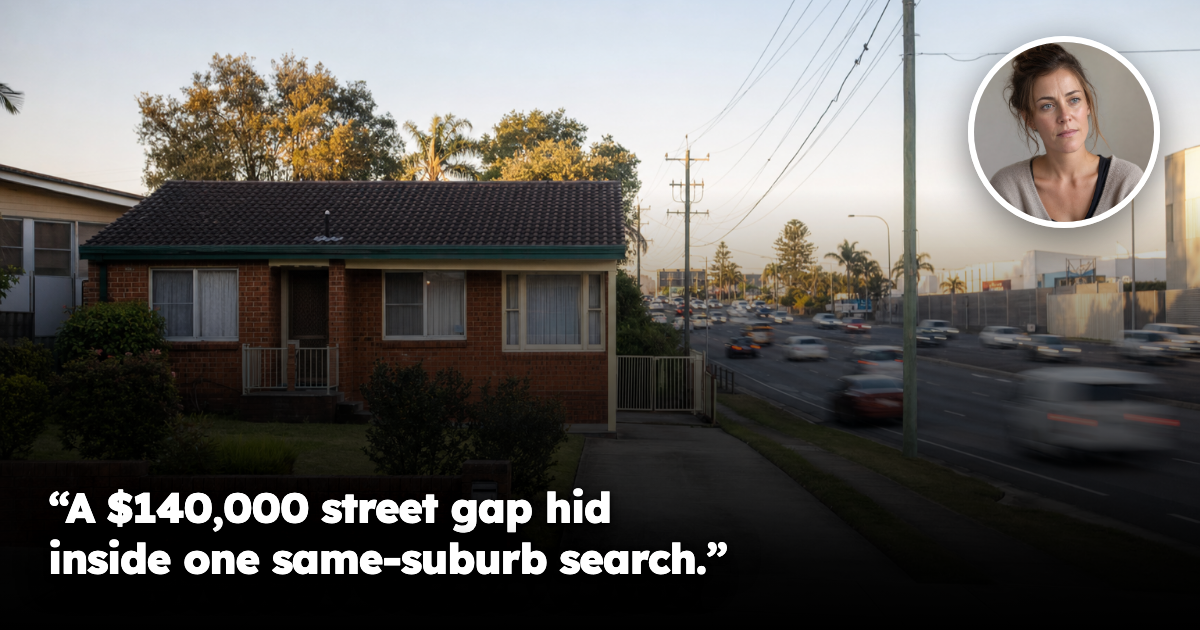
When a newly single parent compared two houses in the same suburb, the advertised difference looked like a bargain. Both had three bedrooms, similar land and access to the same schools. One was listed at $140,000 less.
The catch was not visible on the suburb profile. It was visible from the front gate.
The question
“If two properties share the same suburb, school zone and broad market, why would one be worth so much less? Is the cheaper one the smarter investment, or am I buying a problem that the next buyer will notice too?”
It is a question we receive regularly. Buyers often begin with suburb-level numbers, then discover that the market is pricing the final 50 metres much more aggressively than the postcode.
The answer: the street is part of the asset
The cheaper house sat close to a busy arterial. The living room faced the traffic, the driveway was difficult to exit during the afternoon peak and the rear garden picked up road noise. The other house was several streets away on a quiet loop, despite sharing the same suburb statistics.
Neither address was automatically “good” or “bad”. They were different products. The first might suit a buyer who values a lower entry price and can improve the internal layout. The second could attract a deeper pool of owner-occupiers and tenants who are prepared to pay for quiet, easier access and a more private outdoor space.
That distinction matters because the headline discount can be consumed in several ways. A buyer may need to accept a longer selling campaign, a narrower tenant pool or a larger discount when market conditions cool. A lower purchase price is useful only if the future exit market still recognises the property’s strengths.
Why suburb averages miss the risk
Suburb medians combine quiet streets, busy roads, main-road frontages, cul-de-sacs, apartment pockets, flood-affected sections and homes beside commercial activity. The resulting number is useful as a starting point, but it cannot answer an address-level question.
Our street-level screen compares achieved sales rather than asking prices, then checks rent, vacancy, days on market, buyer depth and competing supply. In this case, the same-suburb comparison showed the quieter street had a materially broader buyer audience, while the arterial-frontage homes were more dependent on price-sensitive demand.
The important signal was not a single median. It was the repeated gap between nearby properties with similar bedrooms and land but different exposure. The screen also checked whether the cheaper homes were genuinely moving faster because of value, or simply taking longer to sell after an optimistic launch price.
That is the difference between a suburb story and a street story. A suburb can be improving while a particular frontage remains hard to resell. Conversely, a less fashionable suburb can contain a quiet pocket with strong tenant demand and better buyer competition. The same exact-address discipline matters when testing tenant demand and weekly rent pressure or a supposed future transport premium.
The three checks before calling it a bargain
First, visit at the times the property will actually be used. A ten-minute inspection on a quiet Saturday morning can hide school-run congestion, commuter noise, headlights and difficult turning movements. Walk the route from the front door to the nearest busy road, bus stop, shops or open drain. The physical experience is part of the asset.
Second, compare like with like. Do not compare a renovated quiet-street home with an unrenovated main-road house and call the entire difference a location premium. Match land, condition, parking, orientation and building quality as closely as possible. Then isolate the micro-factor.
Third, test the exit audience. Ask who would rent or buy the property next, and what they would reject. A property can still be a sound investment when it has a clear price advantage, durable demand and a realistic improvement path. It becomes dangerous when the discount is mistaken for demand.
What it means for investors
For investors, the cheaper address may work if the numbers compensate for the narrower audience. That means stress-testing vacancy, letting time, maintenance, insurance, resale costs and the price required to attract a tenant or buyer. The assessment should use achieved evidence from nearby streets, not a broad suburb promise.
For a future home, the decision is even more personal. Noise, privacy and access are experienced every day. A discount can be real and still be the wrong trade if the feature is one the household cannot tolerate.
The broader buyer-turnoff story is not an argument to avoid property. It is an argument to stop treating a postcode as the whole asset. In the same suburb, the right street can have stronger competition, better tenant depth and a more resilient resale market than the wrong frontage.
The opportunity is still there: identify the exact address, measure the street-level evidence and buy the property whose price reflects its real strengths. The right asset, on the right street, backed by the right data, beats a cheap headline every time.
If there's a specific street you're weighing up right now, check its Street Score first — it's free, takes ten seconds, and tells you whether that street is pulling the suburb average up or riding on it.
Frequently asked questions
Why can two houses in the same Australian suburb have such different prices?
Because the street and frontage are part of the asset, not just the suburb. A home near a busy arterial road, with more noise or harder access, can be priced well below a similar house on a quiet street even when the suburb, schools and land size look the same.
Does a cheaper house on a main road automatically mean it is a better buy?
No. The lower price may reflect a narrower resale audience, longer selling times or more price-sensitive demand. It can still work as an investment if the discount is large enough to offset those risks.
What should buyers check before deciding a discounted property is a bargain?
Visit at the times the property will actually be used, compare it with genuinely similar nearby homes, and test who the next renter or buyer would be. Noise, traffic, access, privacy and outdoor usability can all affect value and resale.
Why are suburb medians not enough when comparing property prices?
Suburb medians combine very different types of homes, including quiet streets, main-road frontages, cul-de-sacs and apartment pockets. They are useful as a starting point, but they cannot show the address-level differences that drive resale and tenant demand.
What is the main risk if the discount is mistaken for strong demand?
The property may be harder to rent or resell, especially when market conditions cool. A lower purchase price only helps if future buyers or tenants still recognise enough value to support the exit price.
General information only. It does not take your objectives, financial situation or needs into account, and nothing here is legal, financial, taxation or investment advice specific to your circumstances.