News · 2 September 2026 · 3 min read
He earns six figures and still cannot find a fair rental. What is broken?
A six-figure household still faces rental stress as local scarcity and high weekly costs expose the gap between income thresholds and real housing security.
He earns six figures and still cannot find a fair rental. What is broken?
He cleared $100,000 and still felt locked out
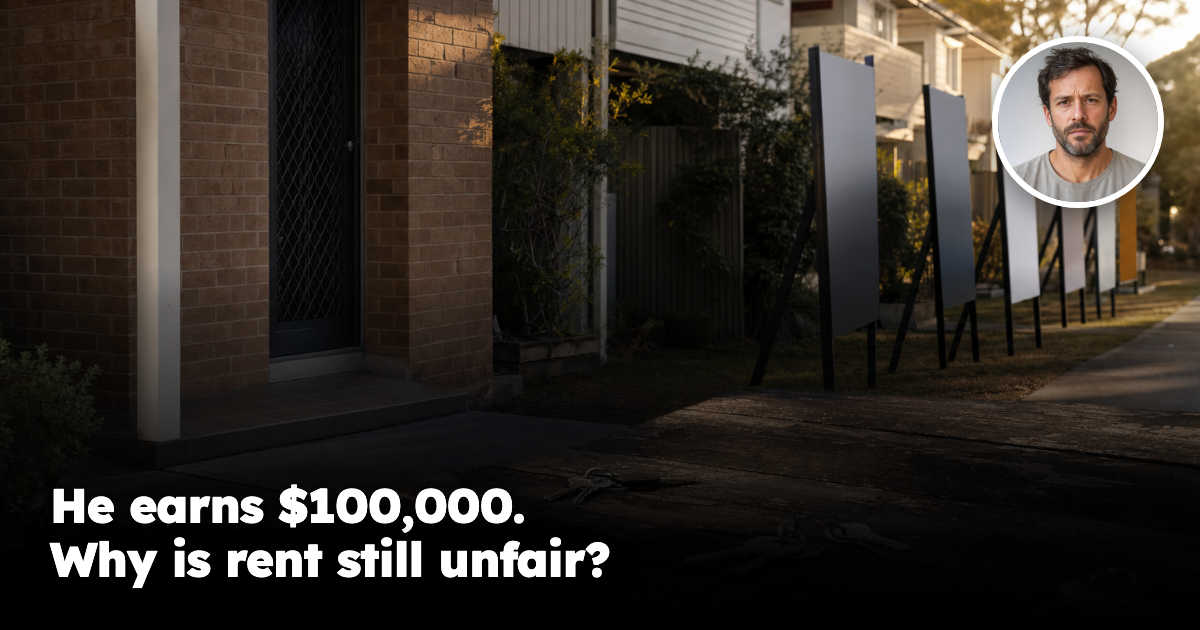
A 43-year-old man recently asked a question that sounds impossible until the numbers are placed side by side: how can a household earning more than $100,000 still be in rental stress?
His weekly rent was $1,180. Add utilities, transport, food, insurance and the cost of supporting a family member, and the annual housing bill was more than $61,000. A small rent increase would not make him poor on paper. It would make the household much less able to save, move or absorb a surprise.
He had done what people are told to do. He had stable income, references and money set aside. Yet the available homes were scarce, the application process was competitive and the advertised suburb average told him almost nothing about the particular streets where he could realistically secure a lease.
That is the unfairness hidden inside the phrase “rental stress”: an income threshold can make a household look comfortable while the local market still prices it out.
Why a high income is not the same as housing security
Rental pressure is a ratio, not a moral judgement. A household can earn above a headline threshold and still carry a large housing cost, dependants, medical expenses or a long commute. When rents rise faster than available savings, the household becomes exposed even if it is not eligible for the assistance people associate with hardship.
The market also does not operate on a national average. A tenant may see a reasonable median for a city while the homes that fit their budget have almost no vacancy. A nearby pocket with a different mix of apartments, school catchments, transport links or competing applicants can behave like a separate market.
This is where policy arguments often miss the human problem. Rules can improve notice periods, reporting or tenant protections, but a tenant still needs an available home at a price they can carry. If supply is thin on the exact streets people need, the benefit of a broad announcement may arrive long after the next application deadline.
The street-level test most people never see
Ripehouse Advisory’s research starts below the suburb label. We compare immediate-street vacancy, achieved rents, days on market, competing listings and the depth of tenant demand. In one suburb, two pockets can show a double-digit difference in available rental stock while appearing identical in a suburb-wide report.
That gap matters to both sides. A tenant may find a workable home by widening the search one kilometre, while an investor may discover that a lower purchase price is offset by weaker demand or longer vacancy. The address is not a footnote; it is part of the market.
Our rental-data explainer shows how notice, replacement rent and moving costs can compound. The negative-gearing policy story looks at the other side of the ledger. Both point to the same lesson: broad headlines cannot substitute for evidence at the address level.
What can change for renters and investors?
For renters, calculate the full weekly cost rather than comparing advertised rent alone. Test travel, utilities, bond, moving costs and the probability of needing to apply again. Search the immediate neighbouring pockets, then inspect whether listings are sitting or disappearing within days. A slightly different street can change the competition more than a small difference in advertised rent.
For investors, the answer is not to treat rental stress as a guaranteed rent increase. It is to understand what demand can actually support. Check the tenant pool, competing stock, achieved—not just advertised—rents and the resilience of the street when more listings appear. A property that serves several tenant groups may hold demand better than one relying on a single narrow audience.
The 43-year-old man was not asking for a free home. He was asking why a seemingly strong income could still leave him with so little control. The answer was partly the rent, partly the cost of living and partly a local market whose averages concealed scarcity.
The opportunity behind the outrage
Housing policy should be judged by what people can secure on real streets, not only by the income bands written into a release. For investors, that same reality creates a clearer edge: understand the exact location, the depth of demand and the supply that can arrive next.
Property investment remains strongest when the right asset is matched to durable local demand. The right property, on the right street, supported by the right data, can turn a noisy national headline into a decision with genuine staying power.
If there's a specific street you're weighing up right now, check its Street Score first — it's free, takes ten seconds, and tells you whether that street is pulling the suburb average up or riding on it.
Frequently asked questions
How can someone earning more than $100,000 still be in rental stress in Australia?
A high income does not guarantee housing security if rent, utilities, transport, food and other obligations take up too much of the household budget. The article says this can leave a household exposed even when it looks comfortable on paper.
Why do suburb-wide rental averages miss what renters are actually facing?
Because rental markets can change street by street. The article explains that nearby pockets can have very different vacancy levels, achieved rents and competition, so a suburb median may not reflect the homes a tenant can realistically secure.
What should renters look at before deciding a rental is affordable?
They should total the full weekly cost, not just the advertised rent. The article suggests factoring in travel, utilities, bond, moving costs and the chance of having to keep applying for other homes.
What does the article say investors should check instead of relying on advertised rent alone?
Investors should look at tenant demand, competing stock, achieved rents and how resilient the street is when more listings appear. The article says a property may perform better if it appeals to several tenant groups rather than just one narrow audience.
What is the main risk when housing policy focuses on broad averages instead of real local supply?
The risk is that renters still cannot secure an available home at a price they can carry, even if headline settings improve. The article says broad announcements can miss the practical problem of thin supply on the exact streets people need.
General information only. It does not take your objectives, financial situation or needs into account, and nothing here is legal, financial, taxation or investment advice specific to your circumstances.