News · 2 September 2026 · 4 min read
The $72,000 substation discount: did she find a bargain or inherit a resale problem?
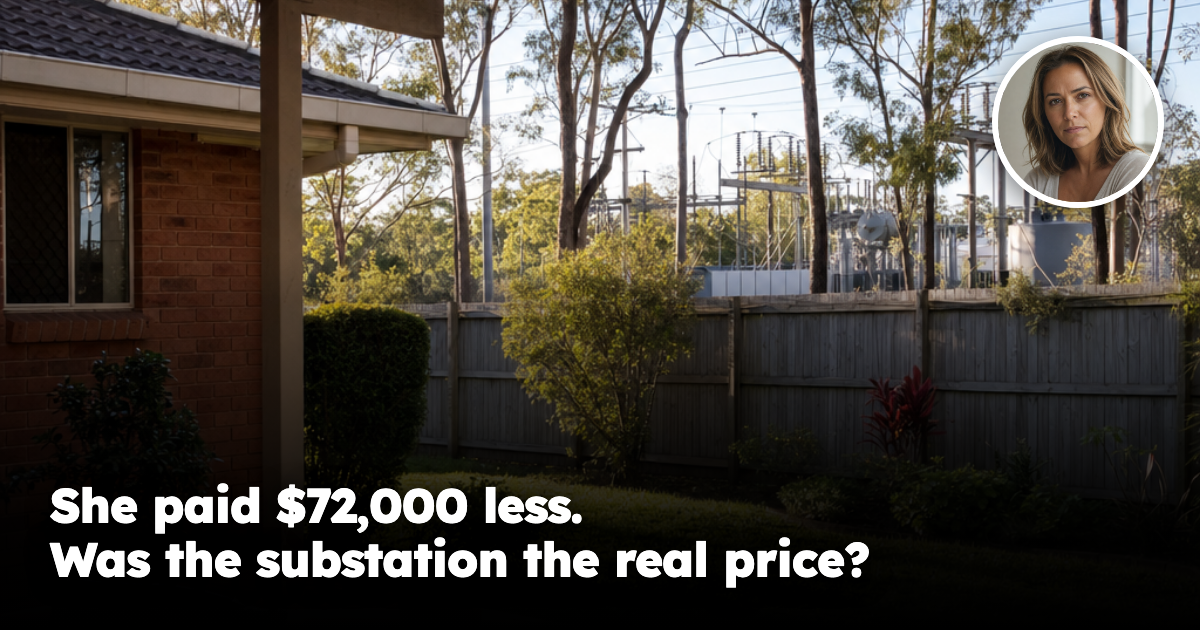
A Brisbane woman pays $72,000 less for a home beside an electricity substation. The real test is whether the discount compensates for a narrower rental and resale audience.
The $72,000 substation discount: did she find a bargain or inherit a resale problem?
A 39-year-old woman thought she had found the kind of price gap buyers talk about for years. Two three-bedroom homes sat in the same outer-Brisbane suburb, on streets with similar school access, comparable block sizes and almost identical advertised rents. One sold for $72,000 less.
The reason was visible from the rear fence: a compact electricity substation, humming behind a locked enclosure and separated from the backyard by a narrow service corridor.
She asked the question many investors ask too late: was the discount compensation for a manageable inconvenience, or a warning that the next buyer would demand an even bigger discount?
The question behind the cheap price
The home looked fine at the first inspection. The substation was not on the title, there was no obvious damage, and the yard still had enough usable space for a table, lawn and small shed. The buyer was not worried about a dramatic safety story. She was worried about the quiet things that affect a sale: noise at night, the view from the living room, maintenance access, insurance questions and the number of people who would simply cross the address off their list.
She paid $618,000 rather than $690,000 for the neighbouring style of house. Her plan was to hold it, improve the tired kitchen and rent it to a household priced out of the better-known streets nearby.
That can be a sensible property-investment thesis. But only if the discount is measured against the asset's actual earning power and future buyer pool, not against a suburb median.
The answer: a substation is a price factor, not an automatic deal-breaker
There is no universal percentage that a substation subtracts from every property. The effect depends on what a buyer can see, hear and use; how close the equipment is to the house; the condition of the enclosure; the presence of trees or a solid boundary; the local planning controls; and whether several comparable sales show the same pattern.
The first job is to establish what is legally and physically there. A title search, deposited plan and a proper inspection can reveal easements, access rights and the area that cannot be built over. The electricity distributor can clarify operational and access requirements. None of that tells you the market value by itself, but it stops a buyer from paying for backyard potential that cannot exist.
The second job is to separate perception from performance. In Ripehouse Advisory's street-level work, the useful comparison is not “what is the suburb median?” It is a matched group of homes within the same suburb and, where possible, the same school and transport catchment. We compare achieved prices, not hopeful asking prices; achieved rents, not the listing headline; vacancy duration; days on market; competing listings; and buyer depth.
That can expose a counterintuitive result. A visually compromised address may still be a strong rental asset if its weekly rent is genuinely competitive, its vacancy is short and its tenant pool values the location more than the outlook. Conversely, a home that looks cheap can be a weak investment if it takes longer to lease, attracts fewer applicants and repeatedly needs a deeper discount when sold.
In this case, the $72,000 gap was not the whole answer. The cheaper home's rent was $15 a week lower, but its comparable listings spent an extra 11 days on market on average. The nearby quiet-street homes also attracted more inspections when sold. That suggested the substation was not merely an emotional objection: it narrowed both the tenant and resale audience.
It did not make the property uninvestable. At the purchase price, the entry yield was higher, the suburb's employment and transport demand still supported renting, and the buyer had negotiated enough of a buffer to fund the kitchen without pretending the address was premium stock. The mistake would have been calling the discount “free money”.
What should an investor test?
Visit at different times, including early morning and after dark. Stand inside the living areas and at the rear boundary. Listen with appliances off. Look at the sightline from the main bedroom and the outdoor entertaining area. Ask whether access vehicles can enter the service area and whether planned improvements would conflict with an easement or clearance.
Then test the numbers against three groups: homes with a similar constraint, ordinary homes on the same side of the suburb, and the best-performing streets. If the constrained group rents almost as well but sells slowly, it may suit a yield-focused strategy but not a short-hold resale plan. If both rent and resale depth are weak, the discount may be a trap.
The same discipline applies to other small features buyers overlook: a drainage corridor, a busy rear lane, a flight-path edge or a road reservation. A suburb label smooths those differences away. A street-level dataset brings them back into the decision.
For more on why two apparently comparable addresses can behave differently, read our analysis of the street-level value gap inside one suburb and the easement hidden behind similar homes.
The opportunity in the awkward address
The woman did not buy the cheapest-looking house because she believed every buyer was wrong. She bought after measuring the constraint, the income and the likely exit audience. That is the difference between a discount and a liability.
Property investment still rewards the buyer who can see what a broad suburb statistic cannot: the right asset, on the right street, at the right price. A substation may reduce the audience, but accurate street-level evidence can show whether the remaining audience is deep enough to compound. The opportunity is not in ignoring the awkward detail. It is in pricing it before everyone else does.
If there's a specific street you're weighing up right now, check its Street Score first — it's free, takes ten seconds, and tells you whether that street is pulling the suburb average up or riding on it.
Market data & R-Scores for locations in this article
Drill Down Into the Markets Mentioned Above
Inspect live monthly R-Scores, median prices, rental yields, and street-by-street scores for the cities and council areas referenced in this article:
Frequently asked questions
Does living beside an electricity substation automatically make a Brisbane home a bad buy?
No. The article says a substation is a price factor, not an automatic deal-breaker. The key is whether the discount properly reflects the reduced buyer pool, the property's use, and any impact on renting or resale.
What should a buyer check before paying less for a house next to a substation in Australia?
The article suggests checking the title, deposited plan and a proper inspection to confirm easements, access rights and any area that cannot be built over. It also says to ask the electricity distributor about operational and access requirements.
Why can a cheaper house beside a substation still be risky for investors?
Because the discount may not be enough if the address has a narrower tenant and resale audience. In the article, the cheaper home rented for less, took longer to sell, and attracted fewer inspections than nearby quiet-street homes.
How should an investor compare a property like this against other homes?
The article recommends comparing it with similar homes in the same suburb, and ideally the same school and transport catchment. Focus on achieved prices, achieved rents, vacancy duration, days on market and buyer depth rather than suburb median or asking prices.
What’s the practical test for deciding if a substation discount is a bargain or a trap?
Visit at different times, including after dark, and assess what you can see, hear and use from the house and yard. Then test whether the property can earn strong rent and still attract enough buyers later; if not, the discount may be a liability.
General information only. It does not take your objectives, financial situation or needs into account, and nothing here is legal, financial, taxation or investment advice specific to your circumstances.