News · 2 September 2026 · 3 min read
The 1.2 million-home promise is slipping. Who pays when she is still waiting?
A recently widowed woman is still paying $620 a week as Australia’s housing target slips. The real test is whether supply reaches the exact streets where demand is strongest.
The 1.2 million-home promise is slipping. Who pays when she is still waiting?
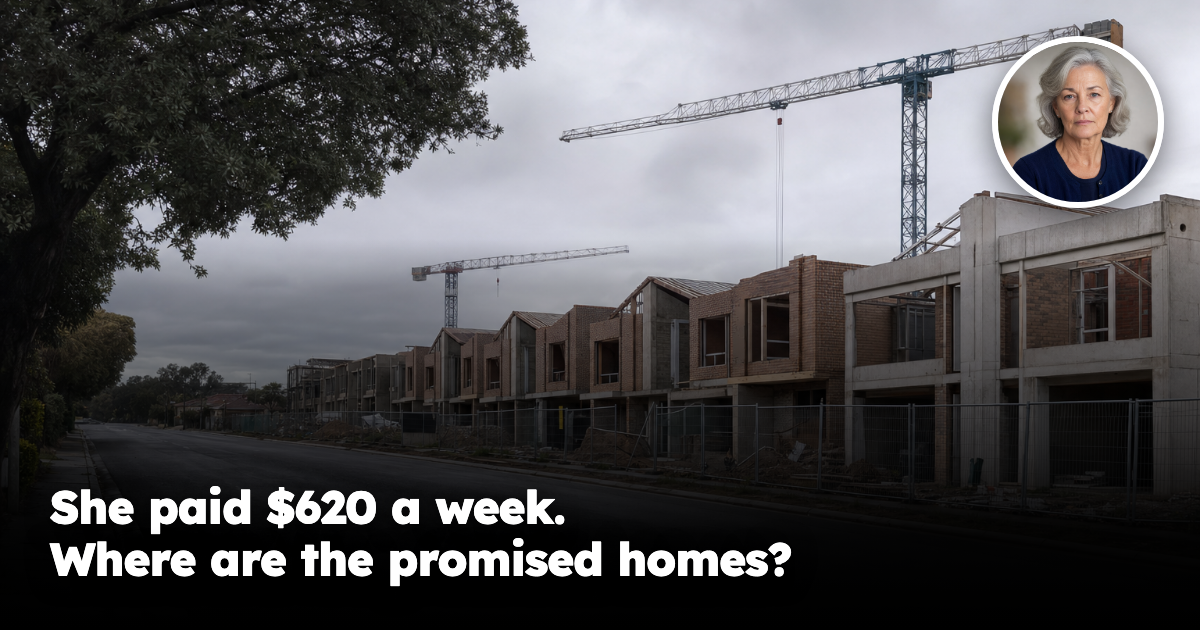
A 68-year-old recently widowed woman had $44,000 in savings and a simple request: a safe, modest home close to the people who helped her manage daily life.
She had been told Australia was planning a vast increase in housing supply. But the national target was now looking harder to reach, and the homes she could actually afford were still scarce. In the meantime, she was paying $620 a week for a small rental while watching new announcements arrive faster than new keys.
Her question was blunt: if governments promise more homes but the delivery falls behind, who carries the cost?
The answer is not just a missed target
A housing target is a policy ambition, not a property that can be inspected. The meaningful test is whether completed, appropriately priced homes are reaching the streets where demand is strongest.
When delivery falls short, the first impact is usually competition. Households that cannot secure new supply stay in older rentals or keep bidding for established homes. Investors then face a market where tenant demand can remain intense even while the policy conversation says supply is improving.
That distinction matters. A headline number can combine approvals, commencements and completions, even though only a completed home can house someone. It can also combine very different price points and locations. A dwelling built far from jobs, transport and essential services may count toward a target without relieving pressure in the exact pocket where people are searching.
For the woman, the issue was not whether Australia needed more homes. It was whether the next home arriving would be affordable, finished and close enough to be useful.
What the street-level data shows
Ripehouse Advisory examines the address beneath the policy headline. We compare achieved rents, vacancy, days on market, competing listings, buyer enquiry and the supply pipeline at street and suburb level.
That view can expose a sharp mismatch. In one outer-metro comparison, the suburb appeared to have a healthy pipeline of approved dwellings. Yet the streets within easy reach of transport had a vacancy rate nearly two percentage points lower than the wider suburb, and suitable two-bedroom rentals were leasing about 11 days faster. New supply was being counted, but it was not necessarily the supply the local renter needed.
The same gap affects investors. A property beside a reliable transport route, with a practical floor plan and limited competing stock, can retain tenant demand even when a state announces thousands of future homes. Another property in the same suburb can struggle if its new competitors are due to arrive on the same street or if its access to services is poor.
This is why the woman’s $620 weekly rent is more than a personal hardship figure. It is a signal about location, product and timing. Each week she remains in an unsuitable rental, the shortage is being priced into someone’s household budget.
What should buyers and investors do with the uncertainty?
First, separate political promises from measurable delivery. Look for completed dwellings, not only announced funding. Check whether the homes are the right tenure, size and price for the people already competing in the area.
Second, test the exact address. Measure nearby achieved rents rather than relying on a suburb median. Check the number of competing listings, the days comparable homes take to lease and whether vacancy is actually easing on the target streets. A broad supply figure cannot tell you whether a particular property is becoming easier or harder to rent.
Third, price policy risk without assuming property investment is broken. A delayed housing program may increase uncertainty, but it can also reveal durable demand in well-connected locations. The investor who buys a sound asset on a resilient street is not relying on a promise being delivered perfectly.
The woman still wanted a home near her support network. Her experience showed why national housing debates can feel remote until the shortage appears in a weekly rent, a longer commute or a failed application.
The opportunity for property investors is to read the gap between announcement and reality. The right asset, on the right street, measured with the right data, can remain valuable through political noise and changing targets.
If there's a specific street you're weighing up right now, check its Street Score first — it's free, takes ten seconds, and tells you whether that street is pulling the suburb average up or riding on it.
Frequently asked questions
Why does the article say Australia’s 1.2 million-home target is not enough on its own?
Because a target is only a policy ambition, not actual housing someone can live in. The real test is whether completed, appropriately priced homes are reaching the streets where demand is strongest.
What is the main problem for renters if new housing supply is delayed?
Households that cannot get into new supply keep competing for older rentals or established homes. That can keep tenant demand intense and leave people paying high rents while they wait.
Why does location matter so much when judging whether housing supply is easing pressure?
A home built far from jobs, transport and essential services may count toward a target without helping people in the area where demand is actually strongest. The article says the useful test is whether homes are being delivered on the right streets.
What should buyers and investors check instead of relying on a headline housing number?
They should look for completed dwellings, not just announcements, and test the exact address. That means checking achieved rents, competing listings, days on market and whether vacancy is actually easing locally.
What is the key risk for property investors when governments announce more housing but delivery lags?
The risk is assuming supply will relieve demand evenly across a suburb or city when it may not. A property in a well-connected street with limited competing stock can still hold tenant demand, while another nearby may face more pressure.
General information only. It does not take your objectives, financial situation or needs into account, and nothing here is legal, financial, taxation or investment advice specific to your circumstances.