News · 18 August 2026 · 6 min read
'I've charged my tenants for water for six years. I've just found out I can't recover most of it'
He never guessed a number, never rounded up, never charged a cent of margin — and emailed every bill through. The entitlement to charge a tenant for water is written as three conditions joined by "and", with a fourth about the fixtures, a paperwork rule that extinguishes the charge entirely, and a fixed-charge exclusion that was never recoverable at any point.
He is a careful landlord. That is what makes the conversation difficult.
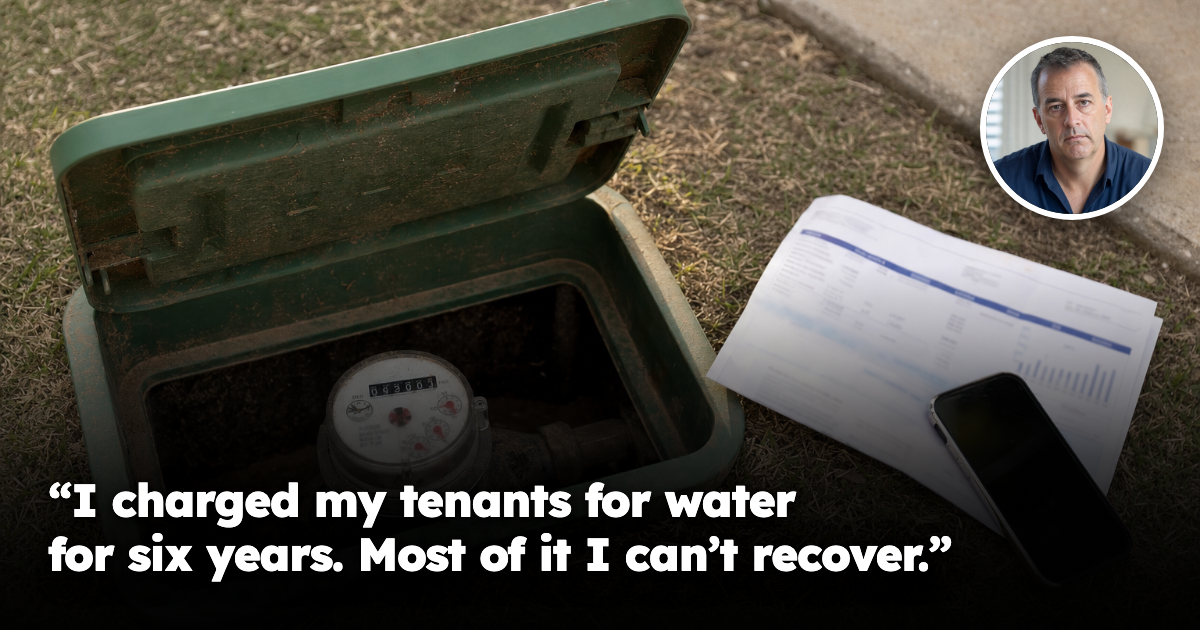
Two properties, both held since the mid-2010s, both self-managed. When the water bill arrives he works out the consumption portion, emails the tenants a copy, and asks them to transfer their share. He has never guessed a number, never rounded up, never charged a cent of margin.
He came to us while refinancing. Somewhere in that conversation he mentioned the water recovery — about $4,180 across the two properties last financial year — and asked, half in passing, whether lenders would count it.
The answer turned out to be much less interesting than the question underneath it.
The question he actually asked
"I've been on-charging water for six years. I email them the bill every time. Nobody has ever complained. Am I actually allowed to do this — and if I'm not, what happens to six years of it?"
It is a question we get constantly, and it almost never comes from someone acting badly. It comes from someone who assumed being fair was the same thing as being compliant.
Those are two different tests. Only one is written down.
The answer: it is not one rule, it is three — and they are joined by "and"
Residential tenancy legislation does allow water consumption to be passed to a tenant. It is lawful, it is normal, and hundreds of thousands of tenancies do it correctly.
But the permission is written as a conditional. A tenant may be required to pay water consumption charges only if three separate things are true at the same time.
One: the tenant is enjoying or sharing the benefit of the water service. Usually satisfied.
Two: the premises are individually metered. Not the building. Not the block. The premises the tenant occupies must have their own meter — or water must be delivered by vehicle. If two dwellings share one meter and the owner splits the bill by floor area, occupancy, or any other sensible-sounding formula, this condition is not met. No proportionality rule rescues it. It is binary.
Three: the tenancy agreement states the amount is payable by the tenant. In the agreement. Not agreed verbally at the inspection, not established by six years of the tenant paying without objection, not implied because everyone knew.
Three conditions, joined by "and". Miss one and the entitlement does not exist — no matter how reasonable the number was.
Then there is a fourth condition that most owners have never heard of
Even where all three are satisfied, the owner can only recover the full consumption charge if the premises are water efficient — meaning they comply with a published technical standard for fixtures. Shower flow rates, taps, toilets.
If the premises are not water efficient, the owner is not entitled to the whole bill. The tenant can only be required to pay the portion above a reasonable quantity of water for that property. The owner wears the baseline.
And "reasonable quantity" is not left to argument. If disputed, the matters that must be considered include local-area water usage information, the area of the land, the presence or absence of water saving devices, and the number of people occupying the premises.
Read that list again from an investor's perspective. Land area. Fixtures. Occupancy. Those are property-level facts. Two houses in the same suburb, at the same rent, can sit on opposite sides of that test. It is the same pattern we see when a rates bill doubles while the valuation stays flat — the number that changes is driven by a classification nobody thought to check.
The two provisions that destroy an otherwise valid invoice
Here is where his six years came apart, and it has nothing to do with fairness.
The document rule. If a tenant is required to pay water consumption charges, the owner must give the tenant a copy of the supplier's own document showing the amount payable — within four weeks of receiving it. Then the legislation does something counter-intuitive: despite everything above, the tenant is not required to pay at all if that document has not been received.
Not reduced. Not adjusted. Extinguished — by a paperwork failure, on a charge that was lawful in substance.
The fixed-charge exclusion. A water bill has two parts: a fixed service charge for having the connection, and a variable charge for the volume actually used. The legislation defines the recoverable amount as the variable part only — and then states separately that a tenant may not be required to pay any amount of the fixed charge.
That exclusion is not a technicality. On a typical residential water bill the fixed access charge is a substantial share of the total. He had been passing through the whole bill, in good faith, for six years. About $1,320 of what he recovered was fixed charge that was never recoverable.
One more: where a tenancy starts or ends mid-billing-period, nothing is payable for that partial period unless a meter reading was taken at the changeover and recorded in the condition report. If nobody read the meter on handover day, that period is gone. He never once did it.
He was not doing anything unfair. He was doing something unrecoverable.
What this means if you own rental property
None of this is hidden. All of it is published, in force, and readable before you buy — which is why it belongs in the acquisition decision rather than the accounting one. Owners discover the same thing when they find out a sewer main runs under the block: the constraint was on a public record the whole time.
Whether a property can lawfully recover water is a physical fact about the asset: does it have its own meter, and do its fixtures meet the standard? Neither appears in any suburb metric. Two houses in one suburb can share a median, a growth rate, a vacancy rate and a school catchment, and still be different assets here — one recovering consumption cleanly on a compliant, individually metered dwelling, the other unable to recover a dollar because it shares a meter with the flat behind it.
This is the same reason street-level data separates properties that suburb averages treat as identical. Our street-by-street analysis regularly finds a 20–30% spread in effective yield between the best and worst streets inside a single suburb once you use achieved rents, real vacancy duration and real days-on-market. Recoverable outgoings sit in that gap. A median cannot see a water meter.
The fix was cheap. Check the meter arrangement. Get the fixtures assessed and upgraded where they fail — a few hundred dollars of plumbing, not a renovation. Put the clause in the agreement at the next renewal. Forward the supplier's document every time, within the window, and keep proof. Photograph the meter at every changeover.
That is the whole remedy, and it costs less than one year of what he had been getting wrong. Cheap, boring checks are almost always the ones that matter — the same lesson owners learn the hard way over a boundary survey they never commissioned.
It points at the thing worth holding onto: this was a knowable risk. Published, specific, checkable before settlement — which makes it a priceable risk. Almost nobody prices it. That is precisely why disciplined investors keep acquiring good assets, on good streets, from owners who never went looking.
He had emailed six years of water bills to his tenants. He never once read one from the other side.
If there's a specific street you're weighing up right now, check its Street Score first — it's free, takes ten seconds, and tells you whether that street is pulling the suburb average up or riding on it.
Frequently asked questions
When can a landlord in Australia charge tenants for water consumption?
Residential tenancy law allows a landlord to pass on water consumption only if three conditions are met at the same time: the tenant benefits from the service, the premises are individually metered, and the tenancy agreement says the tenant must pay. If any one of those is missing, the charge is not recoverable.
What if my rental property shares one water meter with another dwelling?
If two dwellings share one meter, the premises are not individually metered, so the tenant cannot be charged for water consumption under this rule. Splitting the bill by floor area, occupancy or another formula does not fix that.
Do I need to give tenants a copy of the water bill?
Yes. If you require the tenant to pay water consumption charges, you must give them a copy of the supplier’s document showing the amount payable within four weeks of receiving it. If you do not, the tenant is not required to pay at all.
Can a tenant be charged for the fixed service charge on a water bill?
No. The article says only the variable consumption part is recoverable, and tenants may not be required to pay any amount of the fixed charge. On many bills, that fixed charge is a significant share of the total.
What happens if the tenancy starts or ends halfway through a billing period?
Nothing is payable for that partial period unless a meter reading was taken at the changeover and recorded in the condition report. If no meter reading was done on handover day, that period is not recoverable.
General information only. It does not take your objectives, financial situation or needs into account, and nothing here is legal, financial, taxation or investment advice specific to your circumstances.