News · 20 August 2026 · 6 min read
'The insurance paid out $614,000. My lender wanted to keep $180,000 of it. Both of us were within our rights'
An investor's rental burned to a slab. The insurer paid $614,000 — then his lender proposed keeping $180,000 of it to reduce the loan. Who actually decides whether an insurance payout rebuilds the house or repays the debt, and the one unwaivable clause that settles it.
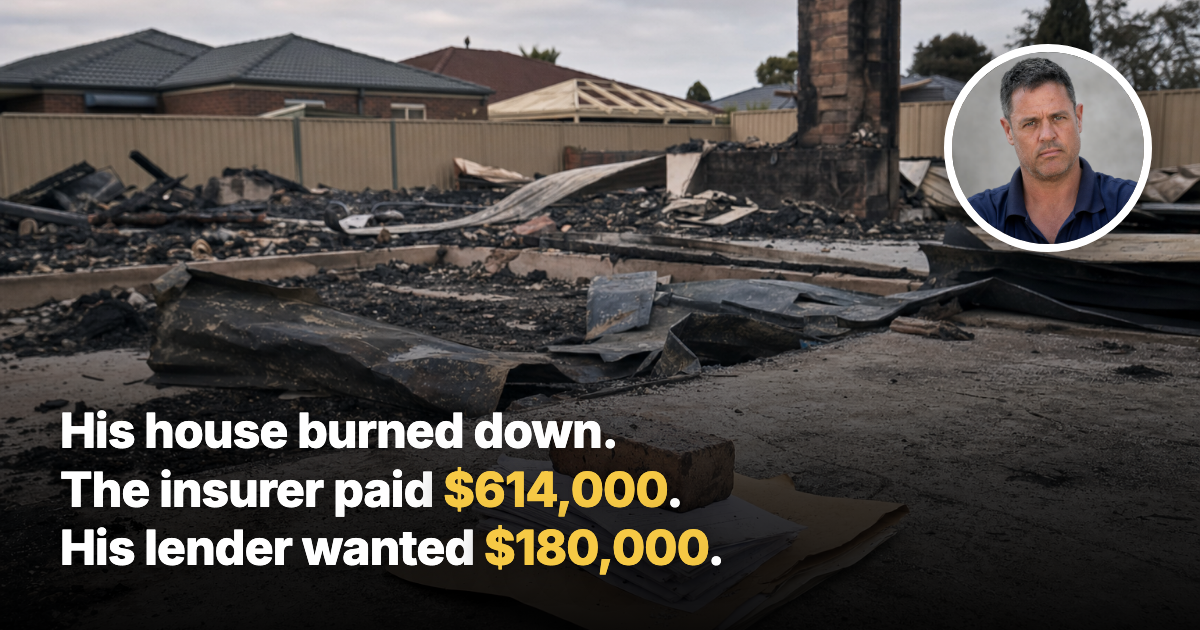
A 47-year-old electrical contractor came to us with a question we had never been asked in this shape. His investment property — bought 2016, never a missed payment — burned to a slab in forty minutes. The insurer did not argue: total loss, settled at $614,000.
Then the money arrived, and it did not arrive to him.
It landed in an account jointly controlled with his lender, whose letter proposed something he had never considered: that $180,000 reduce the loan, the remaining $434,000 released in stages against building invoices.
He did not want a smaller loan. He wanted his house back. The difference between those outcomes was not decided by fairness, by who paid the premiums, or by who owned the land — but by one sentence in documents he signed nine years earlier and never read again.
The question he asked us
"The house is mine. The policy is mine. I paid every premium out of my own account for nine years. How can the bank have any say at all in what the insurance money is used for?"
It is the right question, and the honest answer is uncomfortable: the law gives them a say, gives you one too, then quietly decides which of you wins.
The answer: there is a fork, and it is not a negotiation
When money is received under an insurance of a mortgaged property, the general law of mortgages does not leave its destination to goodwill. It sets out two competing rights — and does not grant them on equal terms.
The lender's right is bare. A mortgagee may require the money be applied towards reinstatement. No precondition, no paperwork test. It exists.
The borrower's right is conditional. A mortgagor may require reinstatement only if one of two things is true: the mortgage expressly states the money may be applied that way, or the borrower insured for reinstatement value — either because the mortgage required it, or with the lender's consent.
Read those side by side and the asymmetry is the whole story. Both can ask for the same thing. Only one must qualify first.
Then the direction he feared. A lender may require the money go towards discharging the debt — but only if both conditions are met: the lender arranged the insurance, and the mortgage expressly says the money may be used that way. Miss either and the lender simply lacks that power.
Then the sentence that decided his case: where the borrower qualifies for the reinstatement right, it overrides the lender's right to take the money off the loan. Not "is weighed against". Overrides.
Striking, because the same body of law is otherwise protective of lenders — it says a judgment debt does not by itself permit seizure, yet lets a mortgagee-sale buyer take clean title without inquiring whether the process was proper. On insurance money, it tilts the other way — much as a refinancing borrower discovered when a rival lender's registered mortgage took priority over a payout figure already agreed in writing.
The part no lender can draft around
Here is what makes this unusual in mortgage law, where the contract normally wins.
Most implied mortgage terms apply subject to any agreement to the contrary — the loan document can switch them off. The lender's implied powers work that way. So does the borrower's repair obligation.
The insurance-money provision does not. It applies despite any agreement to the contrary. The override is unwaivable: a lender cannot bury a clause on page thirty-one reversing it, because the statute has already anticipated that clause and disarmed it.
His mortgage required reinstatement-value cover. He had bought it. He had qualified — nine years earlier, by accident, by doing exactly what the loan document told him. The $180,000 stayed on the table.
Two more traps in the same machinery
The lender's cover is sized to the loan, not the house. A lender insuring a mortgaged property may not insure for more than the amount stated in the mortgage — or, if none is stated, the lesser of the full insurable value of the buildings and the amount owing. If your balance is $180,000 and the rebuild is $600,000, a lender-arranged policy can lawfully be a $180,000 policy. It protects the debt, never you.
A lender's premium becomes your principal. Premiums a lender pays become a charge on the property in addition to the mortgage money — same priority, same interest rate. A policy you did not choose, at a price you did not negotiate, compounding at your mortgage rate. Which is why the law blocks a lender from insuring where you already have — a real protection, at a time when premiums are rising sharply for owners who never claimed.
What this means for you
The lesson costs nothing: the clause governing the largest cheque you will ever receive on a property already sits in a document you signed and filed. Reinstatement-value cover is not merely prudent — for many borrowers it is the precondition deciding who controls the payout. Cover sized to a loan balance, or a stale estimate, can quietly disqualify you from the right that rebuilds your asset.
None of which makes the lender a villain. A mortgagee has a legitimate interest in a security that has stopped existing, and reinstatement usually serves both parties. What matters is that the fork is decided by documents, not argument — and documents can be read in advance.
Where the street-level data comes in
A second question hides inside his, deciding whether rebuilding is even right: what is the rebuilt asset worth on that street?
This is where suburb-level thinking fails. Two houses in one postcode, sharing a median, growth rate, school catchment and council, do not share a rebuild case. One sits on a street where effective yields run 20–30% above the worst street in that suburb, vacancy resolves in days, a new build sells fast. The other is two streets away, wrong side of the same median, where a brand-new dwelling waits, then discounts.
A median has never once rebuilt a house. Ripehouse Advisory's research engine works at street and R-Score level — achieved rents, real vacancy duration, true days-on-market, supply and demand block by block — the resolution at which a rebuild decision is either obviously right or quietly expensive.
He rebuilt. The street told him to, well before the statute did.
The bottom line
This is not a story about property being risky. It is a story about property being readable. The fork, the two conditions, the override, the ceiling pegged to the loan — all published and knowable years before it becomes urgent. Nothing here happens by ambush. It happens to people who never looked.
Risk you can read is risk you can price, and priced risk is not a threat — it is an edge over every buyer who never opened the document. The investors who compound are not the ones who dodged fire, flood or bad clauses. They bought the right asset, on the right street, with the paperwork already understood.
He did not lose $180,000. He lost nine years of not knowing he was one clause away from it. It is the same knowledge gap behind a mortgagor learning that "excessive hardship" is an undefined ground a court weighs case by case, not a guaranteed defence against a possession warrant.
If there's a specific street you're weighing up right now, check its Street Score first — it's free, takes ten seconds, and tells you whether that street is pulling the suburb average up or riding on it.
Frequently asked questions
If an investment property in Australia is destroyed, who decides whether the insurance payout goes to rebuilding or to reducing the mortgage?
The mortgage documents and the mortgage law decide it, not a negotiation between the borrower and the lender. Both can seek the payout to be applied a certain way, but the borrower’s right to reinstatement only applies if the policy and mortgage meet the required conditions.
Can a lender keep part of an insurance payout to pay down the loan after a total loss?
Only in limited circumstances. The article says a lender can require the money be used to discharge the debt only if the lender arranged the insurance and the mortgage expressly allows that use.
What is the one clause that can override a lender’s attempt to take the insurance money off the loan?
If the borrower qualifies for the reinstatement right, that right overrides the lender’s right to apply the money to the loan. The article says this insurance-money rule applies despite any agreement to the contrary, so it cannot be drafted away.
What type of insurance cover matters if you want the payout to help rebuild the property?
Reinstatement-value cover matters. The article says a borrower may require reinstatement only if the mortgage expressly allows it or if the borrower insured for reinstatement value, and that can determine who controls the payout.
Why is lender-arranged insurance not a substitute for your own property insurance?
Because a lender’s cover is sized to protect the debt, not the full rebuilt house. The article says a lender may insure only up to the mortgage amount or, if none is stated, the lesser of the building value and the amount owing.
General information only. It does not take your objectives, financial situation or needs into account, and nothing here is legal, financial, taxation or investment advice specific to your circumstances.