News · 17 August 2026 · 5 min read
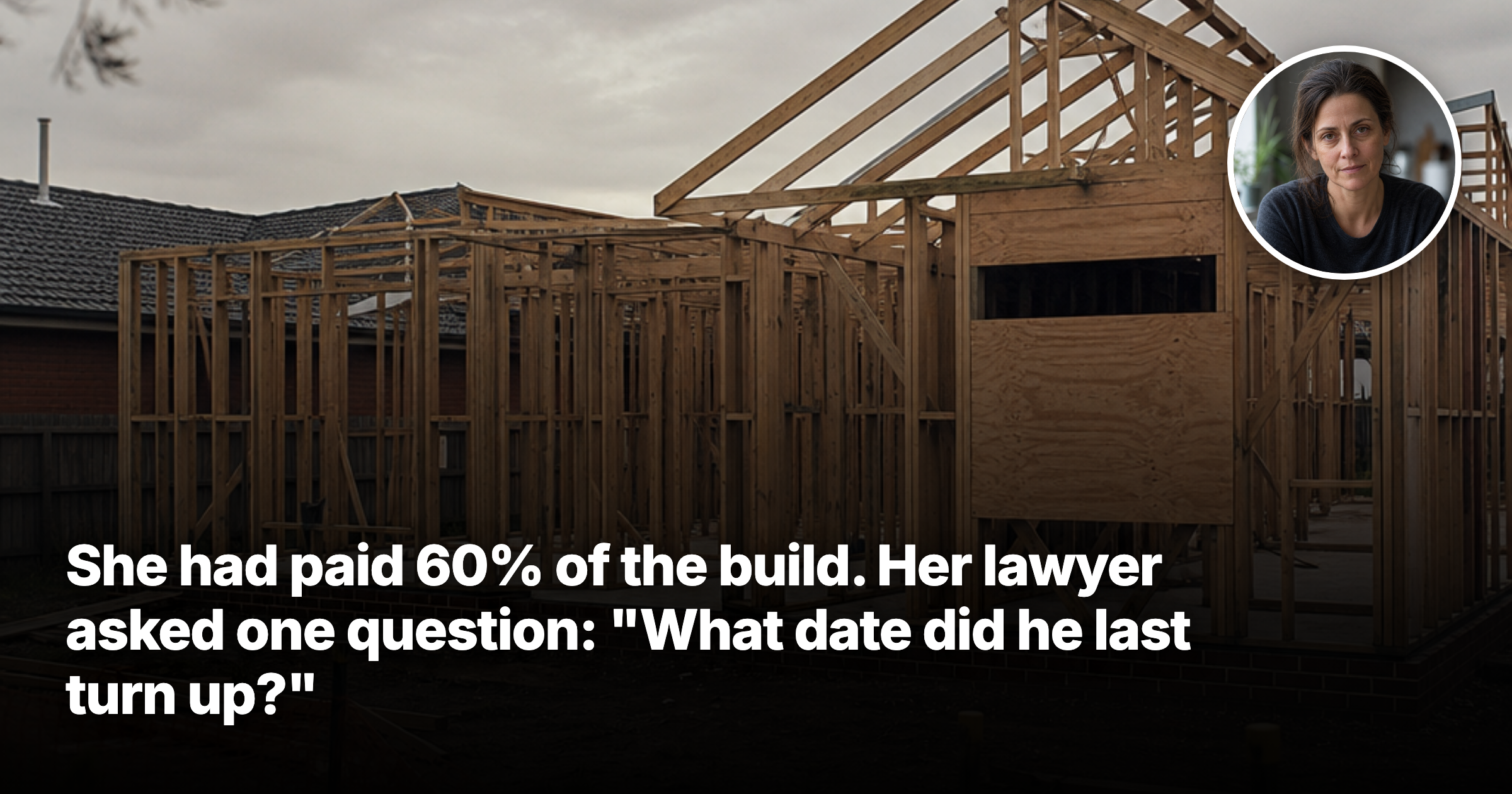
She'd paid 60% of the build. Her lawyer asked one question: what date did he last turn up?
She paid deposit, base, frame and lock-up — 60% of a fixed-price build — every instalment within the statutory cap. Then the site went quiet. Her lawyer asked what date the builder last attended, and the answer mattered more than the money.
We get asked about payment schedules all the time. Usually the question is "is this normal?" Almost never "what does this actually buy me?"
A woman in her mid-forties came to us with a half-finished house and a number she could not make peace with. She had signed a fixed-price contract to build all stages on a block she already owned, and had paid the deposit, then base, then frame, then lock-up. On her own arithmetic that was 60% of the contract price. Every payment was demanded at the right moment. Every one was within the statutory cap. She had done nothing wrong and neither, on the face of it, had he.
Then the site went quiet. No collapse, no notice, no argument. He simply stopped coming. She had a certificate of insurance in the file, which helped less than she expected — home warranty cover is triggered by the builder ceasing to exist, not by the defect or the delay — and hers was alive, solvent and simply not answering.
She asked a lawyer whether she could claw any of it back. He asked one question first, and she said it was the moment the floor moved: what date did he last turn up on site?
She could not answer. Nobody writes that down.
The question she was really asking
Her verbatim question to us was this: "I paid for the stages. Doesn't that mean I own the stages?"
It is the right question, and the answer surprises people. A staged payment schedule is not a transfer of ownership at each rung. It is a ceiling on what the builder may hold — and a ceiling is not a floor.
The answer
Start with what the schedule actually is. In a domestic building contract to build all stages, a builder must not demand, recover or retain more than a fixed percentage of the contract price at the completion of each defined stage: 10% at base stage, 15% at frame stage, 35% at lock-up stage, 25% at fixing stage. Before any work starts, the deposit itself is capped at 5% of a contract price of $20,000 or more. Breach is an offence, and a court that finds it proven may order a refund of some or all of what was paid.
That looks like strong protection. Three things quietly hollow it out.
First, the stage definitions are thinner than the words suggest. "Lock-up stage" is reached when external cladding and roof covering are fixed, flooring is laid and external doors and windows are fixed — and the statute says that counts "even if those doors or windows are only temporary." Temporary. The largest instalment, 35%, becomes payable against a building that can be closed up, not one anywhere near finished. Frame stage at least carries an external check — the frame completed and approved by a building surveyor. Base and lock-up carry no equivalent.
Second — and almost nobody knows this — the caps can be contracted out of. The provision setting them says the subsections do not apply if the parties agree that they are not to apply, in the manner set out in the regulations. The protection owners assume is unwaivable sits one properly-executed clause away from not existing. Compare the implied warranties in the same statute, where any provision restricting the right to sue for breach is simply void — and which, like the way defect liability attaches to a building rather than the builder who left, run with the land to whoever owns it for the time being. The legislature knew how to make something unwaivable. It did that for warranties. It did not do it for the payment schedule.
Third, the clock — the sharpest edge in the area, and what the lawyer was driving at. Where a completion date matters, it is presumed, unless an earlier one can be established, that the date of practical completion was the earlier of the date the builder handed over possession, or the date the builder last attended the site to carry out work. Visits merely to remedy defects that do not prevent practical completion do not count.
Read that from her position. She never took handover. No ceremony, no keys, no certificate. So the date that governs her is the day he last showed up — a day nobody recorded, that arrived without announcement, and that started running against her while she was still waiting for him to come back. A builder who walks off quietly does not just stop building. He starts her clock.
"Practical completion" is itself defined generously — work completed except for omissions or defects that do not prevent it being reasonably capable of use for its intended purpose. And there is an absolute long-stop: where no occupancy permit or final inspection certificate is issued or required, ten years from practical completion; where no such date can be established at all, ten years from the day the contract was signed.
Thresholds and stage names differ between states. The shape does not — and it rhymes with the way a permit can quietly change who carries the risk on a build.
What it means for you
Every metric investors use measures the finished thing. Median price. Days on market. Vacancy. Rental history. Comparable sales. Not one measures how much of a half-built asset has genuinely transferred to you at the moment you have paid 60% for it — or whether your clocks started months ago on a date nobody wrote down.
Those are not suburb facts. They are per-contract, per-title, per-stage facts, sitting underneath two builds that look identical from the street. This is the version of street-level analysis people find least intuitive and most expensive to ignore: our data consistently shows a 20–30% gap in effective yield between the best and worst streets in the same suburb — same postcode, same school zone, same median. Part of that spread has never been build quality. Part of it is who carried the risk on the way up.
The reframe
None of this is an argument against building. It is an argument for reading what you are buying.
Because the remarkable thing is that all of it is published. The percentages are fixed and knowable before you sign. The stage definitions are written down, temporary windows and all. The opt-out clause is findable. The completion presumption is right there in the text. This is not hidden risk — it is checkable risk, which means it is priceable risk.
And almost nobody prices it, so the market prices the anxiety instead of the fact — exactly the gap a data-led buyer gets paid to stand in. Two houses, one street, identical medians, completely different remaining recourse. Property rewards the investor who knows which one they are holding.
It was never a promise that her house would be built. It was a schedule describing the most he could hold at each rung of a ladder he was free to stop climbing.
If there's a specific street you're weighing up right now, check its Street Score first — it's free, takes ten seconds, and tells you whether that street is pulling the suburb average up or riding on it.
Frequently asked questions
If I’ve paid the deposit and each stage payment on a fixed-price build in Australia, do I automatically own those completed stages?
No. The article says a staged payment schedule is a ceiling on what the builder may hold, not a transfer of ownership at each stage. Paying the stage amounts does not mean the completed work has become yours in that way.
What are the usual payment caps in a domestic building contract for all stages?
The article says the deposit is capped at 5% for a contract price of $20,000 or more, then 10% at base stage, 15% at frame stage, 35% at lock-up stage and 25% at fixing stage. It also says a builder must not demand, recover or retain more than those amounts at each defined stage.
Can the stage payment caps be written out of a building contract?
Yes, the article says the caps can be contracted out of if the parties agree they do not apply in the manner set out in the regulations. That means the protection is not automatically unwaivable.
Why does the date the builder last attended site matter if the builder stopped coming back?
Because the article says practical completion is presumed to be the earlier of handover or the date the builder last attended the site to do work, unless an earlier date is established. If there was no handover, that last attendance date can start the clock running against the owner.
What is the article’s main warning for owners of half-finished builds?
The warning is that paying stage claims within the legal caps does not guarantee the build is progressing safely in your favour. The real risk is that the builder may stop, the completion clock may already be running, and the key dates may not have been recorded.
General information only. It does not take your objectives, financial situation or needs into account, and nothing here is legal, financial, taxation or investment advice specific to your circumstances.