News · 16 August 2026 · 6 min read
'The block next door was $18,000 cheaper to build on. Same street, same estate, same size — nobody could tell me why'
Two blocks, four doors apart, same estate and same floor plan — one quoted $18,000 more to build on. The reason is a single letter assigned to the ground under each lot, and almost no buyer ever asks to see it.
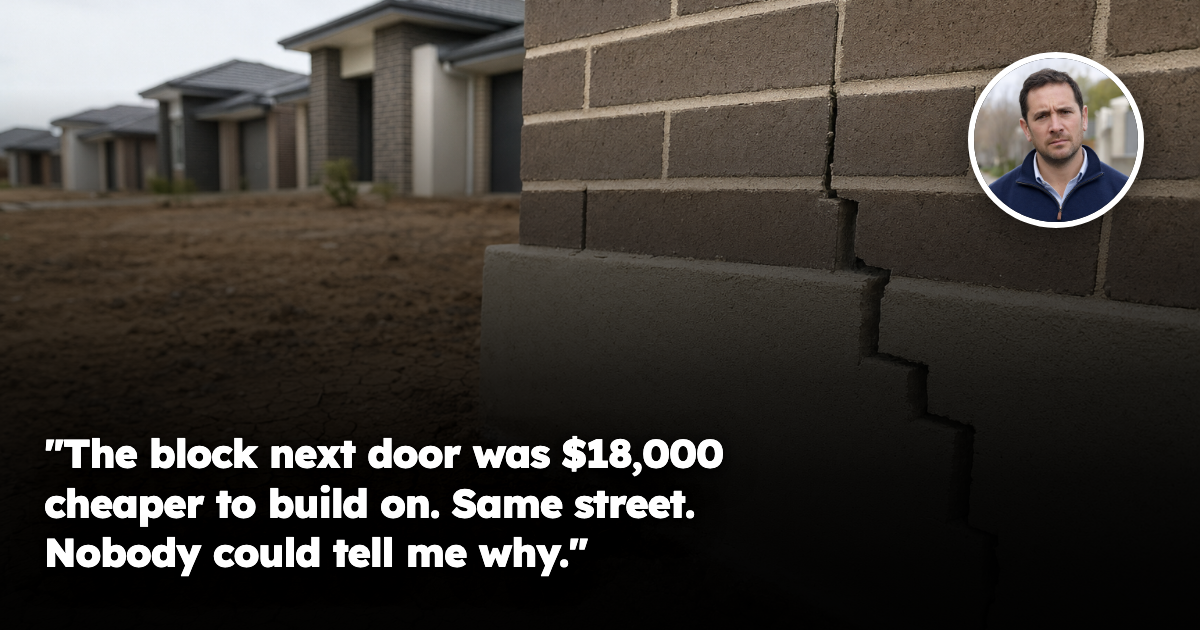
He had two blocks in front of him, four doors apart, in the same outer-Melbourne estate. Same frontage, same depth, same builder, same floor plan, same inclusions list.
One came back with a construction quote roughly $18,000 higher than the other. Not because of the house. Because of the ground underneath it.
He asked the question a lot of people ask us, usually far too late: how can the dirt be worth eighteen grand when the land looks identical?
The letter of the alphabet nobody reads
Before anyone pours concrete on a residential block in Australia, the ground has to be graded. It isn't optional — the National Construction Code requires that the foundation where a footing is located must be classified under the residential slabs and footings standard.
That standard has been in use since 1986. What it produces is a single letter — one of the most financially consequential facts about a block of land that almost no buyer ever asks to see.
The scale runs roughly like this. Class A is most sand and rock sites, with little or no ground movement when moisture changes. Class S is slightly reactive clay. Class M is moderately reactive clay or silt. Class H is highly reactive clay. Class E is extremely reactive. Class F is filled sites. And Class P is the problem category: soft clays and silts, loose sands, landslip, mine subsidence, collapsing soils, soils subject to erosion, or ground that can't be classified any other way. For the M, H and E classes the grade is divided again by the depth of expected movement.
Here's what that letter does to your money: moving up the scale means a heavier, and more expensive, footing system. The letter doesn't describe your house. It dictates what has to be built underneath it before your house is allowed to exist.
What the ground is actually doing
Reactive clay swells when it's wet and shrinks when it dries. That sounds harmless. It is not.
When the ground under a house moves unevenly — one corner heaving while another settles — it loads the footing and everything on it. The results are the things people photograph without knowing what they're looking at: stepped cracking through brickwork, doors that stop closing, windows racked out of square, and in the worst cases structural damage to the slab.
Reactive soil damage is one of the most common causes of building defects in this country, and much of the residential land across south-east Queensland and coastal New South Wales sits on exactly this kind of clay. It belongs in the same family as the other ground constraints mapped lot by lot, like a landslide overlay that catches some blocks in a suburb and not others.
The $1.25 million version of this story
An Australian couple took a builder to court over a newly built home whose concrete slab moved. The court found poorly compacted sandy fill had allowed water to reach the edge of the slab, lifting it and causing extensive damage.
The remedy was not a repair. It was demolition and rebuild. The owners were awarded $1.25 million — after a nine-year legal battle.
The slab was a waffle-type system: a reinforced footing-and-slab built on the ground, with pods forming voids between internal concrete beams. It's generally cheaper than a conventional raft footing, which tends to be dug into the ground.
And this is the part worth sitting with, because it's the opposite of what most people conclude. The engineering evidence in matters like this doesn't say waffle slabs are bad. It says they're a cost-efficient solution on the right block of land, and that problems arise when they're used on a block that isn't suitable.
The distinction isn't the product. It's the match between the product and the ground.
Why your suburb median can't see any of this
A site classification is assigned to a lot. Not a suburb, not a postcode, not a median. Two blocks on the same street, sharing the same school catchment, the same council and the same quoted median price, can carry different letters — because reactivity follows geology, drainage lines, fill history and the fall of the land, none of which stop politely at a property boundary or appear in a suburb-level report.
That is precisely the gap street-level data exists to close. A suburb median averages properties that were engineered differently, sit at different levels, drain differently, and cost materially different amounts to build on. The same dispersion we measure in achieved rents, vacancy duration and days on market — routinely a 20–30% effective-yield spread between the best and worst streets inside one suburb — has a physical counterpart in the ground itself.
It is the same pattern as a bushfire attack level that differs sharply between neighbouring blocks, or an easement that quietly removes buildable area from one lot and not the next.
And classification errors run in both directions. An under-classified site risks movement and damage, with rectification running into tens of thousands and disputes that are drawn-out and rarely straightforward. An over-classified site is the quieter loss: it adds unnecessary cost to every footing built on that land.
What to actually do
Get the classification before you buy the land, not after. Ground conditions are one of the hardest risks to price once a site is already acquired — at that point you own the problem and you're negotiating with yourself.
Understand which kind of assessment you're holding. A desktop classification — an engineer reading nearby borehole records, soil survey data and geological mapping — is reliable for a standard lot in a well-mapped area, and typically costs around $700 to $900, rising toward $3,000 or more for complex sites. But it infers your block from its neighbours. Where there's fill, established trees, a drainage line or a slope, you want samples taken from your lot.
Check the plans were drawn for your block. Footing details produced interstate or overseas, dropped onto a site they were never designed for, are a recurring theme in these disputes. For an established home, an engineer's inspection of the house and its plans costs a fraction of what it protects.
Ask what the letter is doing to the price. If a block is cheaper, find out whether you're being compensated for a heavier footing — or simply handed the bill later.
The part that favours the buyer
None of this is an argument against building or investing. It's the reverse.
Ground conditions are one of the very few property variables in Australia that come with an official, standardised grade attached to an individual parcel of land. It is objective, obtainable before you commit, and routinely ignored by the people bidding against you.
That's not a risk. That's an asymmetry. When a measurable factor sits below the resolution of the data most buyers use, the market prices it inconsistently — so some blocks carry a discount for a problem they don't have, and others are bought at full price with a cost nobody counted.
His two blocks were never identical. One was moderately reactive with shallow movement and one wasn't, and the $18,000 was the honest number — the cost of building correctly on the ground actually there.
He bought the more expensive one. Which, once he understood what he was reading, was the cheaper decision.
The mistake was never buying land in an estate. It was assuming that two blocks that look the same are the same asset.
If there's a specific street you're weighing up right now, check its Street Score first — it's free, takes ten seconds, and tells you whether that street is pulling the suburb average up or riding on it.
Market data & R-Scores for locations in this article
Drill Down Into the Markets Mentioned Above
Inspect live monthly R-Scores, median prices, rental yields, and street-by-street scores for the cities and council areas referenced in this article:
Frequently asked questions
Why can two blocks in the same Australian estate cost different amounts to build on?
Because the ground under each lot can have a different site classification. That letter affects the footing system required under the house, so the build cost can change even when the blocks look identical.
What does the site classification letter actually mean for a home builder?
It tells you how reactive or difficult the ground is, from stable sand or rock through to problem soils. The higher or more difficult the classification, the heavier and more expensive the footing system must be.
What problems can reactive soil cause for a house?
Reactive clay swells when wet and shrinks when dry, which can move a house unevenly. That can lead to stepped cracks in brickwork, doors and windows that no longer fit properly, and in severe cases slab damage.
Should I rely on a suburb report if I want to know whether a block is safe to build on?
No. Site classification is assigned to a specific lot, not a suburb or postcode, so nearby blocks can have different ground conditions and different build costs. Suburb medians can hide those differences.
What should a buyer check before committing to a block of land?
Get the site classification before you buy, and make sure the assessment suits the block. A desktop assessment may be enough for a standard lot, but if there is fill, slope, drainage issues or established trees, samples from the actual lot are better.
General information only. It does not take your objectives, financial situation or needs into account, and nothing here is legal, financial, taxation or investment advice specific to your circumstances.