News · 19 August 2026 · 5 min read
'We added a granny flat. Nobody touched the pool — but it stopped being my pool and the compliance bill tripled'
She renovated properly — approvals, licensed builder, certification at every stage. The pool was never part of the job and was never touched. Eleven months later a compliance letter arrived, and about $6,800 later she learned that adding a second dwelling had changed what her pool legally IS: who is liable for the gate, how long the certificate lasts, and what she must do before every new lease.
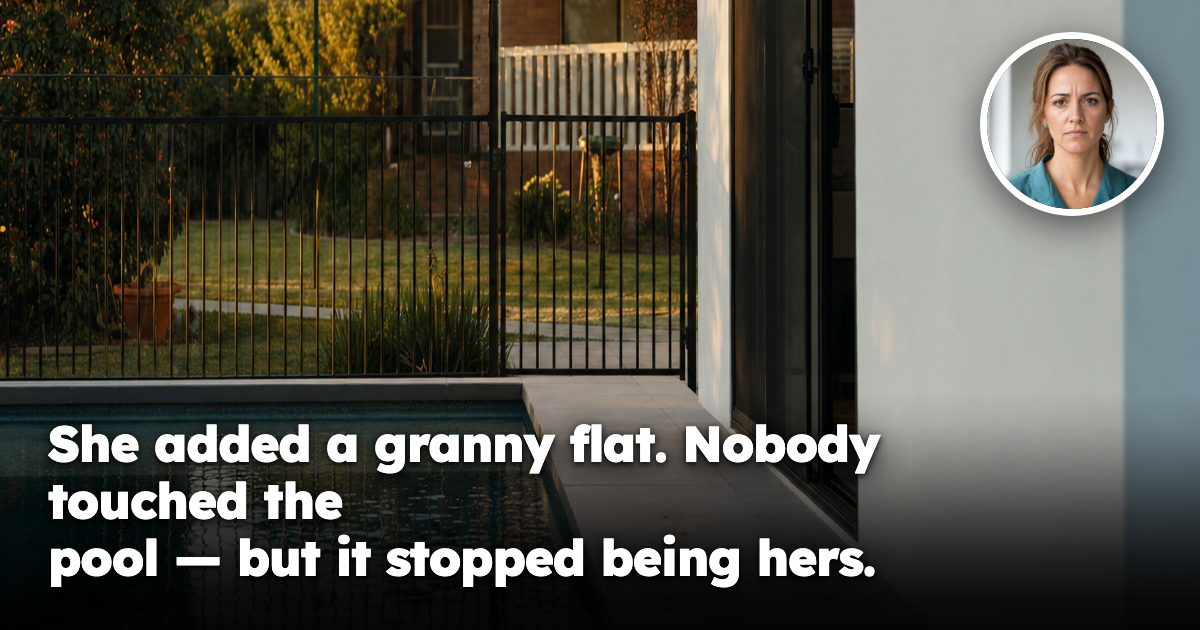
She is 38, a dental hygienist, and she did the renovation properly. Approvals, a licensed builder, certification at every stage. The granny flat went up in the back corner of a block she had owned since 2017 and was signed off without a defect.
The pool was not part of the job. It was not touched. Nobody moved a paver.
Eleven months later a compliance letter arrived about that pool, and she has spent about $6,800 since — a re-inspection, remedial work to a boundary wall she had assumed was just a wall, and a certificate that now expires in half the time it used to.
Her question was two sentences long:
'The pool is exactly the same pool. How can building something forty metres away change the law that applies to it?'
She is right that nothing about the pool changed. What changed is what the pool legally is.
The rule nobody reads until it applies to them
Pool safety law does not classify a pool by its size, depth, fence or age. It classifies it by how many dwellings have a right to use it.
The definition is blunt. If the residents of two or more dwellings built, or to be built, on the land have — or will have — a right to use the pool, it is a shared pool. That is the whole test. Not a body corporate, not a strata plan. Two dwellings and a right of use.
Two details make it wider than people expect. A "resident" is the owner or occupier of the dwelling, or anyone with a right to use it. And the relevant land includes adjacent land in the same ownership or used in association with it — so the pool need not sit on the same parcel.
Note the tense: or will have. The classification can attach at approval, before anyone has moved in or swum a lap.
She did not build a pool. She built a second front door. That was enough.
What actually changes
Nothing physical. Everything legal. Three shifts, each costing money.
First, liability moves house. Two consecutive provisions do the same job in identical words with identical maximum penalties, differing only in who owes the duty. Where a pool is not shared, the person who must keep the gate securely closed at all times when not in use is the occupier — in a rented house, the tenant. Where the pool is shared, that duty sits on the owner.
That is the part that matters most to an investor. On a single-dwelling rental the gate duty rests with the person living there. On a two-dwelling property it rests permanently with the landlord — for a gate opened and closed by people the landlord cannot watch and, in her case, had never met.
Second, the certificate life halves. A pool safety certificate runs two years for an ordinary pool — and one year where the pool is shared. Same pool, same standard, same inspector. Half the validity. Over a ten-year hold that is roughly five extra inspection cycles, and it is the largest line in her $6,800.
Third, a display and handover regime switches on. Once a certificate is in effect for a shared pool, the owner must ensure a copy is conspicuously displayed as near as practicable to the main entrance or a gate giving access to the pool, and must hand a copy to an incoming occupier before entering a new lease. If no certificate is in effect, a prescribed-form notice must instead go to the incoming occupier, the pool's owner and the regulator — before the agreement, not after. Each carries its own maximum penalty. None exists for an ordinary backyard pool.
The wall she thought was a wall
The remedial work surprised her more than the certificate did, and it is the detail most relevant to anyone renovating.
A regulated pool is not just the water. By definition it includes the barriers — and those expressly include the walls of a building enclosing the pool. Her granny flat had been positioned to use an existing masonry wall as one side of the pool surround: sensible design, cheaper than a new fence.
That wall was now a pool barrier, and it had a door in it. The compliance question was no longer about her pool fence. It was about her building.
This is why we flag pool classification at the feasibility stage of any dual-occupancy or granny-flat project, not at handover. The pool is almost never in the scope of works, so it is almost never in the budget — yet it is the one asset whose legal status a second dwelling can change without anyone touching it. It belongs in the numbers alongside the certification steps that can stop you leasing entirely, the structures attached to boundaries you only half own, and the duties that quietly shift between landlord and tenant.
Why a suburb median cannot see any of this
Two properties in the same suburb can share a median price, a growth rate, a school catchment and a postcode. They do not share the number of dwellings on the block, whether a pool sits inside a barrier formed by a building, or which party carries a statutory duty every day of a tenancy. One is a house with a pool. The other, after a $180,000 granny flat, is a shared-pool property with an annual certificate cycle, a display obligation, a pre-lease handover duty and permanent owner-side liability for a gate.
Those two assets get reported as the same suburb. They are not the same investment.
This is the gap we spend our time in. Across a single suburb, the spread between best and worst streets typically runs 20–30% in effective yield once you use achieved rents rather than advertised ones, real vacancy duration rather than a quarterly average, and true days-on-market.
A suburb average has never once had to display a certificate near a gate.
The part worth holding onto
None of this is a reason to avoid adding a dwelling. Her granny flat rents, and the yield on the block improved. The rules are aimed at something real: a tighter cycle on a pool used by two households is not arbitrary — more people, more gates opened, more risk.
The point is that all of it was knowable. The definition, the duty split, the one-year term, the display obligation, the handover notice — all published, all readable, all sitting there before she engaged a designer, let alone a builder.
Risk you can read before you commit is not risk. It is a line item. She would still have built the granny flat — with $6,800 already in the feasibility, a barrier-compliant wall designed in from day one, and a certificate cycle diarised instead of delivered by letter.
That is the difference between a surprise and a cost. And a cost you saw coming is an edge over every buyer who never looked.
Her pool never changed. She just stopped being the only household with a key to the gate.
If there's a specific street you're weighing up right now, check its Street Score first — it's free, takes ten seconds, and tells you whether that street is pulling the suburb average up or riding on it.
Frequently asked questions
How can building a granny flat change the rules that apply to an existing backyard pool in Australia?
If the residents of two or more dwellings on the land have, or will have, a right to use the pool, it becomes a shared pool. That can happen even if the pool itself is untouched and the second dwelling is built nearby or on adjacent land used in association with it.
Who is responsible for keeping the pool gate closed when a pool becomes a shared pool?
For a non-shared pool, the duty sits with the occupier, such as a tenant. Once the pool is shared, that duty moves to the owner, which is why the landlord can become liable for the gate instead of the person living there.
Does a pool safety certificate last as long after a second dwelling is added?
No. The article says an ordinary pool certificate lasts two years, but a shared pool certificate lasts one year. That means more frequent inspections and higher compliance costs over time.
What extra pool compliance steps apply before you lease a property with a shared pool in Australia?
The owner must display a copy of the current certificate near the main entrance or pool gate and give a copy to the incoming occupier before a new lease starts. If no certificate is in effect, a prescribed-form notice must be given before the agreement.
Can a building wall become part of the pool barrier after a granny flat is added?
Yes. The article says a regulated pool includes the barriers, including the walls of a building enclosing the pool. In the example, a wall that was once just a wall became part of the pool barrier and had to be treated as a compliance issue.
General information only. It does not take your objectives, financial situation or needs into account, and nothing here is legal, financial, taxation or investment advice specific to your circumstances.