News · 17 August 2026 · 6 min read
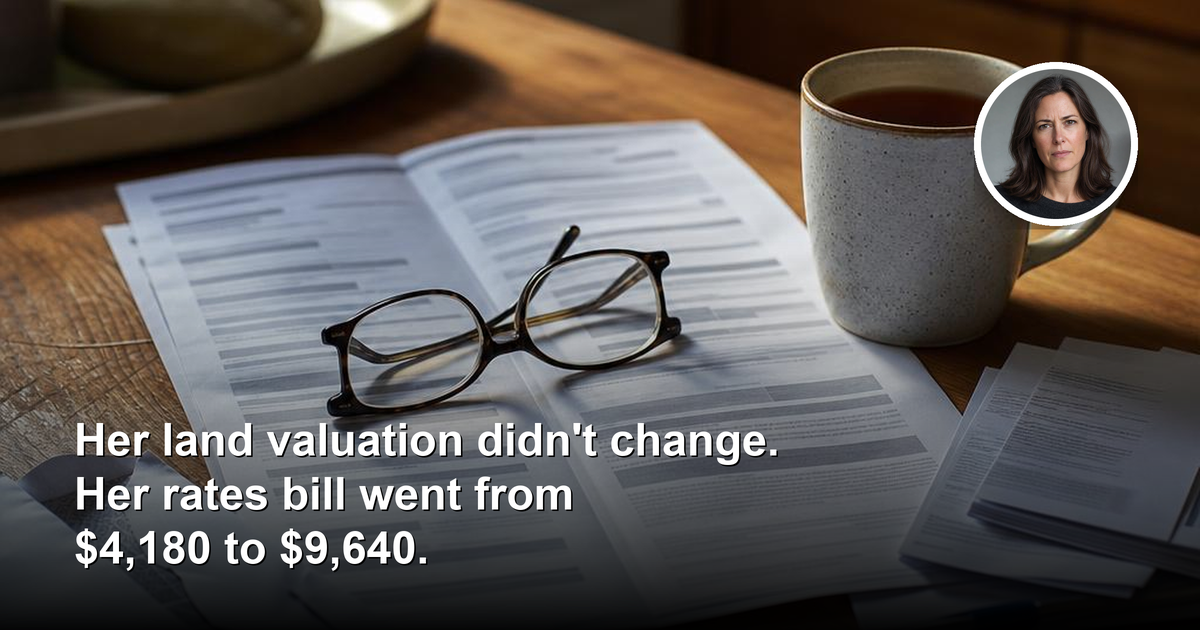
'My land valuation didn't change. My rates bill went from $4,180 to $9,640'
A client's land valuation was unchanged, yet her general rates more than doubled. The cause was a change to her rating category — the half of the rates equation almost nobody watches. Here is how categorisation works, the single ground of objection the law allows, and the 30/60/42-day clock that governs it.
A client wrote to us in the first week of the new financial year with a rate notice and one line of commentary: "There must be an error."
There wasn't.
She owns a 612sqm house on a suburban street, bought eight years ago, tenanted for the last five. Her land valuation was unchanged. Same block, same house, same tenant, same fence. The general rates line had gone from $4,180 to $9,640.
She had already checked the number everyone checks. The valuation was identical. So she assumed a data error, called the council, and was told — politely, and correctly — that her land had been placed in a different rating category.
Her question is the one worth answering, because almost nobody knows the answer until it happens to them:
"If my valuation didn't change, what exactly changed?"
The part of your rates bill that isn't the valuation
Most owners think of council rates as one number: a valuation, multiplied by a rate. Watch the valuation, and you've watched your rates. That instinct is understandable — a land revaluation can move rates and land tax sharply in a single year, and it's the part of the bill that makes the news.
That is half of the equation, and it is the half that gets all the attention.
A council may levy general rates that differ for different categories of rateable land. These are differential general rates. Before levying them, the council must decide, by resolution at its budget meeting, what the categories are — and state a description of each. It must then identify which category every parcel in the area belongs to.
Because categories are built around descriptions of how land is used, a change in the actual use of a property can move it — the same logic that makes how a property's use is classified so consequential. Two houses can carry identical valuations and sit in different categories. When that happens, they are not paying the same rates, and the difference has nothing to do with what the land is worth.
There are two levers on your rates bill. The valuation is the one you're watching. The category is the one that moved.
The reveal: the only thing you're allowed to argue
This is the part that changes how you read a rate notice, and why our client's first instinct led nowhere.
Where a council levies differential rates, your first rate notice for the year must contain or come with a rating category statement — setting out every category and its description, which category your land is in, and that you may object.
But read the ground of objection carefully. The regulation is explicit: the only ground for objecting is that the owner considers the land should belong to a different rating category.
That is the whole ground. Not that the increase is steep, unaffordable, or out of step with the street. The single question you may put is whether your land has been correctly matched against the council's own published descriptions of its own categories.
Which means the descriptions — a document most owners have never opened — are the entire battlefield. An objection that argues the bill is unfair is answering a question nobody asked. An objection that walks through the descriptions and shows your land doesn't meet the one you've been placed in is the only argument that exists.
There's a second sting. Objecting does not stop the levying and recovery of the rates, and the notice must say so. You pay the higher number while you argue about it.
The clock, and the asymmetry inside it
The timeframes are tight and not symmetrical.
You have 30 days from the day the rate notice was issued to give the council an objection notice — stating the category you say your land belongs to, and the facts and circumstances you rely on. The council may allow longer, but that's a discretion, not a right.
The chief executive officer must then consider the objection and decide: move your land to the category you claimed, move it to a different category, or refuse. They must give you reasons, within 60 days.
Note the second option: an objection can land you in a third category you didn't nominate.
If you're refused, you may appeal to the land court by filing within 42 days of receiving the decision. That court sits as a single member, must observe natural justice, must aim at prompt disposal, and is not bound by the rules of evidence.
And here is the asymmetry worth knowing. If your objection or appeal succeeds, the category is treated as changed from the start of the period of the rate notice — you're made whole for that notice. But when a council decides of its own motion that a parcel's category should change, that decision takes effect from the day the decision is made. Corrections in your favour reach back. Reclassifications generally start from now.
Two more things sit in the same regulation. A council may fix a minimum amount of general rates, and may identify which parcels it applies to in any way it considers appropriate. And while a council may resolve to cap increases, that cap is optional — and may specify different percentages for different classes of land. A cap is not a shield you can assume you're standing behind.
What this has to do with the street, not the suburb
This is where our work starts, because a rating category attaches to a parcel, not a postcode.
Two houses can share a street, a school catchment, a zoning and a suburb median, and sit in different rating categories — a holding-cost gap of thousands a year that no suburb-level report will show you. On price growth, days on market and vacancy they look like the same asset. On net yield they aren't, and the gap compounds every year you hold.
Across the streets of a single suburb we routinely see a 20–30% spread in effective yield — driven by achieved rents, real vacancy duration and actual days on market, not advertised figures. Holding costs belong in that calculation. A property analysed on suburb medians and an assumed rates figure isn't being analysed; it's being estimated.
The practical move is cheap. Read the rating category statement that comes with your first notice each year — the actual descriptions, not just the dollar total. Check whether the description genuinely fits your land. Diarise the 30 days. Our client got there eleven months late, and discovered the description she'd been placed under didn't describe her property at all.
The investor's read
None of this is an argument against holding property. It's an argument for holding the right property with your eyes open.
Rising costs and tighter council budgets fall hardest on the marginal asset — the one that only worked while every input stayed still. A well-selected property on a street with genuine scarcity absorbs a reclassification and keeps performing. A thin asset chosen on a headline yield and an assumed cost base does not.
The categories, the descriptions, the grounds and the deadlines are all published before you buy. That makes them priceable. Almost nobody prices them — which is precisely why the market prices the anxiety instead of the fact.
She checked her valuation every single year. She had never once read the page that came with it.
If there's a specific street you're weighing up right now, check its Street Score first — it's free, takes ten seconds, and tells you whether that street is pulling the suburb average up or riding on it.
Frequently asked questions
Why can a council rates bill jump even when the land valuation stays the same?
Because council rates can be based on differential general rates, where the council places land into different rating categories. If the category changes, the rates can rise even though the valuation does not.
What is the only ground for objecting to a rating category in Australia?
The only ground is that the owner considers the land should belong to a different rating category. You cannot object just because the rates increase feels unfair or too high.
What should I check on my first council rates notice each year?
Check the rating category statement, which should list the categories and their descriptions, your land’s category, and your right to object. The key question is whether your land actually fits the council’s own description.
How long do I have to object if I think my land is in the wrong rating category?
You generally have 30 days from the day the rate notice was issued to lodge an objection. The council may allow more time, but that is discretionary.
Does lodging an objection stop me having to pay the higher rates?
No. The notice must say that objecting does not stop the rates being levied or recovered, so you still pay while the objection is considered.
General information only. It does not take your objectives, financial situation or needs into account, and nothing here is legal, financial, taxation or investment advice specific to your circumstances.