News · 21 August 2026 · 6 min read
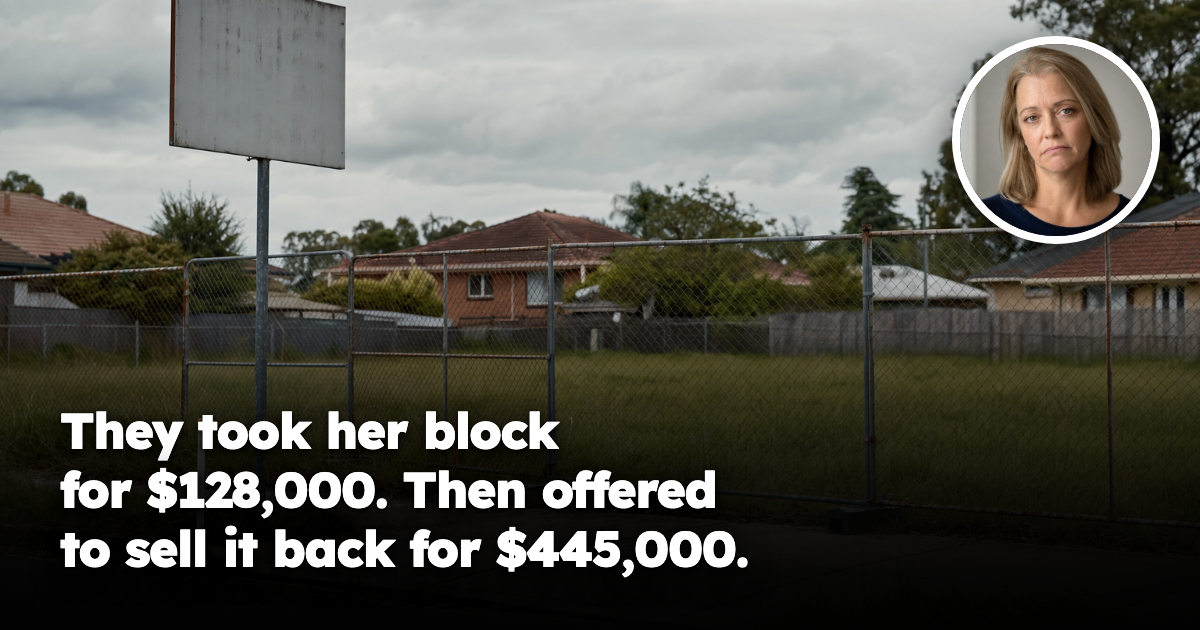
'The government took my block for $128,000. Nine years later they offered to sell it back to me for $445,000'
Her land was taken for a project that never happened. Nearly a decade later the authority offered it back — at today's market price, with 28 days to accept. Nobody broke a rule. That is exactly the problem.
A question landed with us this month we have never been asked in quite this shape. It came from a 52-year-old physiotherapist, and it is not a complaint about being underpaid. It is about being offered something back.
What happened
She and her late husband bought a wide block in 2011. In 2016 a notice arrived: the land was needed for an infrastructure project. She did not fight it. She got a valuer, negotiated in good faith, and settled at $128,000. She has never once said that number was unfair.
Then the project was reviewed, then quietly shelved. The block sat behind a chain-wire fence for nearly a decade, mown twice a year, doing nothing.
In 2025 a letter arrived: the authority no longer required the land, and as the former owner she was being offered the chance to buy it. The price was $445,000. She had 28 days to accept.
Her question, word for word:
"They took it from me for $128,000, did nothing with it, and now want $445,000 to give it back. How is being offered your own land back the thing that ruins you?"
The answer: the right is real, and that is exactly what makes it hurt
The provision she is dealing with is not a loophole and not a trap. It exists to protect her. In broad terms, acquisition legislation of this kind says that where land has been taken and, within a set number of years of the taking, the acquiring body no longer requires it, that body must offer the land for sale to the former owner. Not may. Must.
That is deliberate protection. Without it, an authority could take land, abandon the purpose, and hand the parcel to whoever it liked. The difficulty is in the words that follow.
The price is determined by a statutory valuer, at current value.
Not the amount she was paid. Not that amount indexed. Not a refund. The provision creates a right to buy, and a right to buy is not a right to be restored. Everything the market did in those nine years accrues to the party that held it. She is not being punished; she is simply not being made whole, and the statute never promised she would be. She is treated as a purchaser, because that is what the section makes her.
Nobody misbehaved — the mirror image of the usual grievance, which is that the compensation itself gets quietly reduced at the moment of the taking. Here the compensation was fine. It is the return that costs her.
Three details that decide the outcome
The clock runs from the wrong event. The period is measured from the date of the taking — not from the date the authority decides it no longer needs the land. A project dying in year six triggers the duty. The identical project, dying in year eight, triggers nothing. The party controlling the timing of its own decision is not the party the clock is aimed at.
Twenty-eight days. The offer lapses if not accepted in that window. Consider what a household must do in four weeks: finance approval on vacant land, a bank valuation, a conveyancer, and — in her case — a deceased estate. That period is set to the speed of an institution, not a family. The remedy is real; the window is not sized for the person using it.
"Only one person, still alive." The sharpest edge in the provision. The clean, automatic entitlement is typically drafted for the case where exactly one person held an interest at the date of acquisition and that person is still alive. Two names on the title, a partnership, a mortgagee's interest, a deceased estate — and the bright-line limb cannot apply. What replaces it is not a tie-breaker. It is a discretion, exercised by a Minister, having regard to who is fairly entitled. Drafting of this kind is candid enough to include the words if any, conceding on the face of the statute that the answer may be nobody.
Joint ownership is the ordinary case in Australian property. The strongest version of the right is written for the exception.
The part almost nobody knows
There is usually a further subsection stating that a person dealing with the acquiring body is not concerned to inquire whether these requirements were complied with, and that their title is not affected by any failure to comply.
Read that against the mandatory duty. The body must offer the land back. But if it sells to someone else, that buyer is expressly relieved of checking whether the offer was ever made, and their title stands. Whatever a former owner is left with after a breach, it is not the land.
What this actually means for investors
This is not a story about avoiding land near infrastructure. It is a story about what "the same suburb" conceals.
Two houses can share a postcode, a median, a growth rate, a school catchment and a council — and not share one of the things that decide this outcome. One sits clear of every drawn corridor. The other has a widening line crossing the front third of the block, published on a plan years before anyone knocks. One is held in a single name; one jointly — which quietly changes which limb of the provision a family lands in a decade later.
None of that is visible in a suburb report, because a suburb report is an average — and an average has never once been served with a notice.
This is why we work at street and property level. Corridor plans, reservations and infrastructure alignments are published documents. Title structure is a document. Frontage geometry and retained-lot depth are measurable before you make an offer. We read the individual street and the individual parcel, because that is the resolution at which these facts live — and the same resolution at which we consistently measure a 20–30% spread in effective yield between the best and worst streets inside one suburb, on achieved rents, real vacancy duration and real days on market.
The close
She could not fund $445,000 in 28 days on a deceased estate. But the exercise forced her to look properly at what she still owned nearby, and she has since bought again — deliberately, on a street she checked against corridor plans first.
That is the reframe worth taking. None of this is hidden. Every corridor plan, every registered interest and every statutory timeframe in this story was published and readable long before it became urgent. Almost no competing buyer looks at any of it. Risk you can read in advance is not risk — it is a line item, and pricing a line item nobody else has bothered to read is how disciplined investors keep buying good assets from people who never checked.
Related reading: what happens when an authority takes land over a debt and pays no purchase price at all, and the court order that transfers to a buyer at settlement from a register almost nobody searches.
She never lost money on the land. She lost nine years of what the land became while somebody else was holding it.
If there's a specific street you're weighing up right now, check its Street Score first — it's free, takes ten seconds, and tells you whether that street is pulling the suburb average up or riding on it.
Frequently asked questions
Why was the former owner offered to buy back land that had already been resumed by the government?
Under acquisition legislation, if land taken for a project is no longer required within a set number of years, the acquiring authority must offer it back to the former owner. It is a statutory right to buy, not a refund or restoration of the old price.
Why did the buy-back price jump from $128,000 to $445,000?
The offer-back price is determined by a statutory valuer at current market value, not by the amount originally paid for the land. That means any increase in value while the authority held the land is reflected in the new price.
How long do former owners usually have to accept an offer to buy resumed land back?
In this case, the authority gave 28 days to accept the offer. The article says that timeframe is tight for a family dealing with finance, legal work and estate issues.
What happens if the land was jointly owned or one owner has died?
The automatic right is typically drafted for the case where exactly one person held the interest at acquisition and is still alive. If there are joint owners, a deceased estate or other complications, the decision may depend on ministerial discretion and who is fairly entitled.
If the authority sells the land to someone else without offering it back, does that buyer lose title?
No. The article says a purchaser dealing with the authority is not required to check whether the offer-back requirements were followed, and their title is not affected by a failure to comply. That means the former owner does not automatically get the land back.
General information only. It does not take your objectives, financial situation or needs into account, and nothing here is legal, financial, taxation or investment advice specific to your circumstances.